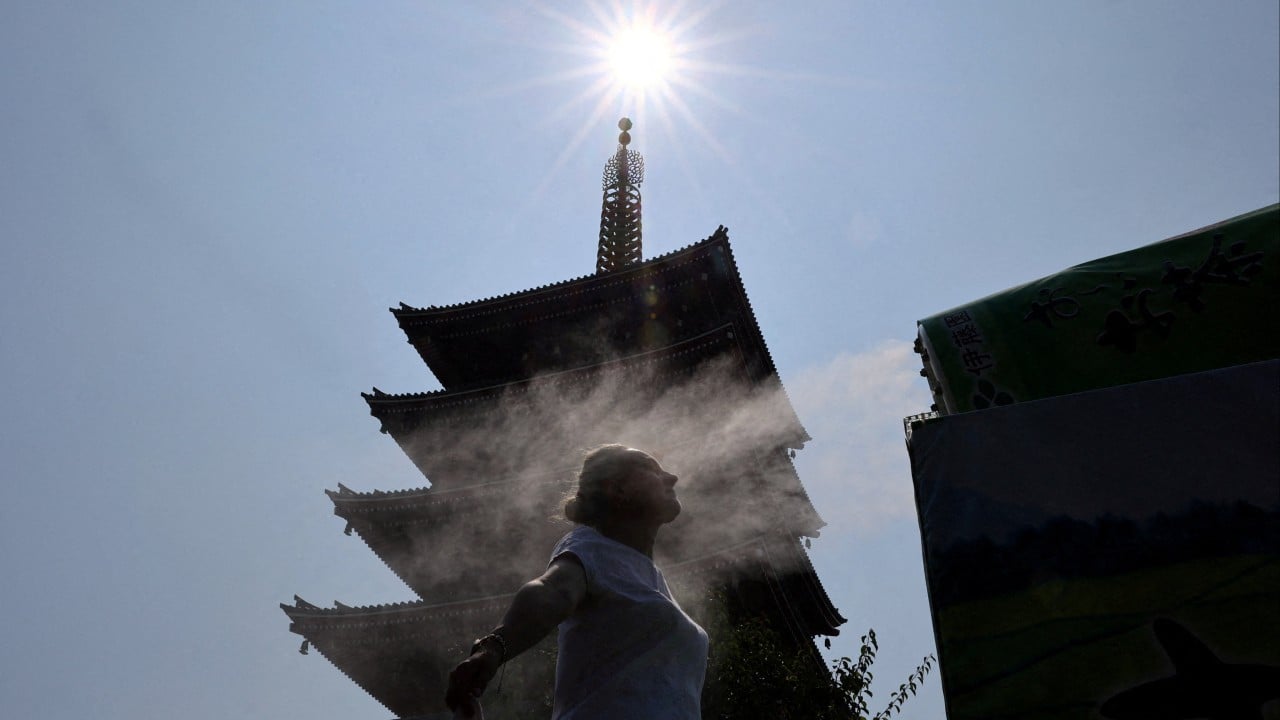
When a government agency rewrites its official lexicon to describe the weather, administrative rhetoric has failed to keep pace with reality. Japan’s Meteorological Agency introduced a new classification called kokushobi—translating literally to "cruelly hot day" or "brutally hot day"—reserved for temperatures breaking 40 degrees Celsius (104 degrees Fahrenheit). Within weeks of its rollout, cities across Gifu and Aichi prefectures triggered the designation as mercury levels smashed localized records. Rebranding extreme heat does not lower body temperatures or reduce hospital admissions.
It exposes an infrastructure and a culture running out of margin for error.
The Paperwork of Extreme Heat
For decades, Japanese weather forecasters relied on a tiered vocabulary. A day over 25 degrees was a summer day (natsubi). Cross 30 degrees, and it became a true summer day (manatsubi). In 2007, officials created moshobi—an "extremely hot day"—to account for temperatures hitting 35 degrees. That ceiling proved short-lived.
Last year, Japan set a national record of 41.8 degrees Celsius in Gunma prefecture, capping off a season where over 100,000 citizens required emergency medical transport for heatstroke. The old terminology stopped scaring people because 35-degree days had become routine summer background noise.
Bureaucrats created kokushobi to shock the public into staying indoors. Yet, semantic escalation does not build emergency rooms or cool urban concrete.
When the Power Grid Meets Aging Demographics
The true crisis lies at the intersection of demographic vulnerability and energy strain. Japan holds one of the world's oldest populations, with nearly 30 percent of citizens aged 65 or above. Elderly individuals frequently suffer from reduced heat perception and are hesitant to turn on residential air conditioning due to rising electricity bills or deep-seated frugality.
During a single week in July, medical personnel transported over 4,500 patients to hospitals due to heat exhaustion and stroke, resulting in double-digit fatalities. More than half of those casualties occurred indoors.
The broader grid faces a precarious balance. Authorities urge tens of millions of households to run air conditioners continuously to preserve life, while simultaneously warning that reserve energy capacity sits dangerously close to outage thresholds. The recommendation to run AC at full blast collides directly with nationwide energy conservation demands.
Corporate Armor Gives Way to Office Shorts
To keep power demands from triggering rolling blackouts, regional governments have relaxed decades of corporate norms. The long-running "Cool Biz" campaign—which previously allowed salarymen to drop ties and unbutton collars during summer months—has morphed into aggressive casualization.
In Tokyo, municipal leaders explicitly gave corporate staff permission to wear polo shirts, sneakers, and tailored shorts into formal office environments. For an industrial culture built on rigid sartorial conformity, approving shorts in the boardroom represents an act of public policy desperation.
The Agricultural Fracture
Urban heatstroke dominates headlines, but the agricultural impact threatens fundamental supply chains. Extreme night temperatures prevent rice crops from cooling down, causing grains to turn chalky, lose moisture, and drop in commercial grading.
Farmers across traditional agricultural prefectures are making radical shifts. Some are switching to genetically modified heat-resistant rice strains, while others are abandoning traditional regional crops entirely in favor of subtropical produce like avocados and mangoes.
When a nation's core staple food requires a geographic rewrite, warning labels on the evening news are merely documenting an ongoing transformation.
Beyond Public Warnings
Renaming heatwaves provides a temporary psychological jolt, but administrative classifications do not stop thermal expansion or lower indoor humidity. The country faces hard structural choices: overhaul building codes to mandate central air conditioning in legacy housing, overhaul regional power generation to withstand summer surges, or accept that every July will bring thousands of preventable hospitalizations regardless of what new terms bureaucrats invent.
Emergency services cannot treat systemic heat with simple public awareness flyers. Words change nothing until the surrounding concrete does.