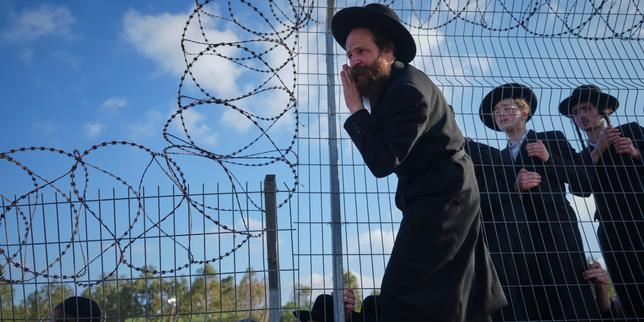
Israel's military is facing a manpower crisis, yet its political leaders just tried to write a blank check for tens of thousands of draft dodgers.
The drama reached a boiling point when the Israeli Supreme Court stepped in to freeze a brand-new law—passed by the Knesset just 24 hours prior—that shielded ultra-Orthodox (Haredi) draft evaders from arrest. The high court’s rapid-fire intervention has set up an explosive constitutional showdown. In similar updates, take a look at: The Geopolitical Architecture of State Condolences in India Qatar Relations.
This isn't just about religious study anymore. It's about a military stretched to its absolute limit and a governing coalition willing to bypass the rule of law to keep its grip on power.
The 24-Hour Law That Ignited the Court
On Tuesday, the Knesset squeaked out a 58-54 vote to pass a law that effectively barred the military and police from arresting ultra-Orthodox men who refuse their draft orders. Under normal circumstances, ignoring a conscription order in Israel lands you in military prison. But this law granted several tens of thousands of Haredi draft evaders complete immunity from arrest, investigations, and criminal proceedings. The New York Times has also covered this critical topic in extensive detail.
The immunity was set to last through November 30, but because of legal technicalities tied to the upcoming October legislative elections, it would have realistically protected draft evaders until January or February of 2027.
The reaction from the military was immediate and scathing.
IDF Chief of Staff Lt. Gen. Eyal Zamir called the law "inconceivable," pointing out that it was "clearly and unequivocally inconsistent with the IDF's needs". He wasn't exaggerating. The IDF is currently short by up to 8,000 combat troops after years of relentless, multi-front combat in Gaza, Lebanon, Syria, and against Iran.
Yet, under the suspended law, roughly 72,000 eligible ultra-Orthodox men aged 18 to 24 would continue to get a free pass.
Within hours of the law's passage, the Supreme Court issued a temporary injunction, freezing the law in its tracks. Justice Ofer Grosskopf ruled that the law raised massive constitutional red flags. He ordered the government to explain why the law shouldn't be permanently struck down, pointing out that suspending law enforcement for only one specific segment of the population is blatantly discriminatory.
A Coalition Built on Selective Law Enforcement
Why would Prime Minister Benjamin Netanyahu’s coalition push through a law that their own military chief calls a threat to national security?
It's simple math. Netanyahu’s coalition relies entirely on the support of ultra-Orthodox parties like Shas and United Torah Judaism (UTJ). UTJ leader Moshe Gafni went as far as threatening to block all coalition legislation unless this arrest-freeze law was put to an immediate vote.
To secure their votes ahead of the October elections, Netanyahu gave them what they wanted: protection for the yeshiva students who refuse to serve.
But the backlash has been fierce, even from within Netanyahu's own ranks. Several coalition members broke discipline during the vote, and Deputy Foreign Minister Sharren Haskel resigned in protest immediately after the law passed.
What’s more alarming is how government ministers responded to the Supreme Court's freeze. Communications Minister Shlomo Karhi openly called on the government and police to ignore the court’s order, claiming the court had "no legal authority". UTJ lawmaker Meir Porush chimed in, claiming that any policeman or soldier who arrests a draft-evading Torah student is the one breaking the law.
This is a dangerous pivot. When government ministers tell law enforcement to ignore the highest court in the land, you are no longer just arguing about military drafts. You are looking at a fundamental breakdown of the rule of law.
The Inequality is No Longer Sustainable
For decades, Israel maintained a status quo where ultra-Orthodox men studying Torah full-time were exempt from military service. In 1948, this applied to a tiny group of about 400 scholars. Today, the Haredi community represents the fastest-growing segment of the population, and those 400 exemptions have snowballed into 72,000 military-aged men sitting out while the rest of the country buries its dead.
The resentment among secular and modern-Orthodox Israelis has reached a boiling point. Non-Haredi Israelis are seeing their reserve duties extended month after month, their businesses ruined, and their families fractured by endless deployments.
The Supreme Court’s landmark June 2024 ruling made it clear: without a specific, equal law passed by the Knesset, the military must draft Haredi men just like everyone else. This arrest-freeze bill was a desperate, back-door attempt by the coalition to bypass that ruling.
What Happens Next
The temporary freeze means the law is dead in the water for now, and the military is technically still required to enforce conscription orders against Haredi draft evaders.
The immediate next steps will shape the future of Israeli society:
- The Supreme Court Hearing: Chief Justice Yitzhak Amit is assembling an expanded panel of judges to hear the petitions against the law. Given the court's previous rulings on equality in service, the law is highly likely to be struck down permanently.
- The October Elections: The draft issue will be the central battleground of the upcoming legislative elections. If the opposition wins, they have promised to prioritize reversing these exemptions. If Netanyahu's coalition holds, expect them to continue their assault on the judiciary to push the exemptions through.
- Civil Unrest: The potential for major street clashes is high. If the military actually begins arresting Haredi draft dodgers en masse, ultra-Orthodox protests will shut down major highways. Conversely, if the government attempts to bypass the court again, secular Israelis will likely return to the streets in massive numbers.
Israel is running out of time, money, and soldiers. Trying to solve a military manpower shortage by exempting 72,000 eligible men to save a political coalition isn't just bad policy—it's a recipe for national self-sabotage.