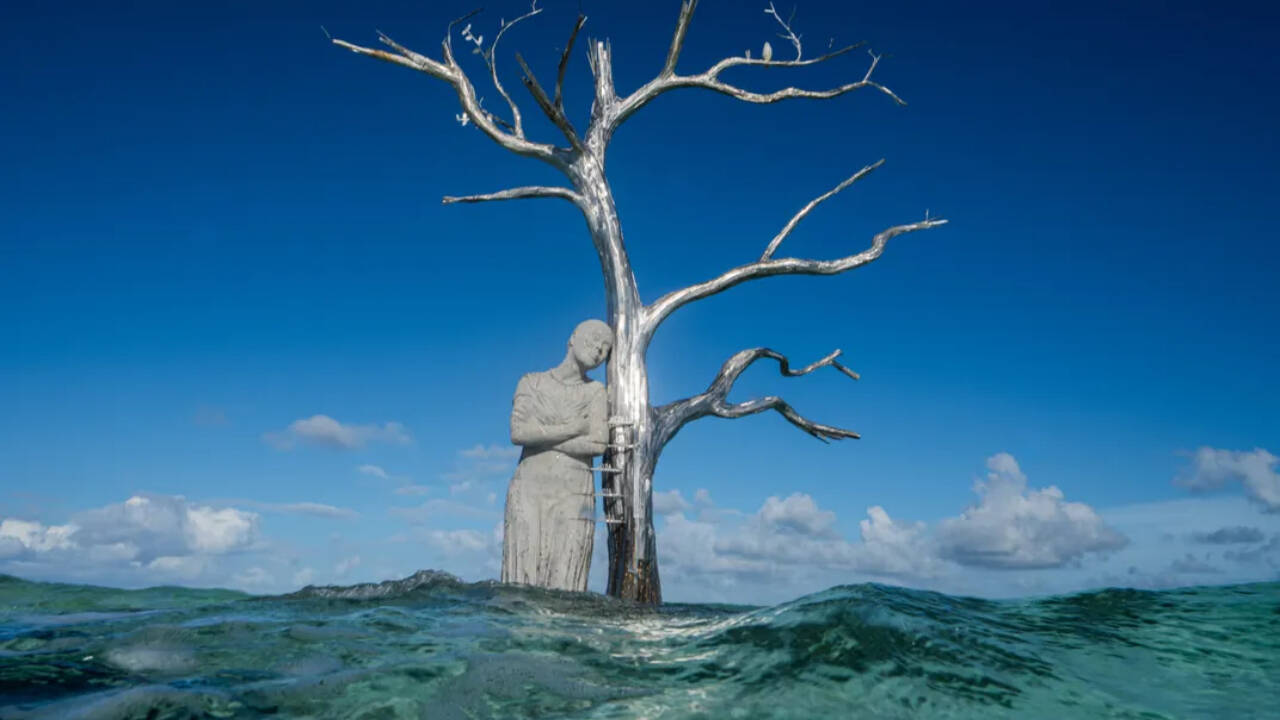
The map on my grandfather's wall showed a smudge of green where no green should have been. It sat out in the vast, indifferent blue of the Pacific, a comma of land called Kale Island. By the time I was old enough to ask why the smudge was fading into a pale pencil line, the water had already claimed the docks.
We forget how fast dirt turns to memory. For an alternative look, read: this related article.
You look at a globe and see permanence. Continents look carved from bone; islands look like permanent anchors dropped onto a blue floor. But water has a long, patient memory, and it always remembers where it used to sleep. Kale Island did not vanish in a single cinematic crash of thunder. It dissolved in whispers. A high tide that stayed an hour too long. A salty crust that killed the breadfruit trees. The slow, creeping realization that the well water tasted like the sea.
Consider what happens next: the people leave. They pack the photographs in greaseproof paper, herd the remaining goats onto the last flat-bottomed boat, and look back one final time at a coastline that is no longer a coastline. Related analysis on this trend has been published by AFAR.
Houses become reefs before they even hit the bottom.
That is usually where the story stops. A tragedy recorded in statistics, filed away in a climate archive, mourned for a polite moment before the news cycle pivots to something louder. But human beings are stubborn creatures who refuse to let things die quietly. We have a strange compulsion to resurrect what we have broken, or at least to carve a tombstone that speaks our language.
Enter the sculptors.
(Note: While the physical events of rising tides and displacement are documented history across vulnerable Pacific atolls, the specific collective response I am tracing here shifts from the tragedy of loss into the realm of intentional human intervention.)
Picture a block of marine-grade concrete sitting on a barge. It is heavy, cold, and entirely dead. An artist looks at that grey mass and sees an anchor. Not an anchor to hold a ship in place, but an anchor to hold a ghost.
What the ocean takes, we sometimes try to give back in a different currency.
When Kale Island went under, the shallow waters above its submerged roots became a liquid graveyard. Coral needs a surface to cling to. It cannot settle on shifting silt or moving sand; it demands a solid truth. So engineers and conservationists lowered massive, intricately carved marine habitat sculptures into the ghost zone where the island used to breathe.
These are not sterile concrete blocks dropped from a crane with a shrug. They are shaped like human forms, like doorways, like roots, like architectural echoes of the villages that slid beneath the waves.
I dove down to see one two summers ago.
The water was thirty feet deep right where the schoolhouse playground used to be. My ears throbbed with the descent, the pressure building like a fist closing around my skull. The light down there is different—filtered, green-gold, moving in slow liquid stripes across the sea floor. And then I saw it. A human figure, life-sized, sculpted from PH-neutral cement, standing silent against the current.
It was covered in life.
Parrotfish grazed across its shoulders. Neon damselfish darted through the hollows of its ribs. A colony of staghorn coral had taken root along the jawline, turning a cold, manufactured face into a living, breathing reef.
Irony is too small a word for this. We drowned the island with our carbon, and now we are seeding the ruins with our art to invite the ocean back in.
The statistics tell us that sea levels are rising at an accelerating rate, swallowing low-lying communities across the globe at a pace that outstrips our ability to build seawalls. The math is brutal. It is cold. It leaves no room for sentimentality. Every millimeter of water gained is an acre of heritage lost.
But statistics do not account for the sheer bloody-mindedness of biology.
When you place a sculpture on a drowned coastline, you are casting a vote against erasure. You are telling the tide that even if the land is gone, the shape of our occupation remains. The fish do not care about property deeds. They do not care about sovereignty or displaced populations. They care about shelter. They care about surface area.
And slowly, terribly, beautifully, the sculpture becomes the island.
Think about the fisherman who used to cast his net from the shore where that concrete figure now stands. His grandson might never touch the dry dirt of Kale Island. He will never feel the crunch of volcanic gravel under his bare feet or smell the specific smoke of coconut husks burning in an afternoon hearth. His inheritance is liquid. He swims above his ancestors' footsteps wearing a mask and a tank of compressed air.
He looks down through the murk and sees a statue of a person who looks like him, draped in purple sponges and swaying sea fans.
Is it enough? Of course not. A submerged statue is a monument to failure. It is a brilliant, desperate bandage placed over a severed artery. We did not save the island. We built a monument to its ghost and hoped the fish would adopt it.
Yet, as I hovered there in the blue silence, watching a sea turtle glide effortlessly through the hollow chest of a concrete watcher, I felt a strange shift in my chest. We are terrible at stopping our own momentum, but we are breathtakingly creative in the ways we mourn.
The water keeps rising. The maps keep changing. Every coastline on Earth is currently negotiating its own expiration date, inch by agonizing inch.
Down in the dark, the coral grows outward, millimeter by millimeter, reclaiming the shapes we left behind. The island is gone. Long live the reef.



