The rain in Hangzhou has a way of erasing the edges of things. By late afternoon, the gray sky bleeds into the asphalt, turning the bustling avenues into smudged watercolors of umbrellas, electric scooters, and hurried commuters. It is a choreography of controlled chaos, millions of individual lives crossing paths under the steady gaze of traffic lights and overhead cameras.
For years, Officer Chen stood at the center of this specific intersection. He knew the rhythm of the damp pavement. He knew the exact second a delivery driver would try to slip past a yellow light on a overloaded scooter, balancing three thermal food crates against the wind. Chen had spent decades waving his arms, blowing his whistle until his throat went dry, and occasionally stepping directly into the path of danger to pull a distracted pedestrian back from the curb.
He was only one man. The city was an ocean.
Then came the machine.
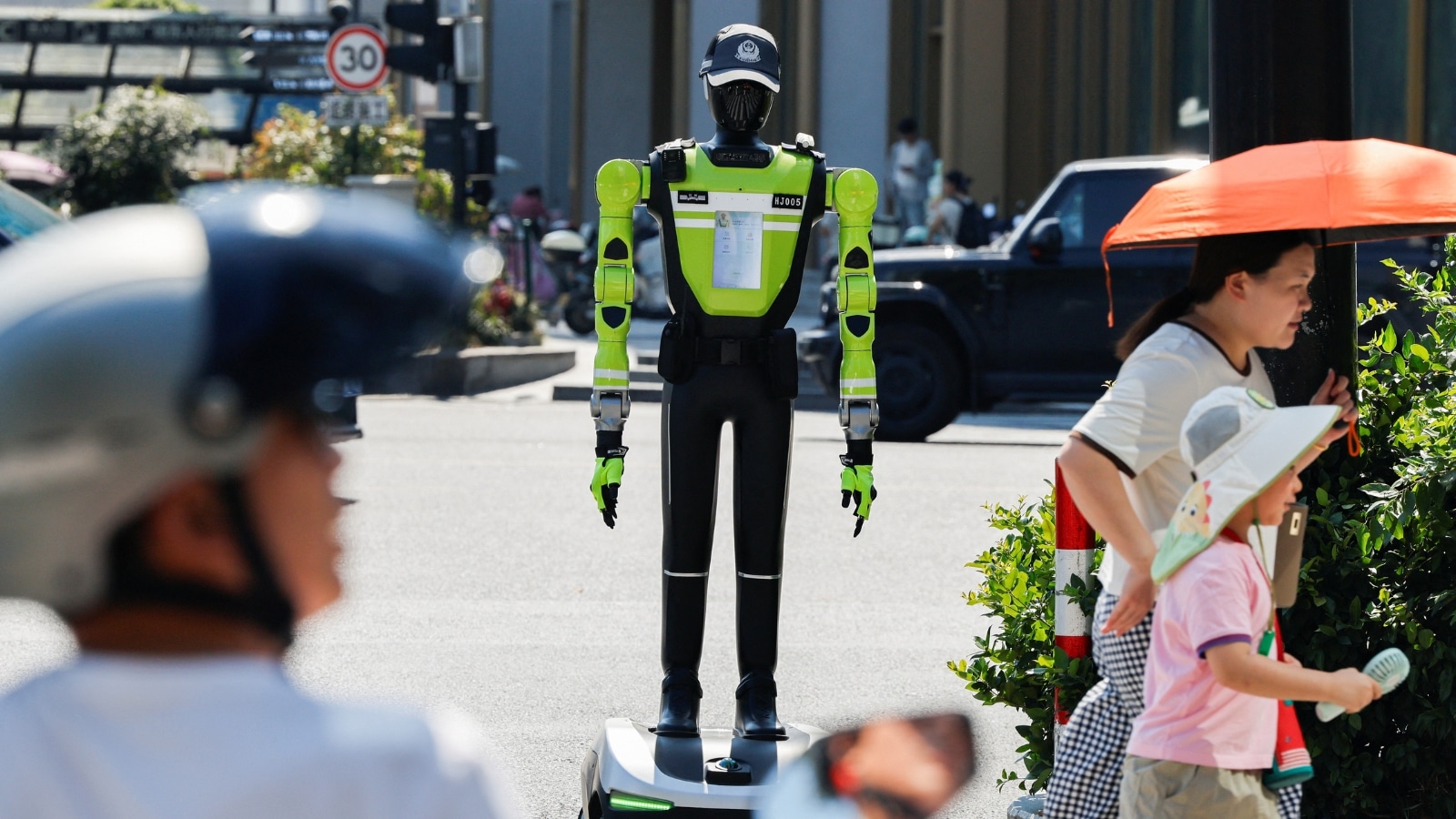
To call it a robot is to invite the wrong kind of terror. We look at metal and silicon through the warped glass of science fiction, expecting an iron fist or an emotionless tyrant. But when the autonomous patrol units first appeared on these streets in May, they did not arrive with a roar of defiance. They rolled forward with the quiet, electrical hum of a household vacuum cleaner.
Standing roughly the height of a grown human, painted in a sharp, high-visibility livery, and bristling with high-definition optical lenses and thermal sensors, these machines became the new local fixtures. They do not sleep. They do not take smoke breaks beneath the meager shelter of a bus stop awning. They do not curse under their breath when a motorist cuts them off.
They simply watch. And remember.
Consider what happens next on a standard Tuesday afternoon. A delivery rider, desperate to beat a looming rain squall and secure a tip, shoots across an empty pedestrian crosswalk while the signal blinks red. To a human officer distracted by three other infractions across the square, that violation might vanish into the statistical noise of a megacity.
To the sentinel, it is a clean math problem.
Within milliseconds, the onboard optical recognition logs the license plate, the timestamp, and the exact coordinates. A synthesized, perfectly polite voice emanates from the unit's onboard speaker, cutting through the din of honking horns and splashing tires.
"Please mind the traffic signals," the machine announces. No anger in the tone. No weariness. Just a flat, persistent reminder of order.
By the time the autumn leaves began to turn, these autonomous units had issued more than 1.7 lakh traffic warnings across the city. Over one hundred and seventy thousand interventions. Think about that number. It represents one hundred and seventy thousand potential collisions averted, close calls rewritten, and quiet reminders delivered before a tragedy could take root on the wet pavement.
Skeptics call it surveillance creep. They see the rotating blue lights and feel the cold breath of a Panopticon closing in. And they are not entirely wrong to feel that way. It is unsettling to realize how thoroughly the public square can be mapped, measured, and managed by something that does not bleed.
Yet, walk with Officer Chen down the wet avenue today, and you will hear a different perspective. His knees ache when the humidity rises. His shifts used to end with a raw throat and a racing heart, wondering how many close calls he missed while turning his head to look down a side street. Now, he patrols alongside the machines. He handles the human element—the distressed driver who needs actual help, the lost tourist, the complex accident report—while the mechanical sentinels hold the perimeter of basic civic discipline.
We are living through a strange historical pivot. We are outsourcing our conscience to code.
The danger is not that the machines will become too human. The danger is that we will become too reliant on their cold perfection, forgetting how to care for one another without an algorithm keeping score. We risk trading the messy empathy of community for the pristine efficiency of a warning issued by a microprocessor.
Yet, standing at that Hangzhou intersection as the evening commuters rush home beneath the sodium streetlamps, watching a mechanical guardian glide silently past a puddle, a different truth emerges. The city was breaking the humans who tried to watch over it. The volume was simply too high. The stakes were too steep.
The rain continues to fall. The metal sentinel rolls on, its lenses catching the neon reflections of a million lives rushing past, keeping watch over a world that refuses to slow down.