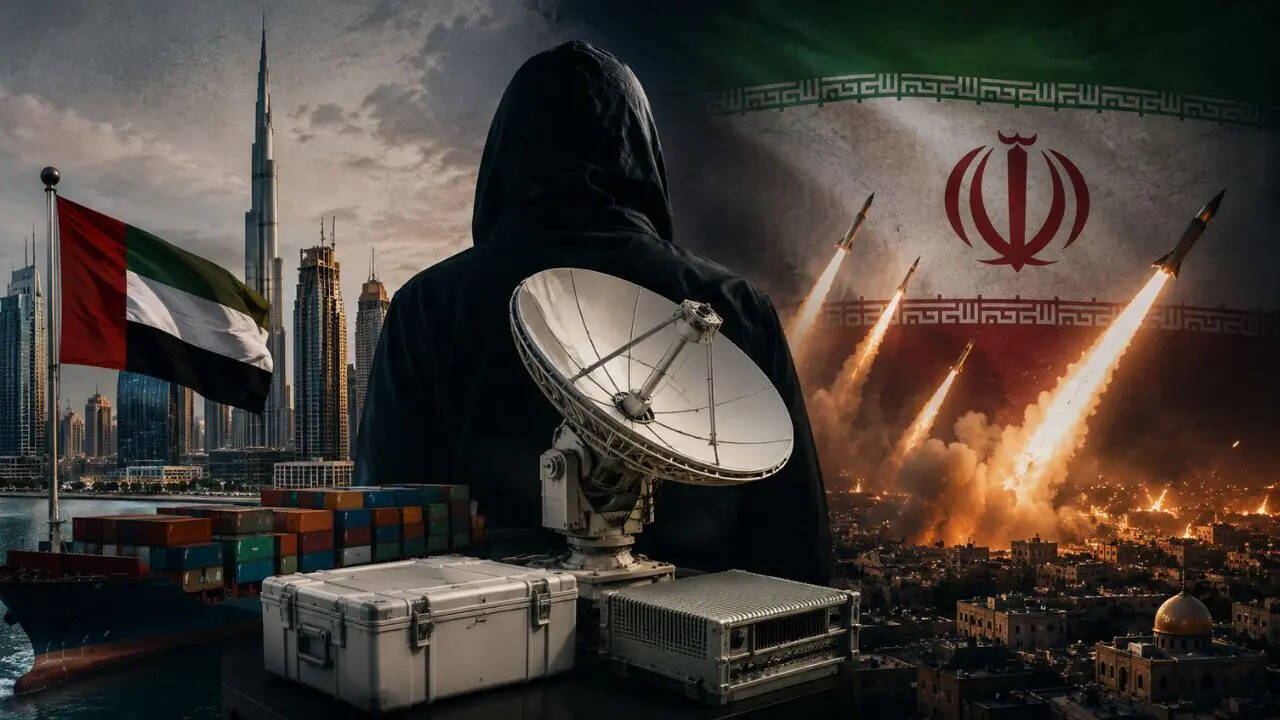
Iran's Revolutionary Guards used a corporate front network inside the United Arab Emirates to buy military-grade Chinese satellite hardware, which was then used to orchestrate devastating aerial assaults across the Middle East. Leaked commercial contracts and maritime shipping records reveal that the Islamic Revolutionary Guard Corps (IRGC) Aerospace Force exploited the UAE’s loose free-zone regulations to import a 1.8-ton motorized satellite antenna manufactured by Chinese firm StarWin. Routed through Dubai’s Jebel Ali port via a shell company, this technology directly boosted the precision drone and missile network that Tehran subsequently turned against the Emirates.
The revelation exposes a glaring systemic failure. For years, Western sanctions aimed to choke off Tehran’s military industrial complex. Instead, Iran successfully converted its chief regional rival into an unwitting logistical staging ground for its electronic warfare and unmanned aerial vehicle (UAV) programs.
The Shell Game in Ras al Khaimah
The procurement trail highlights a highly sophisticated, multi-tiered corporate camouflage strategy. At the center of the operation sits Telesun, a company registered in the UAE emirate of Ras al Khaimah. On paper, Telesun appears to be an ordinary regional logistics and trading entity. In reality, it operated as a procurement arm for Ertebatat Faragostar Kish (EFK), an unsanctioned Iranian telecommunications firm.
EFK was not purchasing the hardware for civilian use. Contractual blueprints demonstrate that EFK was acting on behalf of the Saman Industrial Group. The US Treasury blacklisted Saman for serving as a primary commercial front for the IRGC Aerospace Force Self Sufficiency Jihad Organization—the specific research and development unit tasked with designing Iran's ballistic missiles, drones, and electronic warfare suites.
By utilizing a double-blind layer of corporate entities—an unsanctioned Iranian firm buying through a localized UAE free-zone company—the IRGC successfully bypassed the compliance filters of global shipping conglomerates and maritime customs.
Blind Signals and Ghost Ships
The physical transfer of the military hardware from Shanghai to Iran required active maritime deception to evade Western naval monitoring in the Persian Gulf.
- August 2025: The Chinese container vessel Zhong Gu Yin Chuan departs Shanghai carrying six specialized crates listed on customs declarations under the generic description of "antenna and accessories."
- Late August 2025: The vessel docks at Dubai’s Jebel Ali Container Terminal 1, offloading the 1.8-ton motorized StarWin antenna.
- November 2025: The cargo sits in a secure port zone for nearly three months until an Iranian-flagged vessel, the Rama III, arrives at the exact same quayside.
The Rama III took delivery of the container and immediately initiated tactical "spoofing" maneuvers. Automatically transmitted GPS and Automatic Identification System (AIS) signals from the vessel indicated it had cleared the Gulf and paused near the coast of Oman.
The digital data was a fabrication. Commercial satellite imagery captured on November 25 confirmed the Rama III was nowhere near its broadcasted coordinates. Instead, the physical ship was docked at Iran’s Shahid Rajaee port in Bandar Abbas, delivering the Chinese satellite communication gear directly into the hands of IRGC engineers. The shipping agent facilitating the Iranian side of the offloading was Blue Calm Marine Services, an entity previously sanctioned by Washington for moving specialized missile propellants for Tehran.
The Irony of the Emirati Free Zones
The UAE built its global economic standing on the frictionless movement of capital and goods. Its numerous free trade zones offer foreign corporations minimal oversight, rapid registration, and total tax exemptions. However, these exact mechanisms create systemic national security vulnerabilities.
Western compliance frameworks place immense pressure on tier-one banks, but the actual physical inspection of dual-use goods within transshipment hubs remains deeply flawed. A 4.5-meter motorized satellite antenna possesses obvious military utility for mobile drone command-and-control structures. Yet, because the paperwork identified the cargo as standard commercial telecommunications accessories destined for a UAE-registered entity, it passed through Jebel Ali without a secondary inspection.
This logistical blindness has yielded disastrous consequences for Abu Dhabi. Tehran launched a massive barrage of over 2,800 drones and missiles targeting the Gulf state. More recently, a drone strike struck the perimeter of the Barakah nuclear power plant in Abu Dhabi, disabling off-site power to an active reactor and forcing the facility to rely on emergency diesel generators. The very branch of the IRGC that designed, coordinated, and executed these strikes did so utilizing satellite infrastructure secured through the UAE's own commercial ports.
The Broader Chinese Space Network
The acquisition of the StarWin antenna is not an isolated intelligence blind spot. It represents the ground-segment component of a much broader, highly integrated space surveillance strategy orchestrated between Tehran and Beijing-based entities.
The IRGC Aerospace Force also secretly acquired the TEE-01B spy satellite, manufactured and launched by the Chinese firm EarthEye Co. This dedicated intelligence platform granted Iranian commanders real-time, high-resolution imagery of the Middle East. The IRGC utilized this satellite data to map out US military installations, including the Prince Sultan Air Base in Saudi Arabia and the Muwaffaq Salti Air Base in Jordan, directly prior to launching coordinated drone strikes.
To manage the massive influx of orbital data, Iran secured access to global commercial ground stations operated by Emposat, a satellite data services provider based in Beijing. The 1.8-ton antenna procured via the UAE provided the critical localized uplink needed to integrate these diverse space assets directly into mobile field units on the ground in Iran.
The Cost of Strategic Friction
The blowback from these procurement leaks has triggered an aggressive, destabilizing restructuring of the regional economy. Recognizing that its financial system has been thoroughly compromised, the UAE government launched a quiet but sweeping domestic crackdown on Iranian assets.
Hundreds of thousands of Iranian expatriates who spent decades building legitimate commercial operations within the Emirates are facing immediate visa cancellations, frozen corporate banking access, and forced asset liquidations. The historic maritime trade route between Dubai and Bandar Abbas is effectively paralyzed under a tightening domestic blockade.
Western regulators are now shifting their focus from punitive economic sanctions toward aggressive secondary enforcement against third-party logistics hubs. The United States State Department recently issued sanctions against EarthEye Co. and signal providers tied to the network, warning that neutral jurisdictions hosting front companies will face systematic disconnection from the dollar-clearing system. For the UAE, the era of balancing unfettered global trade with loose regional enforcement has hit a hard geopolitical wall. Abu Dhabi must now choose between maintaining its frictionless commercial model or sealing the structural loopholes that allowed its deadliest adversary to weaponize its own infrastructure.


