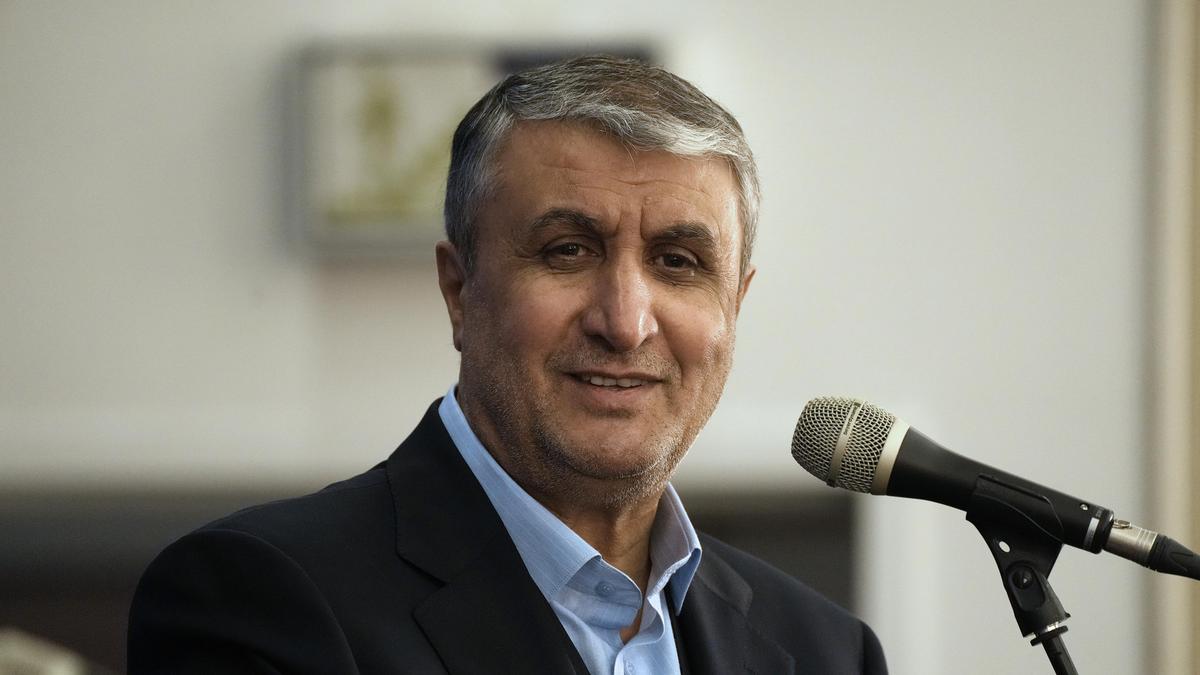
Western media loves a monster. Every time Mohammad Eslami, Iran's nuclear chief, mentions "enrichment rights," the press treats it like a countdown to a Hollywood explosion. They obsess over the breakout time—the theoretical window between a political decision and a functional bomb. They track centrifuges like sports stats. But they miss the entire point of the board.
The mainstream narrative is that Iran wants a bomb to use it. That’s wrong. They want the process of building the bomb because the process is more valuable than the weapon itself. In the world of high-stakes diplomacy, a finished weapon is a static asset. It’s a paperweight that invites immediate, existential retaliation. But a fluctuating, advancing enrichment program? That is a dynamic lever that forces the United States to stay at the table forever.
The "necessary right" Eslami talks about isn't a scientific goal. It’s a permanent insurance policy against irrelevance.
The Enrichment Trap
The competitor's take suggests that enrichment is a hurdle to overcome for talks to succeed. That's a naive reading of Middle Eastern power dynamics. Enrichment isn't the hurdle; it’s the oxygen.
Without the centrifuges spinning at Natanz and Fordow, Iran has very little to offer a superpower. Their conventional military is largely a collection of upgraded 1970s hardware and asymmetric drone tech. Their economy is battered. Their regional influence is expensive and messy. But $U^{235}$? That is a universal currency.
By maintaining the right to enrich uranium to 60%, Iran creates a "sunk cost" for Western diplomacy. If Washington walks away, the enrichment levels go up. If Washington stays, they have to pay—in sanctions relief or frozen asset releases—just to keep those levels where they are. It is a brilliant, circular economy of crisis management.
Why the Breakout Time is a Distraction
Experts at places like the Institute for Science and International Security spend their lives calculating how many weeks it would take Iran to produce enough weapons-grade uranium (WGU) for a single device. These numbers are accurate, but the context is hollow.
Producing 90% enriched uranium is only step one. To have a credible threat, you need:
- Miniaturization: Fitting a physics package into a nosecone.
- Re-entry Vehicles: Ensuring the thing doesn't burn up when it hits the atmosphere.
- Delivery Systems: Reliable ICBMs that can actually hit a target across an ocean.
Iran hasn't mastered the full triad. They know it. We know it. So why the panic? Because the West treats the fuel as the finish line. Eslami plays into this perfectly. By insisting that enrichment is a "necessary right," he anchors the conversation on the one thing Iran can actually do well, rather than the three things they can't do at all.
The Myth of Scientific Necessity
Let’s dismantle the "medical isotopes" and "energy independence" defense. It’s the standard line from Tehran: "We need 20% or 60% uranium for the Tehran Research Reactor (TRR) to make medicine."
Technically, yes, you can use highly enriched uranium for medical research. But you can also buy those isotopes on the open market for a fraction of the cost of building an underground bunker in a mountain. No one builds a multi-billion dollar enrichment infrastructure to save money on cancer treatments.
This isn't about science. It’s about Sovereign Technical Autonomy.
In my years observing how sanctioned states bypass international norms, the pattern is always the same. You don't build a capability because you need the product; you build it because you need the permission to exist without oversight. If Iran stops enriching, they lose their status as a "threshold state." And in the 21st century, being a threshold state is the only way to ensure you don't end up like Libya’s Muammar Gaddafi, who gave up his program and ended up in a drainage pipe.
The Failure of "Maximum Pressure"
The 2018 withdrawal from the JCPOA (Joint Comprehensive Plan of Action) was predicated on the idea that if you squeeze the Iranian economy hard enough, they will trade their centrifuges for bread.
It failed because it ignored the Internal Legitimacy Engine. For the hardliners in Tehran, enrichment is a symbol of national pride that outweighs the price of eggs. When Eslami says enrichment is "necessary" for talks, he isn't just talking to Mike Pompeo or Antony Blinken. He is talking to the Basij and the Revolutionary Guard.
He is saying: We have not been defeated.
The Mathematics of Deterrence
Let’s look at the actual physics of the leverage. To get from 0.7% (natural uranium) to 3.7% (power plant grade) requires about 75% of the total work (Separative Work Units or SWUs). To get from 3.7% to 20% requires another 15%. To get from 20% to 90% (weapons grade) requires only about 10% more effort.
$$Total\ Effort = \int_{initial}^{final} W(c) ,dc$$
Because the enrichment process is non-linear, once you hit 60%, you are effectively at the doorstep of a bomb. This is where the status quo gets it wrong. They think 60% is a "provocation." It’s actually a Stall Tactic.
By staying at 60%, Iran keeps the threat "imminent" without crossing the red line that would trigger an Israeli or American kinetic strike. It is the ultimate "Grey Zone" strategy. They are hovering at 90% of the way there, reaping 100% of the diplomatic benefits, while taking 0% of the risk of an actual nuclear war.
What Negotiators Get Wrong
Diplomats enter the room thinking they are solving a technical problem. They want to talk about the number of IR-6 centrifuges and the kilograms of stockpiled UF6.
They should be talking about Psychological Equivalence.
Iran views the enrichment program as their equivalent to the U.S. Navy. It is their way of projecting power into spaces where they shouldn't be able to reach. You don't ask a superpower to sink its own fleet before you start talking about trade. Yet, that is exactly what Western "Zero Enrichment" hawks demand.
It is a non-starter. It has always been a non-starter.
The Actionable Reality
If you are a policy maker or an investor trying to read the tea leaves of the Middle East, stop looking at the enrichment percentages. Look at the IAEA Access Agreements.
When Eslami restricts camera access or bars inspectors, he is signaling a move toward escalation. When he talks about "rights" and "necessity," he is signaling a desire for a deal. The rhetoric is a "For Sale" sign. He is telling the world exactly what the price is.
The mistake we make is believing that "winning" means Iran having zero centrifuges. That world ended in 2003. The new reality is a managed Iranian threshold. We are not negotiating for their surrender; we are negotiating for the speed of their treadmill.
The Harsh Truth of Nuclear Diplomacy
We have entered an era where "Nuclear Hedging" is the standard for middle powers. Japan could build a bomb in months if they chose to. South Korea is openly discussing it. Iran is simply the first one to do it while being an adversary of the West.
The competitor article treats Eslami’s statement as a hurdle to peace. It’s actually the blueprint for the only peace available. A deal that allows Iran to keep its "pride" (the centrifuges) while the West gets its "security" (the monitoring).
Anything else is a fantasy.
The U.S. doesn't need Iran to stop enriching uranium to have a successful talk. The U.S. needs to recognize that the enrichment is the talk. It is the language they speak. If you take away the centrifuges, the conversation ends—and that’s when the shooting starts.
Stop waiting for Iran to give up its "rights." They won’t. They’ve realized that in a world of giants, the only way for a smaller player to be heard is to keep a hand on the light switch. Eslami isn't being stubborn; he's being logical. He’s holding the only card that matters, and he has no intention of playing it until the pot is big enough to justify the risk.
The enrichment isn't the bomb. The enrichment is the seat at the table. And as long as those rotors are spinning, we are forced to listen.


