The map makes it look like a whisper. A narrow strip of blue water, a handful of miles separating two continents, a casual blink on a globe spinning through the dark. Look closer. That blue line is a chasm.
Let me take you to the razor's edge. You might also find this connected article insightful: Why Spain Immigration Realities Matter Right Now.
Imagine standing at the southern fringe of Europe, where the Mediterranean wind tastes of salt and ancient trade. Ahead lies Ceuta. It is a strange architectural anomaly, a tiny scrap of Spanish soil physically anchored to the northern coast of Africa. To anyone holding the right passport, it is a quirky border crossing, a quick passport stamp, a curiosity of colonial geography. To anyone else, it is a fortress wrapped in razor wire.
A man stands at this threshold. Let us call him Tariq, though his real name is carried by thousands of others who share his exact silhouette in the crowded twilight of the border zone. Tariq has spent months walking across dust and stone, carrying nothing save for the memory of his family's kitchen table and the stubborn belief that human dignity should not expire at an arbitrary political line. He is exhausted. His boots are hollowed out at the heels. His palms are calloused from gripping truck beds and climbing drainage pipes under the cover of a moonless sky. As highlighted in recent coverage by TIME, the implications are notable.
He reaches the perimeter.
What the evening news reports as a routine statistic—a minor uptick in border crossings, a logistical hiccup for local authorities—is, to Tariq, a physical wall of steel, cameras, and indifference. The statistics tell you that crossings are up. They tell you about fence heights, budget allocations, and diplomatic friction between Madrid and Rabat. They do not tell you what it feels like to smell the bakeries of Europe while your stomach twists with hunger, knowing an invisible line stands between you and a crust of bread.
The mathematics of modern migration are cold. We treat human movement like a plumbing problem, something to be blocked, diverted, or piped away from view. But water always finds a crack in the dam.
Consider what happens next when the official gates close.
When the legal pathways narrow to the width of a needle's eye, the desperate do not simply turn around and walk back into the desert. They adapt. They look toward the gray water, toward makeshift vessels fashioned from rubber and inflated dreams, toward the treacherous currents of the Strait of Gibraltar where the Atlantic and the Mediterranean collide in a chaotic dance of deep water and sudden squalls.
I remember the smell of diesel and fear on a small wooden skiff years ago, watching the horizon blur until the distinction between sky and sea vanished entirely. In that kind of void, time loses its shape. Minutes stretch into hours. Every wave feels like a deliberate attempt by the universe to remind you of your own fragility. When you reach the shore—if you reach the shore—you realize the hardest part has only just begun.
Ceuta is not Europe, not really. It is a waiting room. It is a cage with a view.
Those who manage to scale the double-fenced perimeter or slip past the maritime patrols find themselves trapped in an administrative limbo. They are on European territory, yet legally and practically suspended in midair. Detention centers swell beyond capacity. Food runs thin. Local infrastructure groans under the weight of a humanitarian crisis that politicians prefer to treat as a seasonal weather event rather than a permanent structural reality.
Why do they keep coming?
Economics alone fail to capture the truth. People do not risk drowning in freezing water simply for a slightly better wage. They come because home has become a place where staying alive requires a miracle every single morning. When political corruption, climate collapse, and structural violence strip away every possible future, the dangerous journey north stops looking like a reckless gamble and starts looking like the only rational choice left.
We build higher fences because we are terrified of what happens when we admit that the world is deeply, systemically fractured. We prefer the clean lines of bureaucracy. We prefer the euphemisms of border management. We talk about security, deterrence, and sovereignty, words that sound noble in parliamentary chambers but taste like ash in the mouth of a man sleeping on a flattened cardboard box beneath a highway overpass in Ceuta.
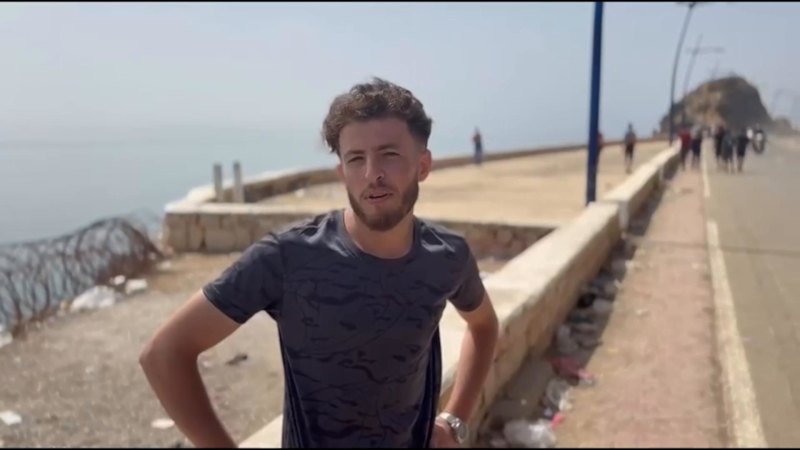
The man who warned of the difficulties faced in crossing this border was not complaining. He was issuing a distress flare. He was trying to pierce the thick layer of digital noise that insulates comfortable lives from the raw, bruising reality of human desperation.
Listen to him.
The wind off the Strait does not care about our political parties or our immigration quotas. It sweeps across the water, indifferent and eternal, carrying the salt of the sea and the quiet, heavy breathing of thousands of people waiting for tomorrow to begin.