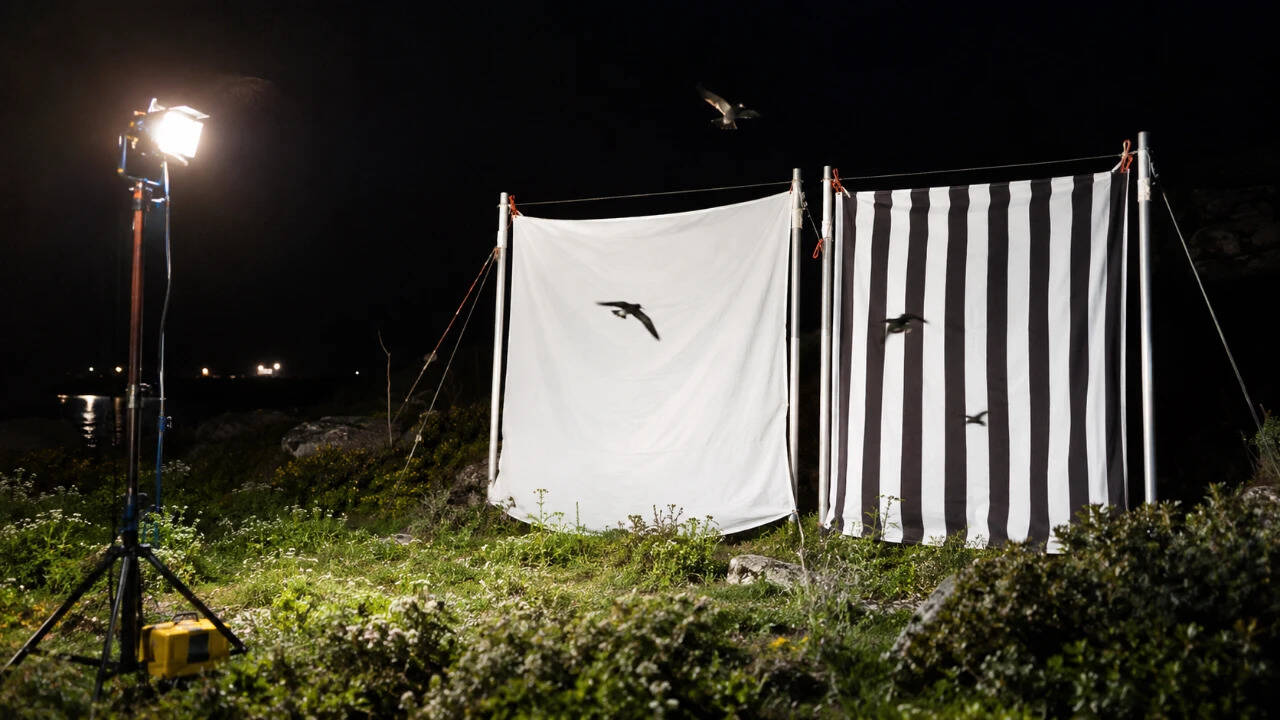
The sound happens at four in the morning.
It is not a screech, nor is it the rustle of feathers against cedar siding, because birds moving at forty miles an hour over open water do not brake before they hit a wall they cannot see. It is a dull, heavy thud against reinforced concrete or plate glass, followed instantly by silence.
If you have ever walked the perimeter of a coastal power station or a waterfront high-rise just after dawn, you know what comes next. You step around the corner of the building, coffee cooling in your hand, and you find them lined up along the concrete walkway like dropped grey stones. Puffins. Storm-petrels. Murres. Birds built by millions of years of evolution to survive North Atlantic gales, eighty-foot swells, and freezing spray, undone in a fraction of a second by a coat of beige paint.
For decades, we assumed we knew why birds hit buildings. We blamed glass. We blamed the mirror effect of modern skyscrapers reflecting clouds and trees, tricking songbirds into flying straight into office windows. So we invented window decals, ultraviolet films, and fritted glass dots designed to break up reflections in urban downtowns.
We got the ocean completely backward.
Out on the coast, where offshore wind turbines, lighthouses, marine research stations, and seaside condos rise out of the fog, the killer is not just reflection. It is invisibility. And a team of Canadian researchers just proved that the fix is sitting in the hardware store paint aisle—though it looks nothing like what architects want to build.
A Blind Spot in the Fog
To understand how a seabird dies against a solid wall, you first have to stop seeing the world through human eyes.
Consider a hypothetical engineer—let us call her Clara—tasked with designing a new coastal weather station on a windswept headland in Newfoundland. Clara wants the building to blend into the rugged granite cliffs and overcast sky. She chooses pale grey cladding, off-white trim, and muted slate accents. On architectural renderings, it looks tasteful, modern, and unobtrusive.
To a Leach’s storm-petrel skimming three feet above the waves at dusk, Clara’s building does not exist.
Human vision is built for sharp, high-resolution detail directly in front of us. We have binocular overlap, high visual acuity, and brains wired to recognize flat geometric planes like walls and roofs. Seabirds operate on entirely different hardware. Their eyes are positioned on the sides of their heads to scan a wide horizon for predators and schools of fish, leaving a narrow—and sometimes completely blind—zone directly ahead of their beaks when they fly at full speed.
More importantly, seabirds possess remarkably low contrast sensitivity compared to humans. When a pale grey or white structure sits against a pale grey fog bank, or reflects the washed-out glare of morning light off the water, the edges of that building dissolve. There is no horizon line. There is no depth cue.
Think of it like driving a car at sixty miles an hour into a whiteout snowstorm, only to discover too late that someone parked a white semi-truck across the highway without hazard lights. By the time the bumper registers in your headlights, physics has already decided the outcome.
Across North America alone, building collisions kill up to a billion birds every single year. While songbirds migrating through cities like Chicago and Toronto grab the headlines, coastal and marine infrastructure quietly takes a devastating toll on seabird populations already battered by warming oceans, plastic ingestion, and collapsing fish stocks. Unlike robins or sparrows, which lay multiple clutches of eggs each summer, many seabirds raise only a single chick per year—and some do not even begin breeding until they are five or six years old. Lose a few hundred adult puffins or shearwaters to a poorly painted coastal facility, and you erase decades of reproductive future in a single foggy night.
I still remember standing on a concrete pier in Nova Scotia years ago, holding a juvenile gannet that had struck a whitewashed storage shed during a heavy mist. Its neck was unbroken, its plumage immaculate, white as fresh chalk with pale golden tips on its head. It felt impossibly light in my hands, all hollow bones and salt-stiffened feathers, its pale blue eyes wide and unblinking before they slowly filmed over. The facility manager stood beside me, genuinely shaken. They had put bird-deterrent silhouettes on the two small windows. They had turned off the floodlights. They had done everything the city bird-safety brochures told them to do, and the bird had flown straight into the blank white wall between the windows anyway.
We were solving an urban problem on a marine frontier. And we were guessing.
The Experiment on the Coast
This is where the Canadian research team—led by visual ecologists and conservation biologists studying seabird sensory systems—decided to stop guessing and test what seabirds actually register before impact.
Instead of asking how to make buildings prettier or less reflective for human eyes, they modeled the visual systems of vulnerable coastal species, including alcids, gulls, and tubenoses like petrels and shearwaters. They wanted to know which visual patterns, colors, and luminance contrasts trigger an avoidance response early enough for a heavy, fast-moving seabird to bank away.
The results upended decades of coastal design orthodoxy.
First, the researchers found that pale, neutral, and light-colored exteriors—the exact whites, beiges, and soft greys favored by coastal developers, lighthouse authorities, and offshore wind engineers—are the hardest for seabirds to detect against open sky, sea spray, and mist. Against low-contrast marine backdrops, light surfaces wash out entirely.
Second, solid dark colors—deep blacks, charcoal greys, and dark navy blues—dramatically increase detection distance. A dark silhouette punches a hole through fog and glare, giving a bird’s low-contrast visual system an unmistakable boundary line against the bright horizon.
Third, and most striking of all, adding high-contrast stripes—alternating dark and light bands across a facade or tower—supercharges that visual warning.
Why stripes? Because a solid wall, even a dark one, lacks internal visual texture. As a bird approaches a uniform surface, its brain struggles to judge how fast the wall is rushing toward it—a phenomenon visual scientists call optic flow. Bold, high-contrast stripes create rapid spatial frequency changes across the bird’s peripheral field of view. As the bird closes distance, the stripes appear to expand and separate rapidly, firing an urgent neurological alarm that screams solid object ahead, turn now.
It is the exact same principle behind the black-and-yellow hazard tape wrapped around low steel beams in a warehouse, or the bold vertical bars painted onto historic lighthouses. For centuries, mariners painted lighthouses in dramatic black-and-white spiral or horizontal stripes so ship captains could spot them against white cliffs and grey clouds.
Somewhere along the way, modern coastal architecture forgot what nineteenth-century lighthouse keepers knew instinctively.
Why We Resisted the Obvious
If dark paint and bold stripes save seabirds, why are we still wrapping coastal condos, ferry terminals, and offshore wind turbines in pristine white?
Part of the answer is pure aesthetics. Coastal zoning boards and luxury developers obsess over "visual integration." They want buildings that whisper rather than shout, structures that dissolve into the natural palette of sand, surf, and cloud. A stark black-and-white striped wall feels industrial, jarring, even aggressive to a homeowner paying two million dollars for an unobstructed ocean view.
Another part of the problem is engineering inertia. Offshore wind turbines—which are rapidly expanding along the Atlantic coasts of Canada, the United States, and Europe—are almost universally painted light grey or off-white. Aviation regulators require high visibility against dark terrain, while marine engineers favor light colors to reduce solar heat absorption inside the tower blades and nacelles.
Yet previous European field studies on offshore wind farms hinted at what the Canadian scientists have now confirmed for coastal buildings: when researchers painted just a single turbine blade black on a wind farm in Norway, annual bird fatalities dropped by more than seventy percent.
Still, changing global building codes and industrial paint specs is slow, agonizing work. You run into thermal expansion questions on dark metal cladding. You run into municipal design committees who worry that striped facades look like shipping containers or prison uniforms. You run into the quiet, persistent human bias that if we can see a building clearly at noon on a sunny Tuesday, a bird ought to be able to see it at midnight in a drizzle.
Honestly, it is easy to feel cynical when a solution this simple stalls against vanity and red tape. I have sat in municipal planning meetings where three hours were spent debating the exact shade of "driftwood grey" for a waterfront pavilion, while a thirty-second comment about avian collision mortality was brushed aside with a promise to "look into window stickers." We love nature as scenery, right up until nature asks us to change the paint on our walls.
Rethinking the Shoreline
Now return to Clara, our hypothetical engineer in Newfoundland, armed with the Canadian team’s findings before she orders a single pallet of siding.
Instead of pale grey aluminum panels that vanish into the North Atlantic mist, Clara redesigns the weather station’s seaward facade. She specifies deep charcoal-black composite cladding broken up by bold, high-contrast white vertical bands spaced at intervals calibrated to seabird visual acuity. Around the glass observation windows, she replaces invisible UV decals with dense, high-contrast ceramic frit patterns that continue the striped rhythm across the glazing.
Does the building disappear into the cliffs? No. It stands out against the fog like a crisp charcoal sketch on wet paper.
And when a flock of Atlantic puffins hurtles back toward their cliffside burrows through a blinding November squall, their lateral eyes catch the sharp vertical bars fifty yards out. Their brains register the sudden surge in optic flow. Before the wind can push them into the steel, they bank hard left, wings beating furiously against the gale, and clear the roofline by twenty feet.
No thud. No broken necks on the concrete walkway at dawn. Just the rush of salt wind and the receding flap of wings disappearing into the dark.
You do not need a billion-dollar laser array or an experimental acoustic cannon to stop killing seabirds along our coasts. You do not need to halt renewable energy projects or abandon waterfront architecture. You just have to stop building invisible walls in the middle of the oldest highway on Earth, pick up a roller, and paint the warning in black and white.


