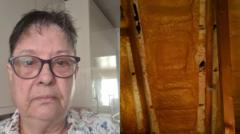
The air in the attic was thick with the scent of chemicals and the muffled promise of lower utility bills. For Sheila, a retiree living in a modest semi-detached home she had spent thirty years paying off, that smell represented security. It was the scent of a "modern solution" to the rising costs of heating a drafty British winter.
She watched the technicians spray the thick, expanding liquid onto the underside of her roof. It looked like shaving foam but hardened into a rigid, yellowed crust that promised to seal her home against the elements forever. The salesman had been charming. He spoke about government-backed initiatives and the eco-friendly "future of insulation." He didn't mention that he was effectively sealing her financial coffin.
Two years later, Sheila decided to downsize. She found a smaller cottage closer to her grandchildren. She had a buyer. She had a price. Then came the surveyor’s report.
The bank refused the mortgage. Not because of the foundation or the wiring, but because of the foam. To the lenders, that "modern solution" was a toxic asset. They saw a roof that could no longer breathe, timber that might be rotting unseen behind a plastic shroud, and a property that was, for all intents and purposes, unmortgageable.
Sheila wasn't just stuck. She was £13,000 in the hole before she could even think about moving.
The Alchemy of the Hard Sell
We are told to insulate. We are told to save the planet and our wallets in one fell swoop. This creates a psychological fertile ground for the "spray foam" industry. It preys on the logic of the homeowner who wants to do the right thing. The pitch is simple: traditional mineral wool is messy and inefficient, while spray foam is a surgical strike against heat loss.
But the reality of building physics is less cooperative than a glossy brochure.
Think of a house like a human body. It needs to regulate temperature, yes, but it also needs to perspire. When you apply closed-cell spray foam directly to the underside of roof tiles or felt, you create an impermeable barrier. Moisture that naturally rises through a house—from showers, kettles, and breathing—hits that cold barrier and has nowhere to go. It sits. It soaks into the rafters.
Behind that beautiful, clean-looking foam, the wood begins to suffer. It’s a slow, silent decay. By the time you smell the rot, the structural integrity of your home is already compromised. Lenders aren't being cruel when they reject these properties; they are being cold-bloodedly logical. They are protecting themselves from a house that might literally be eating its own skeleton.
The High Price of "Free" Advice
The tragedy of the spray foam scandal isn't just about physics; it’s about the collapse of trust. Many homeowners like Sheila were targeted during periods of high energy prices. They were often told that this specific type of insulation was "required" or "highly recommended" by local authorities.
The industry operates in a gray zone of aggressive telemarketing and door-to-door persuasion. They use the language of the state to bypass the natural skepticism of the elderly. They offer "free surveys" that inevitably find "urgent damp issues" which only their product can fix.
Consider the math of a nightmare. Sheila paid £3,500 for the initial installation. She thought she was investing in her property value. When the bank flagged the foam, she had to hire a specialist removal team. Removing spray foam isn't like taking out old fiberglass. It’s a brutal, manual process of scraping, grinding, and often replacing the timber that the foam has bonded to.
The removal cost her £9,500. Add that to the initial cost, and she had spent £13,000 to end up exactly where she started, but with significantly less in her savings account and a heart full of bitterness.
The Mortgaging Wall
The Royal Institution of Chartered Surveyors (RICS) has been vocal about the risks, yet the message hasn't reached the average kitchen table. We live in a world where we assume that if a product is sold openly, it must be safe for our biggest asset. This is a dangerous fallacy.
Banks operate on a "valuation" model that looks thirty years into the future. If a surveyor cannot physically inspect the roof timbers because they are encased in two inches of hardened polyurethane, the bank assumes the worst. In their eyes, the roof is a mystery. And banks hate mysteries.
This has created a two-tier housing market. On one side, homes that are "clean." On the other, a growing number of properties—estimated in the tens of thousands—that are trapped in a cycle of foam and debt. Homeowners find themselves in a "Catch-22." They can't sell without removing the foam, but they can't afford to remove the foam until they sell.
The Ghost in the Roof
Imagine standing in your hallway, looking up at the ceiling, and knowing there is a £13,000 secret sitting just above the plasterboard. It changes how you feel about your sanctuary. The home stops being a source of pride and becomes a source of anxiety. Every rainstorm makes you wonder if the water is trapped. Every cold snap makes you wonder if the timber is sweating.
The industry is now seeing a "second wave" of exploitation. The same companies—or their cousins—that sold the insulation are now rebranding as "remediation specialists." They call the same people they sold the foam to, claiming they’ve heard about the mortgage issues and offering to remove it for a "discounted" fee.
It is a predatory loop. It is a tax on the vulnerable.
The Breathable Truth
There is a way to insulate a home safely. It involves understanding that a house is a system, not a collection of parts. It involves breathability, ventilation, and the use of materials that have been tested over decades, not just through a high-pressure sales pitch.
The "quick fix" is rarely a fix at all. It is usually just a way to move a problem from the present into the future, where it can grow and fester in the dark.
For Sheila, the story ended with a bridge loan and a lot of tears. She eventually got her cottage, but the inheritance she planned to leave her children was significantly lighter. She still looks at roofs now. When she drives through her new neighborhood and sees the distinctive trucks of the spray foam installers, she doesn't see a home being improved.
She sees a trap being set.
She sees another person about to discover that the most expensive thing you can put in your home is something that was promised to be a bargain. The yellow foam sits there, hard and silent, holding the heat in and the future hostage.