At 3:14 AM, the human nervous system does not process geopolitics. It processes sound.
If you have ever stood in a cramped hallway in central Kyiv while an air raid siren rises from a low mechanical groan into a shriek that vibrates inside your teeth, you know that billion-dollar defense contracts feel entirely abstract. In that moment, the only currency that exists is seconds. You count the heartbeat between the distant thud of an interceptor launch and the sharp, metallic crack high in the black sky above the Dnieper River. If the crack comes first, you breathe. Your shoulders drop an inch. You go back to bed, or at least you sit on the cold tile floor with a mug of lukewarm tea and stare at the wall until the all-clear chime buzzes on your phone.
If the crack does not come, a substation burns, a hospital goes dark, or an apartment block folds in on itself like wet cardboard.
Washington just put a price tag on those seconds. The United States government approved a $2.1 billion Foreign Military Sale to Ukraine, centered on the Patriot air defense system, its interceptor missiles, sustainment hardware, and the logistical backbone required to keep the batteries firing. On paper, in the dry, sterile language of Pentagon press releases and Defense Security Cooperation Agency notifications, it reads like an accounting ledger. Hardware. Munitions. Spare parts. Technical support.
Read between the lines of that ledger, however, and you find something far more visceral. You find the story of a race against physics, exhaustion, and the cold arithmetic of modern warfare.
The Mathematics of a Falling Sky
To understand why $2.1 billion disappears into the night sky so quickly, you have to strip away the military jargon and look at what a Patriot battery actually does.
Consider a hypothetical scenario to picture the mechanics. Imagine standing in a pitch-black gymnasium while someone across the court fires a rifle bullet directly at your chest. Now imagine your only defense is to fire a second rifle bullet from your own hip, timing the shot down to the millisecond so that the two pieces of lead collide mid-air in the dark.
That is the daily reality of an air defense crew.
Unlike older anti-aircraft systems that exploded near a target and hoped shrapnel would do the messy work, modern Patriot interceptors—specifically the PAC-3 MSE variants that form the backbone of Ukraine’s defense against ballistic threats—rely on kinetic "hit-to-kill" technology. There is no proximity fuse forgiving a slight miscalculation. The interceptor must physically slam into an incoming ballistic missile traveling at several times the speed of sound, pulverizing its warhead through sheer kinetic energy miles above the ground.
It works. Against weapons once billed as unstoppable, such as Russia's Kinzhal aero-ballistic missiles, Patriot batteries have repeatedly proven they can turn hypersonic nightmares into harmless confetti of twisted aluminum.
Yet physics is merciless, and economics is worse.
A single Patriot interceptor missile costs roughly $4 million. When an incoming salvo arrives—say, a coordinated wave of six ballistic missiles aimed at a critical power plant—doctrine often dictates firing two interceptors at each target to guarantee a kill. Twelve shots. Forty-eight million dollars vaporized in less than ninety seconds.
Now stretch that math across a winter. Stretch it across months of relentless nocturnal barrages designed not merely to destroy military targets, but to break the psychological spine of a nation by turning off its heat, water, and light when temperatures plunge below freezing. Suddenly, $2.1 billion stops looking like an astronomical sum. It starts looking like a lifeline measured in weeks and months rather than years.
A Kitchen Table in Lviv
Let us ground this in human terms through a composite character—let’s call her Olena—representing the millions of Ukrainian civilians whose daily routines are dictated by the inventory levels of American defense contractors.
Olena is a forty-two-year-old structural engineer living on the seventh floor of a concrete apartment building. She does not follow the intricacies of Congressional appropriations or the supply chain bottlenecks of solid-fuel rocket motors. She knows two things with absolute clarity: her eight-year-old son has asthma, and the elevator stops working the moment the grid goes down.
When the sirens wail, Olena has less than four minutes to wake a half-asleep child, grab a pre-packed backpack containing an inhaler, two bottles of water, and their passports, and descend seven flights of unlit stairs into a damp basement.
"You learn to listen to the rhythm of the city," she might tell you if you sat across from her at a café the morning after a heavy strike, both of you squinting into the sunlight with the hollow-eyed fatigue that has become a permanent facial feature across the country. "You know the sound of a drone. It sounds like a cheap lawnmower flying across the roof. You hate it, you curse it, you stay away from windows. Ballistic missiles are different. There is no lawnmower sound. There is only silence, and then the sky splits open."
For Olena, the approval of a $2.1 billion Patriot package is not a geopolitical signal to Moscow or a talking point for diplomats in Brussels. It is the reason the hospital down the street keeps its generators idle instead of burning through emergency diesel. It is the reason her son’s school stays open. Without those interceptors sitting on launchers outside the city limits, the calculus of her survival changes overnight.
Why Sustainment Is the Real Story
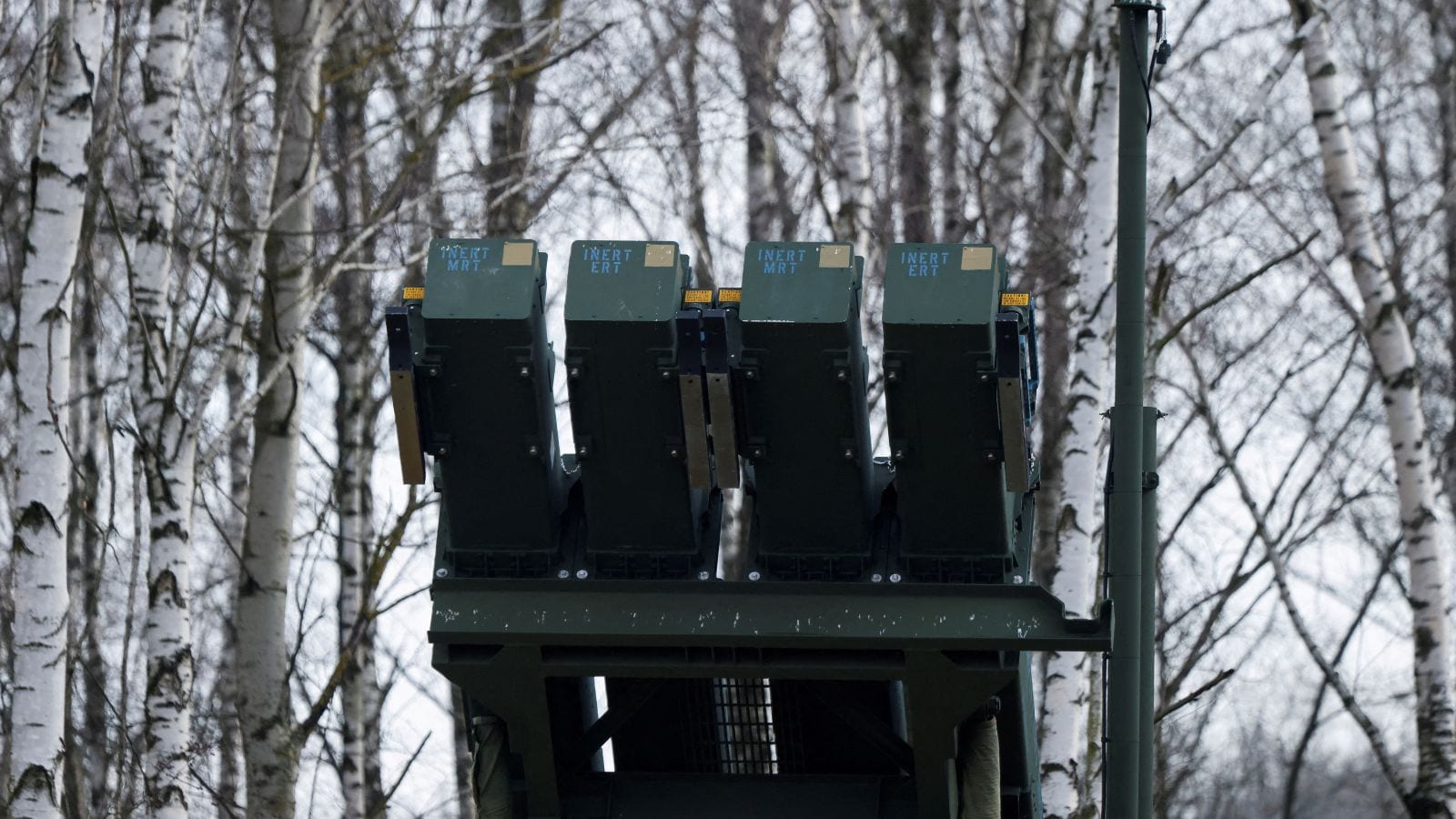
When headlines announce a multi-billion-dollar arms sale, public attention naturally gravitates toward the flashiest hardware—the sleek white canisters tilted at forty-five degrees against the horizon, roaring to life in pillars of orange flame.
Look closer at the breakdown of this $2.1 billion package, and you discover a quieter, less glamorous truth. A massive portion of that money is not buying brand-new batteries. It is buying survival for the systems already in the dirt.
War chews through machinery with terrifying appetite. Radar arrays that run twenty-four hours a day, scanning the horizon for threats traveling at Mach 5, suffer relentless thermal and mechanical stress. Hydraulic launchers get battered by freezing mud, blast overpressure, and shrapnel. Cables fray. Software requires constant updates to counter new electronic warfare jamming techniques deployed by Russian engineers who are learning and adapting in real time.
A Patriot system without spare parts, diagnostic equipment, and specialized field maintenance is just an extraordinarily expensive collection of scrap metal parked in a treeline.
By approving a package heavily weighted toward sustainment, replacement missiles, and logistical support, Washington is acknowledging a reality that armchair strategists frequently overlook: modern warfare is an endurance sport won in repair depots and shipping containers. Keeping an existing shield operational requires an invisible river of components flowing continuously from factories in Arkansas, Massachusetts, and Texas across the Atlantic, through logistics hubs in Poland, and onto muddy roads leading east.
The Weight of the Console
Inside the Engagement Control Station—the armored, windowless command trailer where a Patriot battery’s crew actually fights the battle—there is no cinematic glory.
The room smells of stale coffee, ozone, and human sweat. The only light comes from the greenish-amber glow of radar screens. Three operators sit shoulder to shoulder, strapped into seats, watching symbols crawl across a digital map.
I have spoken with air defenders who describe the psychological toll of that room in terms that rarely make it into official military histories. When a cluster of red icons appears on the glass, moving at speeds that compress decision-making into fractions of a second, the weight inside that trailer becomes suffocating.
The system can run in automated modes, calculating trajectories and firing solutions faster than the human brain can consciously register a threat. Yet a human being still sits at the console, authorizing the engagement, knowing that a software glitch, a jammed radar link, or an empty launcher tube means thousands of pounds of high explosive will slam into a residential neighborhood sixty seconds later.
And there is another terror haunting those operators: rationing.
Imagine sitting in front of that glowing screen, watching ten incoming targets streak toward a major city, and knowing you only have six interceptors left in your canisters because the next resupply convoy is still three days away. Which targets do you let through? Do you protect the power grid that keeps a million people warm, or the military airfield that keeps your own jets flying?
That is the moral nightmare behind ammunition shortages. Every delayed shipment forces young men and women in dark trailers to play God with inadequate math.
The History We Keep Forgetting
If this tension between the cost of defense and the price of inaction feels familiar, it should. History rarely repeats itself verbatim, yet it insists on rhyming with uncomfortable precision.
In the autumn of 1940, as the Luftwaffe pounded London night after night during the Blitz, British Prime Minister Winston Churchill faced a bleak arithmetic of his own. Britain was running out of cash, out of destroyers, and out of anti-aircraft shells. Across the Atlantic, plenty of voices argued that sending vast quantities of American military hardware across an ocean to prop up a beleaguered ally was an unsustainable drain on domestic stockpiles—a dangerous entanglement that could never keep pace with German industrial output.
President Franklin D. Roosevelt understood something that critics missed: you do not measure the cost of a shield against the price of the steel used to forge it. You measure it against the cost of letting the house burn down.
The Lend-Lease Act changed the trajectory of the twentieth century not because it was cheap, but because it turned American industrial capacity into an operational reality on the front lines before it was too late.
Today, the dynamic plays out under a different sky with vastly more sophisticated technology, yet the underlying strategic logic remains identical. Russia’s military doctrine relies heavily on the weaponization of exhaustion. By launching waves of cheap, Iranian-designed Shahed drones alongside ballistic missiles, Moscow attempts to force Ukraine to burn through multi-million-dollar Western interceptors on targets worth a fraction of the cost—a deliberate strategy to bankrupt the sky.
Approving a $2.1 billion sale is Washington’s answer to that attrition strategy. It signals to both Kyiv and Moscow that the shield will not simply be allowed to run dry.
The Doubts Nobody Likes to Voice
Honesty demands acknowledging the uncomfortable questions that hang over every major defense announcement. Pretending this is simple or clean does a disservice to everyone paying for it—both the taxpayers funding the arsenals and the citizens living beneath them.
First, there is the sheer strain on global manufacturing. You cannot simply flip a switch and double the output of PAC-3 interceptors overnight. These weapons require specialized propellants, precision-machined seekers, and rare electronic components. Every missile earmarked for Ukraine enters a fierce global queue alongside orders from allies in the Indo-Pacific and the Middle East, all watching the skies over Eastern Europe and quietly recalculating their own vulnerability.
Second, approval is not delivery. A Foreign Military Sale authorization clears the diplomatic and legal hurdles, allowing contracts to be signed and production slots to be reserved. Yet between a signature in Washington and a canister arriving at a firing position outside Kharkiv or Odesa lies a maze of manufacturing timelines, shipping schedules, and political friction.
And finally, there is the sobering truth that air defense, by its very nature, can never win a war on its own.
A goalkeeper can make twenty miraculous saves in a single match, diving into the mud, bruising ribs, tipping shots off the crossbar. Even so, a team that never crosses midfield cannot score. Patriot batteries buy time. They preserve the civilian infrastructure, the economy, and the human lives required for a nation to keep functioning. They stop the bleeding. They do not cure the wound.
What $2.1 Billion Actually Buys
Step back from the spreadsheets and the geopolitical chessboards for a moment, and the picture sharpens into focus.
A $2.1 billion Patriot package buys the continuation of ordinary life in extraordinary circumstances. It buys the hum of a refrigerator in a Kyiv apartment. It buys the steady beep of a heart monitor in a pediatric ward in Dnipro. It buys a barista grinding espresso beans at 8:00 AM on a street corner that would otherwise be buried under shattered glass and pulverized concrete.
Most of all, it buys time—the one resource no factory on earth can manufacture, yet the only one that gives diplomacy, strategy, and human resilience a chance to work.
Tonight, somewhere outside a Ukrainian city, a radar dish will begin its slow, silent rotation against the stars. Inside a darkened trailer, an operator will lean forward, resting tired elbows on a metal console, eyes fixed on the amber glow. Out in the treeline, white canisters will stand tilted toward the black horizon, waiting.
When the sirens begin to wail again, the sky will not be empty.


