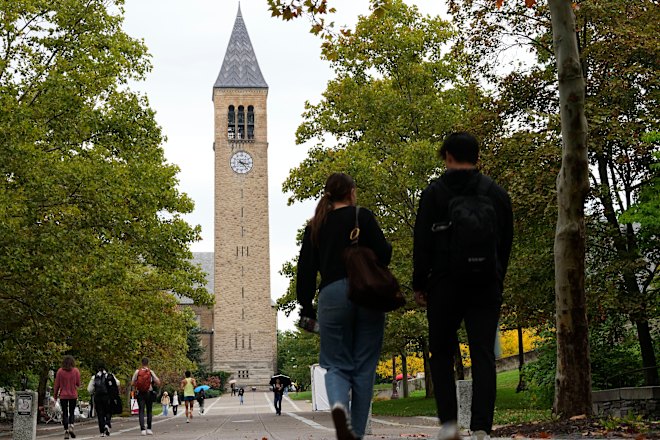
The heavy oak doors of the university boardroom usually smell of old paper, floor wax, and the quiet, permanent weight of institutional history. On a crisp autumn morning in Ithaca, however, the air inside felt different. It tasted like ash.
Martha Pollack sat at the head of that long table, surrounded by the polished brass and leather of academe, thinking about a phone call she had received months earlier. A student had sat across from her office desk, hands trembling around a paper cup of lukewarm chamomile tea, trying to explain why the courtroom experience felt worse than the assault itself. The legal system, with its cold procedural gears and archaic statutes, had ground her down to a statistical footnote.
It is a strange and brutal thing to survive an assault only to discover that the machinery meant to protect you was built for a different century.
When university leaders step outside their ivy-covered quadrangles to demand legislative blood, pay attention. When a sitting university president publicly breaks protocol to take aim at the New York State penal code, the ground beneath our feet is shifting. The demand is simple, sharp, and long overdue: New York needs stronger rape laws. But behind those five words lies a labyrinth of legal loopholes that have allowed perpetrators to walk free for generations, protected by definitions written when rotary phones were state-of-the-art.
Consider what happens in a typical campus courtroom versus a state court. Inside the university disciplinary bubble, investigators look at consent through the lens of modern behavioral science. They understand trauma responses. They know that freezing is not consenting. They understand that a survivor who continues to text her assailant or sits next to him in a lecture hall the next morning is not demonstrating forgiveness; she is demonstrating the ancient, hardwired survival mechanism of appeasement.
Then step outside the gates.
In a New York state courtroom, the prosecutor must often climb an impossibly steep mountain built out of outdated legal constraints. For decades, New York's definition of rape has hinged on proving forcible compulsion—physical resistance or the explicit threat of immediate injury. If a survivor froze, if they were intoxicated to the point of incapacitation without being entirely unconscious, or if the assailant relied on psychological coercion, intimidation, or the sheer power imbalance of an institutional hierarchy, the statutory definition often fractures.
That is not justice. That is a technicality with a high body count.
To understand why this matters so deeply, we have to look past the cold text of the statutes and into the biology of fear. When a predator strikes, the human brain does not consult a legal brief. The amygdala hijacks the nervous system. Rational thought retreats to the basement. Blood rushes to the large muscle groups, preparing for a fight or flight that might spell certain death if executed against a stronger opponent. For many victims, the brain chooses a third evolutionary path: freeze. The limbs go heavy. The voice locks in the throat. You lie there, fully conscious, watching the ceiling tiles, while your body betrays you by playing dead.
Try explaining that to a jury when the defense attorney stands up and asks, Why didn't you scream? Why didn't you kick? Why did you walk with him to his car?
The questions themselves are acts of violence. They weaponize the very survival mechanisms that kept the victim alive against the person who deployed them.
This is the gap Cornell’s administration and a coalition of legal advocates are trying to bridge. They are looking at states like California and Connecticut, where penal codes have evolved to recognize that non-consent is the core violation, not the presence of bruises. They are arguing for laws that explicitly account for incapacitation, abuse of authority, and the modern realities of psychological coercion.
Change does not happen in a vacuum. It is dragged into the light by people who are tired of comforting grieving parents and counseling traumatized students who ask the ultimate, damning question: What is the point of reporting it if nothing happens to them?
The opposition to these legal upgrades usually hides behind procedural conservatism. Critics whisper about the potential for false accusations, as if the current system’s staggering rates of attrition and underreporting are somehow a preferable safeguard. They worry about the burden of proof, forgetting that the burden has always rested heaviest on the shoulders of the person whose life was upended.
Let us be entirely honest about what is at stake here. This is not about rewriting history or punishing awkward social encounters. This is about drawing a bright, unyielding line around bodily autonomy. It is about acknowledging that a person’s silence under duress is not an invitation. It is a scream that no one around them is trained to hear.
When a university president risks her political capital to lobby lawmakers in Albany, she is carrying the weight of every student who ever sat in her office holding a cold cup of tea. She is speaking for the ones who packed their bags in the middle of the night, abandoning their majors, their scholarships, and their dreams because the campus felt less like a place of learning and more like a crime scene with a view of the gorge.
The legal machinery in New York is slow, creaking, and stubborn. It resists grease. It fights against overhaul. But the pressure is mounting. Every time a survivor speaks, every time an administrator refuses to sweep an incident under the rug, every time a journalist or an essayist drags these uncomfortable truths out into the daylight, the gears turn just a fraction of an inch further.
We are living through a quiet reckoning. The old ways of silence, shame, and institutional protection are rotting from the inside out. They are being replaced, slowly and painfully, by a demand for absolute accountability.
The doors of the boardroom in Ithaca eventually closed that afternoon, the meeting adjourned, the papers gathered up and filed away. But outside, down on the slope where the leaves were turning brilliant shades of amber and gold, students walked past the old stone libraries, carrying futures that are still waiting for the law to catch up to reality.


