Silence.
That is the first thing you notice when a maritime corridor goes dark. Not an explosion, not a siren wailing across the harbor, and certainly not the cinematic rumble of engines tearing through the upper atmosphere. Just an abrupt, bureaucratic vacuum where commercial airliners used to hum.
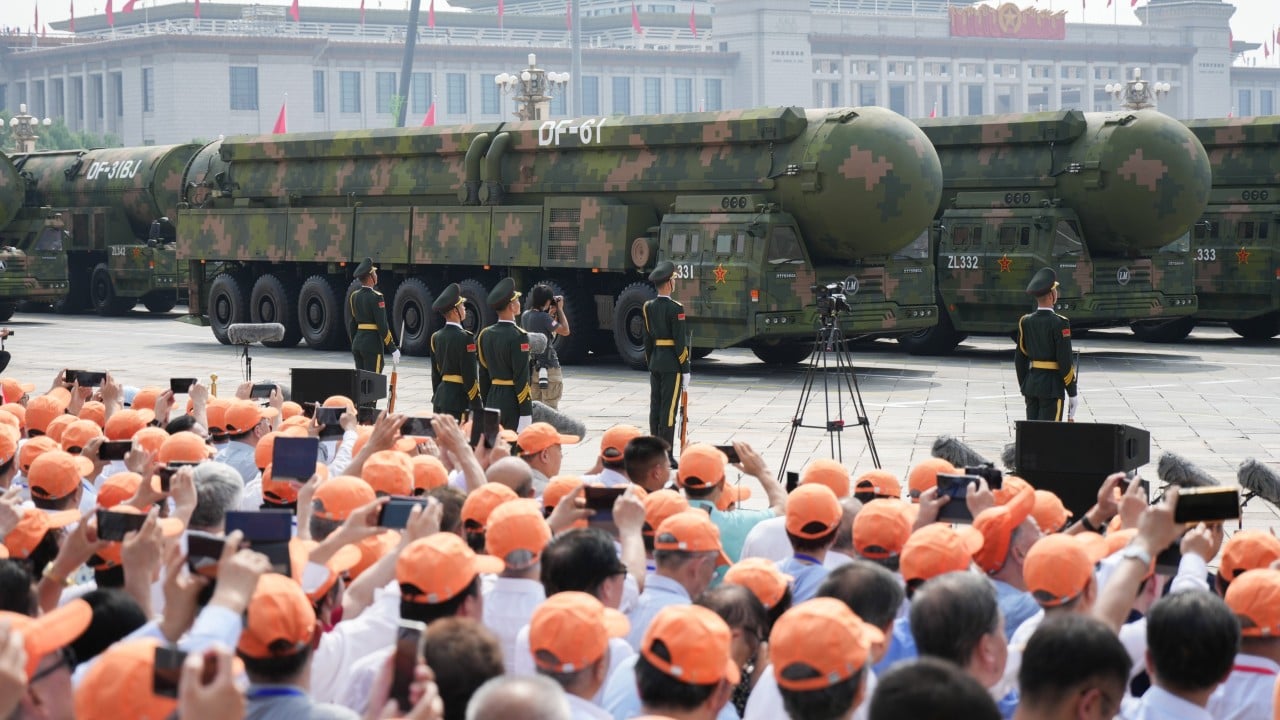
To understand what happens when Beijing quietly closes a slice of the sky while rolling its largest nuclear-capable hardware onto the parade grounds of the capital, you have to stop looking at the steel and start looking at the coordinates. Picture a fictional cargo pilot—let’s call him Captain Miller—flying a routine red-eye freighter route across the Western Pacific at three in the morning. His cockpit is bathed in the familiar amber glow of avionics, the autopilot tracking a highway in the sky that thousands of planes have flown without incident for decades. Then, his dispatcher routes a mandatory Notice to Air Missions, a NOTAM, to his screen. A polygon of ocean, hundreds of miles long and dozens of miles wide, has been declared off-limits for a four-hour window.
Miller doesn’t see a missile. He doesn’t hear a warning shot. He simply banks his aircraft twenty degrees to the south, burning an extra four tons of jet fuel to skirt an invisible box drawn over international waters.
That box is the real story.
In the autumn of 2024, when China’s Rocket Force launched a dummy-warhead intercontinental ballistic missile into the open waters of the Pacific Ocean—its first such public test in over forty years—the world watched the grainy footage of a white plume rising over a tropical horizon. Months later, as massive transporter-erector-launchers carrying the Dongfeng series—the DF-41s, the DF-31AGs, the hypersonic DF-17s—rolled through tightly choreographed displays alongside fresh aviation hazard zones, military analysts reached for their calipers. They measured the length of the canisters. They debated solid-fuel propellant burn rates. They counted rivets.
They missed the point entirely. When a superpower pairs a public parade of Dongfeng missiles with sudden, surgical flight bans over the South China Sea or the Bohai Strait, it isn't merely testing rocketry. It is editing the map of human movement. It is reminding every fisherman in a wooden trawler, every logistics manager in Rotterdam, and every family sleeping beneath a flight path in Tokyo that the air above them is only open by permission.
The Anatomy of a Shadow
I have spent years tracking the paper trails of modern deterrence, sitting in windowless briefing rooms and poring over aviation telemetry until the lines blur into static. And if there is one thing that experience teaches you, it is that the most terrifying weapons on earth are rarely designed to be fired. They are designed to be believed.
A missile sitting in an underground silo in the deserts of Gansu or the mountains of Shaanxi is an abstraction. To a voter in Ohio or a bond trader in London, an underground silo is a rumor. You cannot photograph a rumor, and you certainly cannot put it on the evening news to send a message to a rival parliament. To turn concrete and uranium into political gravity, you have to bring the hardware into the sunlight.
Enter the Dongfeng—"East Wind"—family of ballistic missiles.
Consider the DF-41, the undisputed heavyweight of China’s road-mobile arsenal. On a parade ground, it looks less like a weapon and more like an industrial bridge resting on sixteen massive tires. Inside that composite tube sits a three-stage, solid-fuel rocket capable of carrying multiple independently targetable reentry vehicles—MIRVs, in the cold shorthand of nuclear strategy. Think of a MIRV not as a single bullet, but as a shotgun shell packed with guided warheads, each one capable of peeling away in the vacuum of space to strike a separate city thousands of miles apart. With an estimated range exceeding twelve thousand kilometers, a DF-41 parked in central China holds virtually every square mile of the continental United States within its mathematical reach.
Then there are its cousins, built for a closer, faster fight. The DF-26, nicknamed the "Guam Express" by defense observers, bridges the gap between conventional precision strikes and nuclear retaliation. It is a dual-capable weapon, meaning an adversary watching it launch on infrared satellites has no way of knowing—until the moment of impact—whether the incoming warhead carries high explosives meant for an aircraft carrier or a thermonuclear device meant to end a war.
That ambiguity is deliberate. It is a psychological trapdoor.
When Beijing parades these systems in crisp formation, with white-gloved troops marching in hypnotic unison beside matte-green launch tubes, the spectacle is aimed inward as much as outward. Domestically, it is a monument to technological self-reliance, proof that a nation once humiliated by foreign gunboats now commands the ultimate high ground. Internationally, it is a visual ledger. It forces intelligence agencies in Washington, New Delhi, and Canberra to update their spreadsheets, shifting defense budgets by billions of dollars just to account for the sheer number of mobile launchers now roaming China’s highway network.
Yet a parade is static. It is theater. To prove the theater has teeth, you need the flight bans.
Lines Drawn in Ink
To understand why aviation hazard zones send tremors through defense ministries long before a single rocket engine ignites, you have to understand how an ICBM actually flies.
Imagine throwing a baseball across a stadium. You don't throw it flat; you arc it high into the rafters so gravity can pull it down toward the catcher’s mitt. An intercontinental ballistic missile does the exact same thing, except the rafters are a thousand kilometers above the Earth, well into the blackness of low-Earth orbit. During the first few minutes of flight—the boost phase—the missile burns furiously to escape the thickness of the lower atmosphere. Once its fuel is spent, the heavy metal stages drop away like spent matches, falling back toward the planet while the warheads coast silently through space at twenty times the speed of sound.
Those discarded rocket stages have to land somewhere.
Because China’s test ranges generally fire from inland bases toward the east or south, those falling metal cylinders plummet toward the busy shipping lanes and air corridors of the Western Pacific. Under international aviation rules, a nation conducting hazardous aerospace activity issues a NOTAM, warning pilots to stay clear of specific drop zones.
When open-source researchers—often ordinary civilians armed with nothing more than a laptop, public aviation databases, and an obsessive eye for geometry—spot two or three rectangular hazard zones aligned along a straight azimuth stretching from an inland launch site out toward the sea, the alarms go off. You don't need top-secret satellite clearance to connect those dots. Draw a line through the boxes, measure the distance from the suspected launch pad to the first drop zone, and you can calculate the exact trajectory, angle, and probable class of the missile before it ever leaves the ground.
I remember the first time I watched an analyst map one of these closures in real time. There was no dramatic music, just the quiet click of a mouse as red polygons bloomed across a digital map of the East China Sea. Looking at those glowing red rectangles, I felt a sudden, sharp tightness in my chest—the realization that the modern world’s fragility isn't hidden in bunkers. It is painted right onto the navigation charts we use to deliver mail, medicine, and tourists across the ocean.
We like to think of globalization as an unstoppable tide, a web of fiber-optic cables and container ships that binds nations together too tightly for war to make sense. Those flight bans tell a different story. They show how effortlessly a sovereign state can reach up into the global commons and carve out a private firing range, forcing the rest of the world to detour around its ambitions.
The Logic of the Unthinkable
Why now? Why display the crown jewels of the Rocket Force while simultaneously hinting at live-fire tests that rattle regional neighbors?
To answer that, we have to confront a reality that makes most of us deeply uncomfortable, even if we rarely admit it over morning coffee: the quiet, thirty-year vacation from nuclear anxiety is over.
For a generation after the collapse of the Soviet Union, strategic deterrence faded into the background noise of history. The United States and Russia slowly dismantled thousands of warheads under arms-control treaties, while China maintained what strategists called a "minimum deterrent"—a relatively small arsenal of a few hundred warheads, kept off hair-trigger alert, intended solely to ensure that no one could ever nuclear-blackmail Beijing without risking a devastating counterstrike.
That era has vanished.
According to Pentagon assessments and independent arms-control monitors, China has embarked on the most rapid expansion and modernization of its nuclear forces in history, building hundreds of new missile silos in its northern deserts and fielding a growing fleet of road-mobile launchers and ballistic-missile submarines. By the end of this decade, analysts project Beijing could field over a thousand operational warheads.
From Beijing’s perspective, this buildup is not aggression; it is insurance. Chinese strategists look at American missile defense interceptors stationed in Alaska, California, South Korea, and Japan, and they see a shield designed to neutralize China’s ability to retaliate. They look at long-range conventional strike weapons being deployed across the First Island Chain, and they worry that a regional conflict over Taiwan could escalate into an existential threat to the regime itself. To guarantee that their deterrent remains credible—that an adversary’s missile shield can be overwhelmed by sheer numbers—China concluded it needed more missiles, more warheads, and more mobile launchers that cannot be easily hunted from space.
From Washington and Tokyo’s perspective, however, that same insurance policy looks like a loaded gun placed on the negotiating table. When one nation builds up its arsenal in secrecy, refusing to enter bilateral arms-control talks until its stockpile rivals the superpowers, the other side inevitably responds by building newer submarines, upgrading bomber fleets, and hardening bases across the Pacific.
This is the classic security dilemma, played out at Mach 20. Every step taken by one side to feel safer makes the other side feel more vulnerable, trapping both in an upward spiral where no one wants a war, yet everyone prepares for one with terrifying efficiency.
The Human Cost of Calibration
It is easy to get lost in the acronyms—ICBM, MIRV, NOTAM, TEL—because technical jargon acts as an emotional anesthetic. It turns instruments of mass extinction into engineering problems.
Let’s strip away the anesthetic for a moment.
Consider a hypothetical scenario—a routine night shift at an air-traffic control center in Manila or Taipei during one of these heightened alert windows. On the radar screens, hundreds of green blips represent real people: a nurse flying home to Cebu after a two-year contract in Dubai, a software engineer nodding off over a spreadsheet on her way to Seoul, a crate of temperature-sensitive insulin bound for a clinic in Okinawa.
When military flight bans abruptly close established airways, those hundreds of blips must be squeezed into narrower corridors. Controllers work overtime, their voices tight over the radio as they space aircraft closer together than usual, burning through margins of safety that were written in the blood of past aviation disasters. Meanwhile, thousands of feet below, naval destroyers from three different nations shadow the closure zones, their radar operators staring at glowing screens in darkened combat information centers, trying to distinguish a routine telemetry test from the opening salvo of a crisis.
In those darkened rooms, human beings—often twenty-two-year-old enlisted sailors running on stale coffee and four hours of sleep—are asked to interpret ambiguous signals in seconds.
History teaches us that nuclear crises rarely begin with a villainous mastermind pressing a red button out of malice. They begin with miscalculation. They begin with a corrupted radar return, a misunderstood military exercise, or a flight ban that coincides with a political crisis at the exact wrong moment. In 1983, a Soviet air-defense officer named Stanislav Petrov stared at a computer screen claiming five American Minuteman missiles were inbound, and only his gut instinct that a real first strike wouldn't consist of just five rockets prevented him from triggering a protocol that could have ended human civilization.
The more missiles we put on the road, the more silos we dig into the desert, and the more frequently we close the skies to test them, the more times we force fallible human beings to play that same high-stakes guessing game.
What the Display Really Measures
Walk back onto the parade ground in your mind for a second. Look again at those massive, multi-wheeled vehicles rolling past the viewing stands, the sunlight glinting off freshly painted olive-drab steel.
The public spectacle is meant to project absolute control. Every boot hits the asphalt at the exact same millisecond. Every missile canister is aligned to the millimeter. Every airspace closure is calculated down to the arc-second of latitude and longitude. The message from Beijing is unmistakable: We have mastered the physics, we have mastered the logistics, and we are no longer content to live under anyone else’s shadow.
Yet there is a profound paradox buried inside every display of overwhelming force. The more sophisticated and destructive these weapons become, the less usable they actually are. A hypersonic glide vehicle or a multi-warhead ICBM cannot fix a slowing domestic economy. It cannot solve a demographic crisis, cool a warming ocean, or win the genuine trust of neighboring nations who watch those flight bans appear on their maps with growing unease.
Instead, these displays create a strange, brittle equilibrium. We live beneath an invisible architecture of deterrence—lines of trajectory calculated in supercomputers, hazard boxes drawn over open water, submarines gliding silently through the abyssal plains of the Pacific, all calibrated to ensure that the weapons on the parade ground never leave their tubes in anger.
The next time a headline flashes across your phone about a sudden flight ban over the Pacific or a fresh column of Dongfeng missiles rolling through Beijing, resist the urge to scroll past it as just another piece of distant geopolitical noise. Look up at the contrail of a passing airliner fading into the afternoon blue.
That clear, uninterrupted stretch of sky is not the natural state of human affairs. It is a fragile truce, negotiated hour by hour, coordinate by coordinate, in the quiet spaces between the launches.


