You rinse the greens under the cold tap, watching the droplets bead and scatter across the fragile leaves of romaine. It feels like an act of care. You are washing away the grit of the earth, preparing a simple meal for the people who sit across the kitchen table from you. But the water is a lie. It cannot wash away what you cannot see.
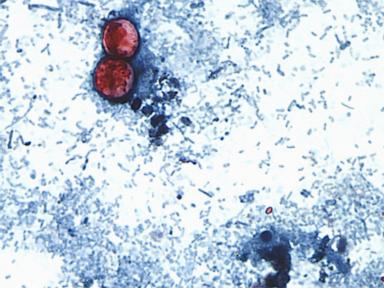
Across the country, a quiet sickness begins to stir in thousands of stomachs. It arrives without a sound. No alarms ring out from the fields where the crops were harvested. No warning labels flash on the plastic clamshells stacked neatly in the refrigerated aisle. It is a microscopic hitchhiker, a parasite named Cyclospora, and it thrives in the blind spots of our global pantry.
To understand how it reaches your kitchen, we have to look past the grocery store lights and travel thousands of miles away, past the border, down to the sun-baked valleys of foreign agriculture where your winter raspberries, cilantro, and salad mixes are born.
Consider a hypothetical worker named Mateo. For twelve hours a day, Mateo harvests produce under a blistering sky. His hands are fast, practiced, and exhausted. The fields stretch out to the horizon, an ocean of green destined for northern tables. But water is scarce here. The irrigation canals flow near livestock pastures, picking up invisible, resilient spores of microscopic parasites. When that water touches the crops, it leaves behind a silent passenger.
Once upon a time, someone might have caught this before the produce crossed an international boundary.
That someone was an inspector from the Food and Drug Administration.
For decades, these foreign inspections acted as a vital firewall. Federal officials would board planes, travel to remote processing plants in foreign countries, and walk the concrete floors of packing houses. They tested water sources, swabbed equipment, and audited sanitation logs. They were the invisible shield standing between a contaminated field abroad and your Tuesday night dinner.
Then, the shield began to crumble.
Years before the inevitable outbreak headlines flashed across evening news broadcasts, a slow bureaucratic withdrawal took place. Foreign inspections plummeted. Funding tightened, travel restrictions locked doors, and diplomatic hurdles piled high. The inspectors stayed home.
Imagine a bridge with a hundred wooden planks, and every year, inspectors remove five of them to save money. For a long time, nothing happens. Carts still cross. People still walk. The bridge feels sturdy. Then, a heavy load arrives, exactly over the missing timber.
That is what happened to our food safety infrastructure.
When the FDA pulled back its boots-on-the-ground presence overseas, foreign farms operated under a much lighter touch of accountability. Without federal oversight whispering urgency into foreign supply chains, safety protocols drifted. Water testing became sporadic. Hygiene training grew lax. The invisible bridge had too many missing planks.
By the time the Cyclospora outbreaks spiked, public health officials were left playing a desperate game of epidemiological detective work. They traced back packets of pre-washed salad greens, interviewing sick patients about every bite they took weeks prior. They mapped genomic sequences of parasites, trying to connect a hospital bed in Ohio to a washing vat in a foreign province.
It is a terrifyingly reactive way to live. We do not stop the poison at the gate; we count the casualties after the feast.
The human cost of this regulatory retreat is measured in lost weeks, relentless nausea, exhaustion that anchors you to the mattress, and, for the elderly or immunocompromised, dangerous dehydration. Yet, the grocery stores remain full. The bright packaging reassures us that everything is fresh, natural, and wholesome.
We place immense trust in our food supply, treating it like a law of nature rather than a fragile, human-engineered miracle of logistics. When you bite into a fresh salad, you are participating in a massive trust fall involving millions of strangers across multiple continents.
When the unseen hands that verify that trust step back, the fall becomes a drop into the dark.
We talk endlessly about health trends, superfoods, and organic certifications, obsessing over the micro-details of our diets while ignoring the macro-system holding it all together. No amount of organic labeling protects you if the irrigation water at the source is tainted and no federal eye is there to check it.
The greens sit on your plate, vibrant and crisp. The kitchen window catches the fading afternoon light. You lift your fork, entirely unaware of the invisible history resting on the tines, waiting for a system that used to watch over us to finally wake up.