Darkness beneath the waves is not empty. It is heavy, cold, and absolute.
Imagine standing in the middle of an open ocean, thousands of miles from the nearest coastline, with no sun overhead, no stars to guide you, and no landmarks to anchor your sense of direction. For most of human history, sailors relied on wooden instruments, the positions of constellations, and fragile magnetic needles to keep from vanishing off the edge of the known world. Yet, long before human hands ever carved a compass rose, creatures were swimming through the abyssal blue with a map written directly into their biology.
Marine biologists call them bonnethead sharks. Small, unassuming, and often overlooked cousins of larger apex predators, these coastal dwellers spend their lives navigating complex, shifting marine environments. But for decades, science missed the most profound thing about them. They do not just swim. They read the planet itself.
To understand why this matters, we have to look back at how we used to think about marine life. For a long time, humanity viewed fish and sharks as reactive automatons. They eat, they swim, they breed, driven by raw instinct rather than cognitive mapping. When a bonnethead shark undertakes a seasonal migration across hundreds of miles of open water, returning precisely to the same coastal estuary year after year, textbooks attributed it to simple scent tracking or memory of water temperature.
Water changes. Currents shift. Scent plumes disperse into nothingness. Temperature gradients blur under the relentless churn of global weather patterns. None of these variables are stable enough to explain how a creature measuring just a few feet long can cross an ocean highway and never lose its way.
The answer required a shift in perspective.
(Note: In the following hypothetical scenario, based on the actual 2021 study led by marine scientists at Florida State University, we step into the mind of a researcher watching a bonnethead in a controlled laboratory setting.)
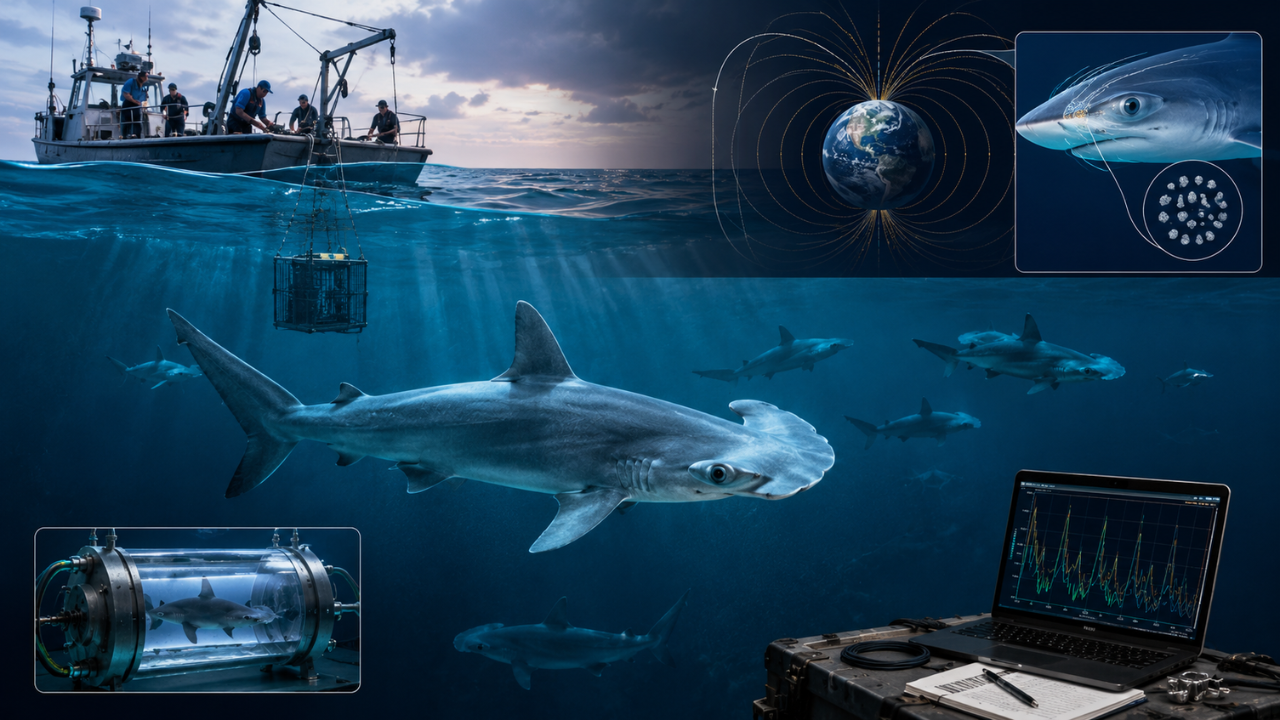
Picture a dimly lit circular tank, shielded from the chaotic electromagnetic noise of the modern world. Inside swims a single bonnethead shark. Above the tank, a specialized coil system generates a localized magnetic field. To human eyes, the water looks identical. Nothing has changed. But to the shark, the invisible architecture of the world has just been shifted thousands of miles off course.
When the researchers altered the magnetic field to simulate a location far away from the shark's home, the animal's behavior instantly transformed. It did not wander aimlessly. It turned with purposeful, deliberate intent, attempting to orient itself toward home based entirely on invisible magnetic cues. It was using a compass it could neither see nor turn off.
The proof was finally captured. Bonnethead sharks use Earth's magnetic field to navigate.
Why does this discovery shake our understanding of the natural world? Because it forces us to confront the limits of our own perception. Humans are visually dominant creatures. If we cannot see it, touch it, or measure it with a digital screen, we struggle to believe it exists. We build massive cargo ships packed with satellite navigation, radar arrays, and gyroscopic compasses, marveling at our technological superiority.
Meanwhile, a small shark with shovel-shaped head contours glides through the dark, tuning its internal nervous system to the geomagnetic pulse of a molten iron core buried thousands of miles beneath its fins.
The stakes of this realization extend far beyond marine biology. Our oceans are changing at a breathless pace. Industrial noise, submarine communication cables, and shifting climate conditions introduce unprecedented electromagnetic interference into marine ecosystems. If migratory species rely on an invisible planetary grid to find feeding grounds, breeding sites, and safe harbors, disruptions to that grid could spell quiet catastrophe for populations that have survived for millions of years.
We are only beginning to comprehend the invisible threads that hold the biosphere together. Every time science peels back another layer of animal behavior, we discover that the natural world is infinitely more sophisticated, sensitive, and interconnected than we ever dared to imagine.
The bonnethead shark does not need a map. It carries the history and the geometry of the Earth within its blood and bone. As we look out over the vast, shimmering surface of the sea, it pays to remember that the most important journeys are guided by forces we are only just learning how to see.