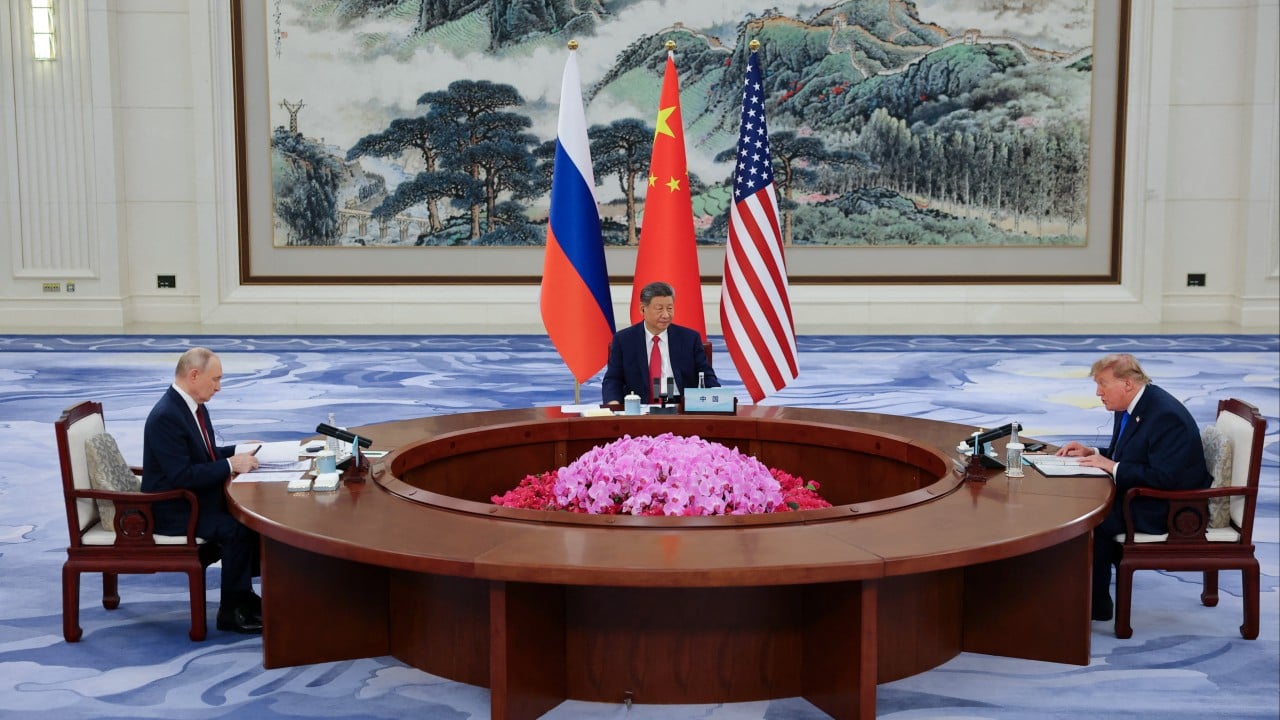
A three-way summit between Xi Jinping, Donald Trump, and Vladimir Putin breaks decades of diplomatic orthodoxy because it bypasses traditional multilateral institutions in favor of direct, transactional power brokerage. For the first time since the Yalta Conference of 1945, the leaders of the world's three most consequential military and economic powers are sitting at the same table without allies, mediators, or institutional guardrails.
The premise is simple. Washington, Beijing, and Moscow are testing whether bilateral friction can be managed through a direct three-party mechanism rather than proxy conflicts, sanctions regimes, and alliance blocs.
Yet the surface optics of a historic handshake obscure the brutal mechanics underneath. When three leaders who view international relations through the lens of zero-sum leverage gather in one room, the outcome is rarely a permanent peace. It is a division of spheres, a recalibration of trade tariffs, and a quiet sidelining of smaller nations whose security depends on the old rules-based order.
The Architecture of a Three-Way Bargain
Diplomacy at this level does not run on goodwill. It runs on asymmetric pressure.
To understand why a Xi-Trump-Putin trilateral is happening now, you have to look at what each leader lacks at home and abroad. None of the three is operating from a position of absolute, unchallenged strength, and each needs something the other two control.
For Washington, the primary driver is economic decoupling and strategic bandwidth. The White House has spent years trying to extricate American supply chains from Chinese manufacturing while simultaneously funding European security commitments. Sitting down with both Xi and Putin offers a shortcut: trade tariff relief and market access for American agriculture and energy in exchange for Beijing and Moscow dialing back coordinated economic resistance. Trump has consistently favored leader-to-leader dealmaking over sprawling diplomatic summits like the G20, operating on the belief that personal rapport can unlock concessions that career diplomats spend decades stalling over.
Beijing enters the room with a different set of calculations. China's export-driven economy faces mounting structural headwinds, from demographic contraction to real estate debt and tightening Western tech restrictions. Xi Jinping needs predictable access to American and European consumer markets, as well as a pause in semiconductor export controls. At the same time, Beijing cannot afford a collapsed or erratic Russia on its northern border. By participating in a trilateral format, Xi positions China not as a junior partner to Moscow or an adversary to Washington, but as the indispensable central pillar of global stability.
Moscow's calculus is the most immediate. Years of Western financial sanctions, energy price caps, and protracted military expenditure have strained the Russian economy, forcing deep reliance on Chinese industrial goods and discounted energy sales to Asia. A direct seat alongside Washington and Beijing instantly shatters any diplomatic isolation narrative. For Putin, the summit itself is a strategic victory before a single document is signed, validating Russia's status as a co-equal pole in a multipolar world.
The Mechanics of Asymmetric Leverage
| Actor | Primary Concession Sought | Core Bargaining Chip | Domestic Vulnerability |
|---|---|---|---|
| United States | Tariff reciprocity, fentanyl precursor controls, European security burden-sharing | Access to US consumer markets, dollar liquidity, sanctions relief | Inflationary pressure from tariffs, fiscal debt ceiling constraints |
| China | Relaxation of semiconductor export controls, tariff reductions | Control over rare earth processing, green tech supply chains, diplomatic sway over Moscow | Slowing GDP growth, youth unemployment, local government debt |
| Russia | Sanctions relief, recognition of regional security perimeters, energy market access | Arctic shipping routes, nuclear arms control treaties, raw commodities | Industrial labor shortages, high interest rates, over-reliance on Beijing |
Each party brings a distinct form of coercion to the table. Washington holds the keys to the global financial clearing system and the world's largest consumer market. Beijing controls the midstream processing of critical minerals required for everything from electric vehicles to fighter jets. Moscow holds vast reserves of cheap energy, grain, and the world's largest nuclear arsenal.
When these three assets are placed in direct negotiation, traditional alliances lose their veto power. Brussels, Tokyo, and Seoul are left watching from the outside, acutely aware that their core security interests are being discussed without their presence.
Why Traditional Alliances Are Nervous
The historical precedent for great-power trilaterals is not encouraging for mid-sized nations.
In February 1945, Franklin D. Roosevelt, Winston Churchill, and Joseph Stalin met at Yalta to determine the postwar architecture of Europe and Asia. While the conference established the framework for the United Nations, it also effectively partitioned Eastern Europe into spheres of influence without the consent of the nations living there. Decades later, in 1972, Richard Nixon's opening to Mao Zedong fundamentally altered the Cold War balance, catching both Moscow and Washington's Asian allies completely off guard.
A modern Xi-Trump-Putin summit carries similar structural risks for the post-1945 alliance network.
European capitals have long relied on the assumption that Washington and Beijing would remain locked in systemic competition, keeping American military and economic focus tethered to transatlantic defense. If Washington strikes a grand bargain that lowers bilateral tensions with Moscow and Beijing simultaneously, European leaders fear they will be left holding the bill for continental defense with diminished American backing.
In the Indo-Pacific, the anxiety is even sharper. Japan, South Korea, the Philippines, and Taiwan rely on American deterrence to counterbalance Beijing's territorial claims in the East and South China Seas. A transactional deal that trades tariff concessions or commercial contracts for a temporary cooling of tensions could leave regional allies questioning the durability of American security guarantees.
The Problem With Leader-Centric Diplomacy
Personal chemistry between strongmen can break bureaucratic deadlocks, but it also creates massive execution gaps.
When agreements are hammered out behind closed doors by three executives rather than vetted through interagency channels, the resulting terms are often vague, unwritten, or subject to wildly different interpretations the moment the cameras turn off.
Consider a hypothetical scenario involving trade and sanctions relief. Suppose Washington agrees to suspend a specific tier of industrial tariffs in exchange for Beijing restricting dual-use component exports to Russian defense contractors, while Moscow agrees to freeze force deployments along a contested border. Within weeks, disputes emerge over what constitutes a "dual-use component" or what qualifies as a "defensive rotation" versus a "force deployment." Without a permanent, transparent verification secretariat—the exact kind of multilateral bureaucracy all three leaders routinely disparage—the agreement begins to fray almost immediately.
History shows that great-power handshakes without institutional enforcement mechanisms tend to have short half-lives. The 1972 Shanghai Communiqué worked only because it was followed by seven years of grueling, granular diplomatic normalization led by career specialists. Without that follow-through, summit breakthroughs quickly revert to baseline hostility.
The Economic Subtext Nobody Is Talking About
Geopolitical analysts love to focus on maps, missiles, and treaties. The real driver behind this trilateral is balance sheets.
All three economies are navigating a painful transition away from the hyper-globalized model of the early 2000s. Cheap capital is gone. Supply chains are fragmenting along political lines, driving up manufacturing costs and keeping baseline inflation stubbornly high across Western economies.
For the United States, maintaining an aggressive trade war with China while simultaneously enforcing secondary sanctions on countries that buy Russian oil creates a self-inflicted economic drag. Every tariff on Chinese intermediate goods raises input costs for American factories. Every sanction on Russian energy tightens global supply and risks spiking fuel prices ahead of domestic election cycles. A trilateral framework allows Washington to selectively dial back economic friction where it hurts American consumers most, framing the move not as a retreat, but as a hard-nosed business deal.
China faces an even steeper math problem. For twenty years, Beijing absorbed domestic overcapacity by exporting manufactured goods to the West. Today, Western markets are throwing up tariff walls against Chinese electric vehicles, solar panels, and steel. Meanwhile, Russia—despite booming bilateral trade—has an economy roughly the size of Texas and cannot absorb the volume of high-end industrial goods China needs to sell. Xi Jinping needs a truce with Washington to keep Chinese factories humming while Beijing attempts to stimulate domestic consumption.
Russia, for its part, is paying a heavy price for its pivot east. Selling crude oil and natural gas to China and India at steep discounts keeps cash flowing into the Kremlin's coffers, but it deprives Moscow of the high-margin European energy contracts that funded its state budget for decades. Furthermore, paying for imports in Chinese yuan leaves Russian banks vulnerable to secondary sanctions whenever Chinese financial institutions decide that preserving access to the US dollar system outweighs their loyalty to Moscow.
Currency, Debt, and the Dollar Question
One of the most sensitive topics behind closed doors is the future of cross-border payment systems.
Over the past several years, Moscow and Beijing have aggressively expanded local-currency trade settlement, bypassing the SWIFT financial messaging network and reducing their reliance on the US dollar. Washington views any coordinated effort to build an alternative reserve currency or payment rail—particularly through expanded BRICS financial mechanisms—as a direct threat to American economic sovereignty.
Trump has repeatedly threatened punitive tariffs against nations that actively seek to dethrone the dollar as the world's primary reserve currency. In a trilateral setting, Washington has the leverage to demand a pause on overt de-dollarization initiatives in exchange for easing financial restrictions on specific commercial banks.
Whether Beijing and Moscow would actually halt their long-term efforts to sanction-proof their economies is another matter entirely. Both capitals have watched how effectively Washington weaponized dollar clearing against Russian central bank reserves. Even if they sign a temporary truce on currency rhetoric, the underlying quiet construction of alternative clearing networks will almost certainly continue in the background.
Nuclear Stability and the End of Old Treaties
Beneath the trade numbers and territorial disputes sits the most urgent issue on the table: strategic nuclear stability.
The Cold War arms control architecture is virtually dead. The Intermediate-Range Nuclear Forces (INF) Treaty collapsed in 2019. The New START treaty, the last remaining bilateral limit on American and Russian strategic nuclear warheads, reached its expiration horizon in early 2026 with no formal successor in place.
At the same time, China is rapidly expanding and modernizing its nuclear arsenal. Pentagon assessments project that Beijing is on track to field more than 1,000 operational nuclear warheads by 2030, moving away from its decades-old posture of "minimum deterrence" toward a full nuclear triad capable of matching American and Russian capabilities.
Washington has long argued that any future nuclear arms control treaty must be trilateral, binding China alongside Russia and the United States. Beijing has historically refused, pointing out that its arsenal remains a fraction of the size of Washington's or Moscow's, and demanding that the two superpowers make deep cuts before China enters negotiations.
Putting Xi, Trump, and Putin in the same room creates the only venue where a three-way strategic stability dialogue can actually begin. Even if a formal treaty takes years to draft, establishing basic guardrails—such as mutual notification of ballistic missile launches, limits on space-based anti-satellite weapons, and agreements against integrating artificial intelligence into nuclear command-and-control systems—would mark a massive shift away from an unrestrained three-way arms race.
The AI and Space Wildcards
Modern deterrence is no longer just about warhead counts and throw-weights. It is about orbital dominance and algorithmic decision-making.
Both Washington and Beijing are pouring tens of billions of dollars into military artificial intelligence, autonomous drone swarms, and hypersonic glide vehicles. Meanwhile, low-Earth orbit has become a congested, contested military domain where commercial satellite constellations play a direct role in battlefield communications and targeting.
Traditional diplomats struggle to regulate technologies that evolve faster than treaty ratification cycles. Leaders with broad executive authority can agree to moratoriums on kinetic anti-satellite testing or establish hotlines for orbital deconfliction in a single afternoon. Whether their respective military establishments will abide by broad verbal commitments without intrusive inspection regimes remains one of the sharpest points of skepticism among defense analysts.
The Gray Areas and Hard Realities
It is easy to mistake a dramatic diplomatic gathering for a permanent shift in global alignment. That would be a mistake.
The structural contradictions between the United States, China, and Russia run far deeper than any single summit can resolve. Washington's political system rotates leadership every four to eight years, meaning any executive agreement not ratified by two-thirds of the US Senate can be torn up by the next administration—just as the 2015 Iran nuclear deal and the Paris climate accords were reversed. Both Xi and Putin understand this constitutional reality intimately, which limits how much permanent capital they are willing to invest in purely executive promises.
Similarly, the deep ideological and strategic alignment between Beijing and Moscow is not easily pried apart. While Western commentators often speculate about engineering a "reverse Nixon"—pulling Russia away from China just as Nixon pulled China away from the Soviet Union in the 1970s—the structural math today is completely different. In 1972, China and the Soviet Union were fighting border skirmishes and viewed each other as existential threats. Today, Xi and Putin share a deeply entrenched suspicion of American hegemony and rely on each other's economies to insulate themselves from Western pressure.
Putin is unlikely to abandon his partnership with Beijing for temporary tariff or sanctions relief from a Washington administration whose policies could shift after the next midterm or presidential election. At best, Moscow will pocket whatever concessions it can extract from Washington while keeping its strategic backchannel to Beijing wide open.
What Actually Changes on the Ground
If the summit does not usher in an era of global harmony, what does it actually accomplish?
First, it establishes a high-level circuit breaker. When tensions spike over naval encounters in the South China Sea, airspace interceptions over the Black Sea, or cyber intrusions targeting critical infrastructure, having an active, validated three-way leadership channel prevents miscalculations from spiraling into direct military confrontation.
Second, it accelerates the shift toward a transactional, multipolar world order. Smaller and mid-sized nations—from the Middle East to Southeast Asia and Latin America—will take the trilateral as confirmation that great powers cut deals based on raw national interest rather than ideological solidarity. Expect middle powers like India, Saudi Arabia, Brazil, and Turkey to become even more aggressive in hedging their bets, playing Washington, Beijing, and Moscow against one another to extract maximum economic and military concessions.
Third, it forces a long-overdue reckoning inside Western alliances. For decades, European and Asian allies have enjoyed the security umbrella of American military power while deepening their commercial ties with China and relying on Russian commodities. A world in which Washington negotiates directly with Moscow and Beijing forces every allied capital to accelerate its own defense spending, industrial resilience, and strategic autonomy.
The real takeaway from the Xi-Trump-Putin trilateral is not that the world's three most powerful leaders have suddenly found common ground, but that they have formally abandoned the pretense of playing by the old rules—leaving every other nation on earth to figure out how to survive in a system where the referees have left the field.


