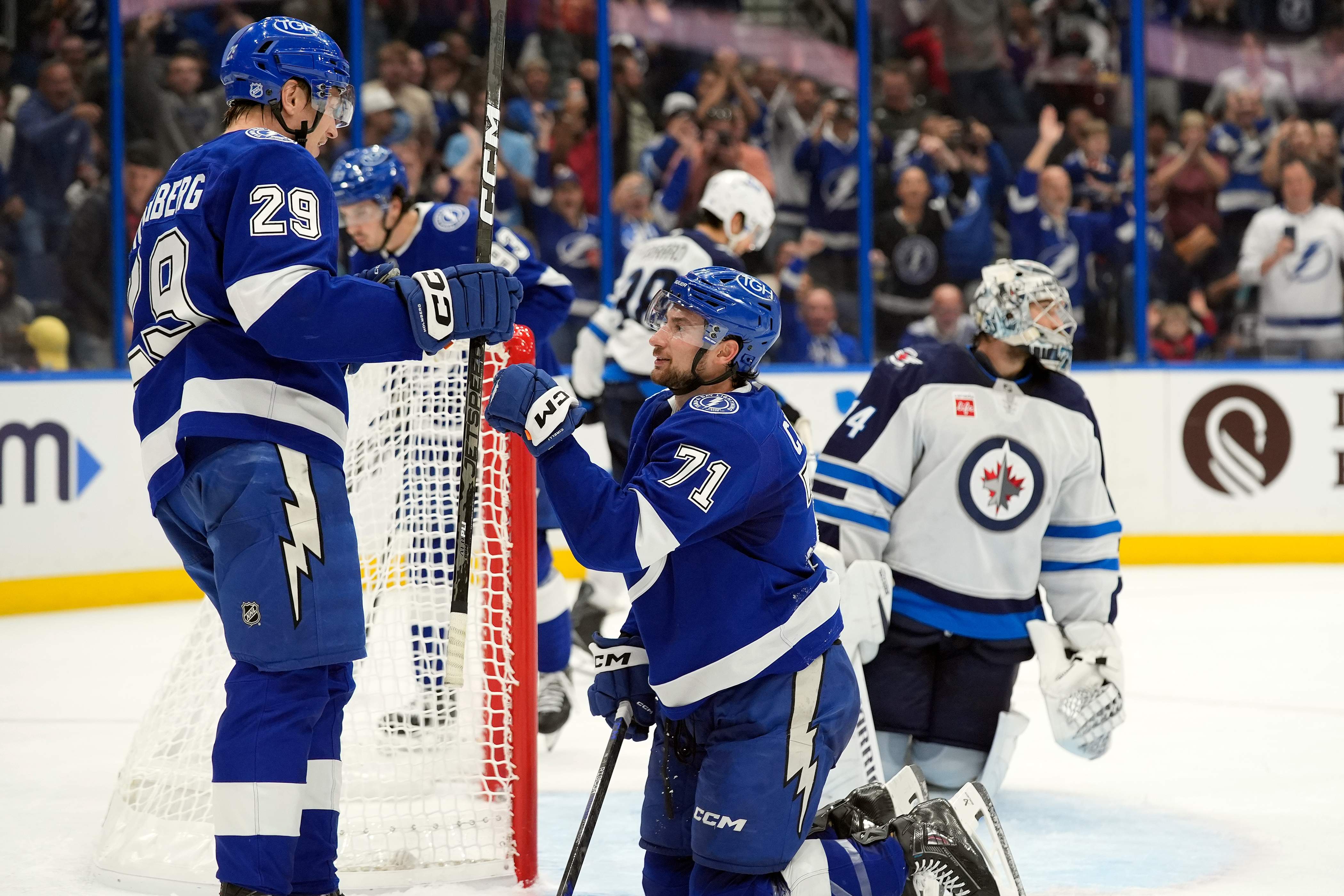
The Winnipeg Jets fell to the Tampa Bay Lightning for their seventh consecutive defeat, exposing systemic defensive breakdowns, predictable offensive zone entries, and an overreliance on elite goaltending that can no longer mask structural flaws. While standard box-score recaps point to bad puck luck or a hot opposing netminder, the reality on the ice tells a far more troubling story about roster construction and tactical rigidity in the modern NHL.
Seven games is not a slump. In an 82-game schedule, a seven-game losing streak represents nearly ten percent of a team's entire season vanishing into the ether. When a perennial contender drops seven straight—culminating in a punishing loss to a battle-tested Tampa Bay squad—the narrative usually shifts toward effort, grit, or locker-room chemistry. Those are comfortable excuses for coaches and easy copy for beat writers. They are also largely irrelevant to why Winnipeg is losing hockey games.
To understand how the Lightning dismantled the Jets, you have to look past the final buzzer and examine the structural mechanics of both teams. Tampa Bay did not simply outwork Winnipeg; they systematically exploited a defensive zone coverage scheme that breaks down the moment a puck carrier crosses the blue line with speed.
The Anatomy of a Breakdown Against Tampa Bay
Tampa Bay operates with a deceptive simplicity that punishes hesitant defenders. Against Winnipeg, the Lightning repeatedly attacked the weak-side seam, forcing the Jets' defensemen to make binary choices under extreme pressure. Every time a Winnipeg defender stepped up to challenge the puck carrier at the top of the circle, the weak-side winger drifted into the soft ice behind him.
Watch the tape of any prolonged losing streak in professional hockey, and you will see the same visual cue. Sticks stop moving. Defenders start watching the puck instead of tracking the bodies invading the slot.
Against the Lightning, Winnipeg’s penalty kill and five-on-five defensive structure suffered from identical symptoms. When Tampa Bay cycled the puck low to high, the Jets' forwards collapsed too deep toward the goal line. That compression surrendered the entire upper third of the defensive zone to Tampa’s defensemen, allowing unimpeded sightlines for point shots and cross-ice seam passes. In today's NHL, giving NHL-caliber shooters two full seconds to survey the ice from the blue line is a death sentence.
Why Elite Goaltending Stopped Being Enough
For years, Winnipeg’s organizational safety net has been world-class goaltending. When your netminder routinely posts a goals-saved-above-expected metric near the top of the league, structural leaks in front of the crease get papered over in the standings. A team can surrender 35 shots a night, lose the high-danger scoring chance battle, and still walk away with two points because the guy in the pads stands on his head.
That safety net has snapped. Even the best goaltenders in hockey cannot survive lateral movement across the royal road—the imaginary line splitting the offensive zone down the middle—four or five times per period. When a pass crosses that central axis below the faceoff dots, a goaltender's save percentage plummets regardless of their pedigree. Tampa Bay understood this geometry. They refused to settle for low-percentage perimeter shots, opting instead to hold the puck along the half-wall until a Winnipeg defender overcommitted, opening the cross-ice lane for a tap-in or a one-timer against a sliding goalie.
The Neutral Zone Bottleneck
Losing seven straight games is rarely just a defensive issue. Winnipeg’s inability to generate sustained offensive pressure directly feeds their defensive exhaustion. You cannot defend for forty minutes a night and expect to have the legs required to execute crisp breakouts in the third period.
The Jets' transition game has become painfully predictable. Under heavy forechecking pressure from a disciplined team like Tampa Bay, Winnipeg’s defensemen frequently resort to firing the puck off the glass and out, or attempting low-percentage stretch passes through a congested neutral zone. When those passes miss by six inches, the result is an icing call, a tired five-man unit trapped on the ice, and an offensive zone faceoff for the opposition.
Even when Winnipeg successfully navigates the neutral zone, their entry tactics lack variation. Without clean speed through the middle lane, the puck carrier is forced to dump the puck into the corner and initiate a physical retrieval battle. Dump-and-chase hockey works when your wingers arrive at the puck simultaneously with the opposing defensemen. During this seven-game skid, Winnipeg’s forecheckers have consistently arrived a half-second late. Tampa Bay’s defensemen absorbed the contact, moved the puck to a supporting center, and exited their own zone before the Jets could even establish a forecheck.
Tactical Rigidity Versus In-Game Adaptation
Coaches love systems because systems create accountability. When a player misses an assignment, the video coach can pause the clip, draw a red circle around the offender, and show exactly where the breakdown occurred. The danger arises when a coaching staff mistakes adherence to a flawed system for proper execution.
When a team hits a three-game skid, doubling down on foundational habits makes sense. When that skid reaches seven games, stubbornness becomes a liability. Against Tampa Bay, Winnipeg’s neutral zone forecheck remained static even after the Lightning repeatedly bypassed it with quick weak-side reverses. Tampa’s coaching staff identified the over-aggression of Winnipeg’s strong-side winger and instructed their defensemen to look immediately across the ice upon retrieving the puck.
A hypothetical adjustment would have seen Winnipeg drop their weak-side winger back into a tighter 1-2-2 lock, conceding the red line to protect the blue line and force Tampa Bay to dump the puck in. Instead, Winnipeg continued to send two forecheckers deep into the offensive zone, leaving a single defenseman exposed to odd-man rushes the other way. High-end NHL talent will feast on three-on-two rushes all night long.
The Psychological Toll of the Skid
Analytics explain how a team loses, but human psychology explains why losing streaks compound. Confidence in professional sports is not an abstract concept; it is the microscopic difference between making a tape-to-tape pass under pressure and hesitating for a fraction of a second until the passing lane closes.
During a seven-game losing streak, players begin gripping their sticks tighter. Shooters pass up prime scoring opportunities to look for an extra, unnecessary pass. Defenders back into their own goalie's lap rather than holding the blue line, terrified of getting beaten wide and ending up on the wrong side of a highlight reel.
You could see that hesitation in Winnipeg’s power play against the Lightning. A functioning power play relies on decisive puck movement that forces penalty killers to rotate out of position. Winnipeg’s man-advantage looked static, with perimeter players holding the puck while waiting for a lane to magically appear rather than creating movement through quick give-and-go exchanges. Tampa Bay’s penalty killers simply stood in their lanes, blocked shooting angles, and cleared the zone whenever a pass missed its mark.
Roster Construction and the Cap Era Reality
Zooming out from the ice level to the front office reveals the broader organizational tension facing the Jets. Building a contender in a hard salary-cap environment requires ruthless efficiency. Every dollar spent on an underperforming middle-six forward or an aging bottom-pairing defenseman is a dollar unavailable to address glaring roster holes.
Winnipeg’s current roster construction relies heavily on a core group of veterans who have played massive minutes over the past several seasons. When injuries strike or fatigue sets in, the organizational depth gets tested immediately. The gap between Winnipeg’s top-six forwards and their bottom-six grinders is stark. Against a deep, balanced lineup like Tampa Bay’s, that disparity becomes glaringly obvious whenever the third and fourth lines step over the boards.
Championship-caliber teams roll four lines that share a unified tactical identity. Even if the fourth line isn't expected to score, they must be able to hem the opposition in their own zone, draw penalties, and tilt the ice so the top line can take an offensive zone faceoff. Right now, Winnipeg’s depth lines are simply trying to survive their shifts without getting scored on. That survival mentality breeds passive hockey.
The Path Out of the Spiral
Teams do not snap seven-game losing streaks by holding players-only meetings or delivering fiery intermission speeches. Those theatrical moments make for great television narratives, yet they rarely translate into better gap control in the neutral zone.
Breaking out of a tailspin of this magnitude requires stripping the game down to non-negotiable tactical fundamentals. First, Winnipeg must simplify their defensive zone exits. Instead of forcing low-percentage stretch passes through traffic, the defensemen need short, reliable outlets from their centers curling low through the middle of the ice. Five-foot passes beat fifty-foot passes every time when a team is fighting for its confidence.
Second, the coaching staff has to address the neutral zone gap. Defensemen cannot afford to surrender the blue line uncontested, nor can they pinch recklessly without forward support. Tightening the distance between the forwards and the blue line compresses the ice, taking away the time and space that teams like Tampa Bay use to pick defenses apart.
Finally, Winnipeg has to rediscover net-front traffic in the offensive zone. Perimeter shots without screens are nothing more than warm-up drills for NHL goaltenders. Until the Jets commit to paying the physical price required to take away the opposing goalie's eyes and hunt down rebounds in the dirty areas, their scoring drought will continue.
The standings do not care about moral victories, close losses, or hard-fought third periods. Every point lost in November and December carries the exact same mathematical weight as a point lost in April. Winnipeg’s seventh straight loss to the Lightning is a loud, undeniable warning siren, and the only way to silence it is to fix the structural rot before the season slips permanently out of reach.