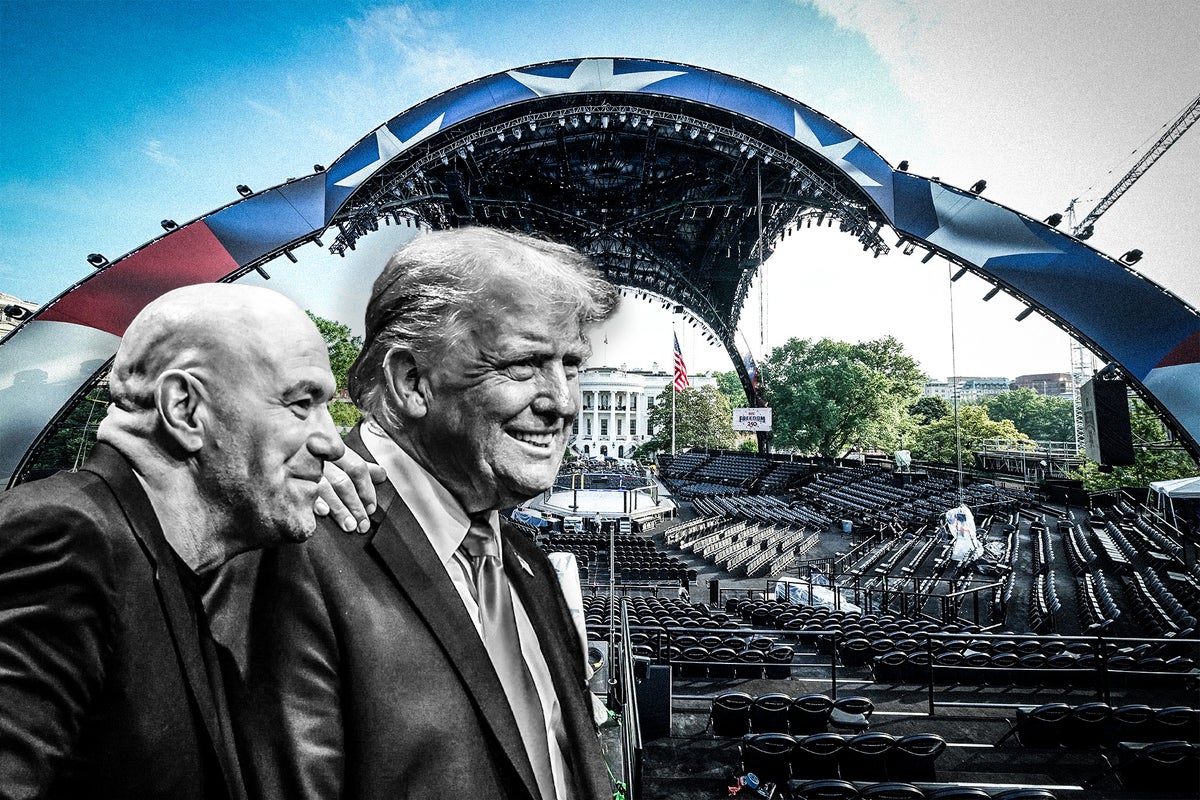
TKO Group Holdings and the UFC have poured over $60 million into erecting a massive mixed martial arts arena on the South Lawn of the White House for the UFC Freedom 250 event. This unparalleled corporate capture of federal property marks the first time a private combat sports promotion has transformed the executive mansion into a branded sporting venue. While public interest litigation and political outrage have dominated the headlines, the ultimate success of this multi-million dollar corporate gamble hinges on volatile operational risks, logistical chaos, and deeply compromised commercial entanglements.
The Audacity of the South Lawn Arena
A 92-foot red, white, and blue superstructure now towers over the executive residence, casting a literal shadow across the historic grounds. At its epicenter sits the Octagon, the trademark eight-sided chain-link cage that will host seven professional mixed martial arts bouts. The sheer scale of the construction required an unprecedented occupation of the National Mall ecosystem. You might also find this connected coverage insightful: Why Charlie Javice Wants a Trump Pardon.
Beginning May 20, a daily convoy of 20 to 30 heavily armored equipment trucks rolled through security checkpoints managed by the Secret Service. Between 700 and 900 corporate event technicians flooded the lawn every morning, radically altering the daily workflow of the executive branch. Seven federal agencies, including the Department of Homeland Security and the Federal Aviation Administration, diverted massive manpower away from routine operations to secure a corporate promotional stunt.
The legal battle over this event exposed the sheer vulnerability of the project. The Public Integrity Project filed a federal lawsuit on behalf of local residents, arguing that using the South Lawn for a blood sport violated long-standing National Park Service regulations designed to protect federal parklands from private commercial exploitation. Court filings revealed the sheer scale of the financial sunk costs, noting that well over $60 million and tens of thousands of hours of labor had already been spent. In a stunningly candid legal brief, the National Park Service defended the project by whining that a last-minute injunction would ruin the spectacle on the "whim of two people who believe they have superior taste." As reported in recent reports by The Economist, the effects are notable.
While a federal judge ultimately cleared the way for the matches to proceed, the legal panic highlighted a glaring structural reality. The entire $60 million apparatus was vulnerable not just to judicial intervention, but to the natural operational friction of outdoor broadcasting.
The Corporate Sprawl and VIP Economy
TKO Group Holdings, the corporate behemoth formed by the merger of the UFC and WWE, claims it will not turn a profit on the live gate. Executives have publicly projected a $30 million net loss on the event. Yet TKO President Mark Shapiro casually brushed off the deficit, publicly asking, "Are we really losing?"
The answer lies in the immense political access and corporate brand valuation unlocked by the event. The arena holds a tight, highly exclusive crowd of 4,000 spectators on the lawn. These are not ordinary sports fans. High-end corporate sponsorship packages and cage-side VIP seats command astronomical prices up to $1.5 million. The premium tickets buy unparalleled proximity to power, situated directly beneath the broadcast rigs on the lawn of what has historically been dubbed "The People's House."
Corporate logos now cover the federal grass. Crypto.com, a primary sponsor of the event, recently secured a partnership with Trump Media & Technology Group, creating a direct loop of commercial alignment. Furthermore, two prominent corporate sponsors of the event have poured millions into pro-Trump super PACs. The weekend itinerary cleverly connected the sporting event to direct political fundraising, featuring a $1 million-per-head dinner at a nearby Trump golf club the evening before the fights.
The financial web extends directly into the executive branch and personal portfolios. Linda McMahon, a longtime WWE executive and cornerstone of the TKO corporate family, serves in the cabinet as Education Secretary. More glaringly, public financial disclosures revealed that Trump's personal financial trust purchased between $15,000 and $50,000 of stock in TKO Group Holdings just months before the event was finalized. Simultaneously, a private entity licensing the president’s likeness began aggressively marketing commemorative White House fight coins priced as high as $12,000 apiece.
The Hidden Logistics of Athlete Preparation
While executives toast to political proximity in air-conditioned tents, fourteen elite fighters are undergoing extreme physical torment just yards away from the Oval Office. The operational realities of professional mixed martial arts do not easily bend to the rigid security protocols of a wartime executive mansion.
Fighters must cut up to 20 pounds in the final days before the official weigh-ins to hit their contracted weight limits. This brutal process relies on severe dehydration, intensive sauna sessions, and hot Epsom salt baths. Corporate organizers had to custom-build temporary athletic preparation facilities within the secure perimeter, transporting specialized training equipment, portable saunas, and hundreds of pounds of recovery supplies past bomb-sniffing dogs and federal agents.
The extreme heat of a Washington summer introduces severe physiological risks. Dehydrated athletes entering an outdoor cage under heavy television lighting face accelerated fatigue and elevated risks of heatstroke. If a main-card athlete collapses during a weight cut or suffers a medical emergency inside the secure perimeter, the corporate spectacle quickly morphs into a public relations disaster on federal property.
Environmental Volatility and Broadcast Vulnerabilities
For all the money spent on steel structures and federal security, the entire broadcast remains at the mercy of environmental factors that cannot be controlled by executive order. An outdoor broadcast on a humid summer evening presents a nightmare for high-definition television production.
The massive television lights required to illuminate the Octagon for millions of global pay-per-view viewers generate immense heat and light. In the swampy summer climate of Washington, these setups act as a giant beacon for nocturnal insects and swarms of flies. The visual of flies disrupting a multi-million dollar international broadcast, landing on the camera lenses or swarming bloodied fighters in the cage, threatens to turn an elite sporting event into a bizarre farce.
More critically, the physical canvas of the Octagon cage is highly sensitive to moisture. Humidity, evening dew, or a sudden summer downpour transforms the canvas into a hazardous, slick surface. In mixed martial arts, footwork and leverage are everything. A slippery canvas drastically alters the mechanics of wrestling takedowns, striking combinations, and basic fighter safety. A single slip caused by condensation can prematurely end a world championship bout, rendering years of athletic preparation and millions in corporate sponsorships moot.
The UFC climbed to the top of the sports entertainment world through ruthless operational efficiency and an iron grip on its labor force. Yet by staging its ultimate corporate coming-out party on the lawn of the White House, the promotion has traded the predictable, hyper-controlled environment of modern indoor arenas for a chaotic mix of political controversy and environmental exposure. The spectacle represents the absolute peak of corporate-political synergy, but the infrastructure supporting it remains precarious.