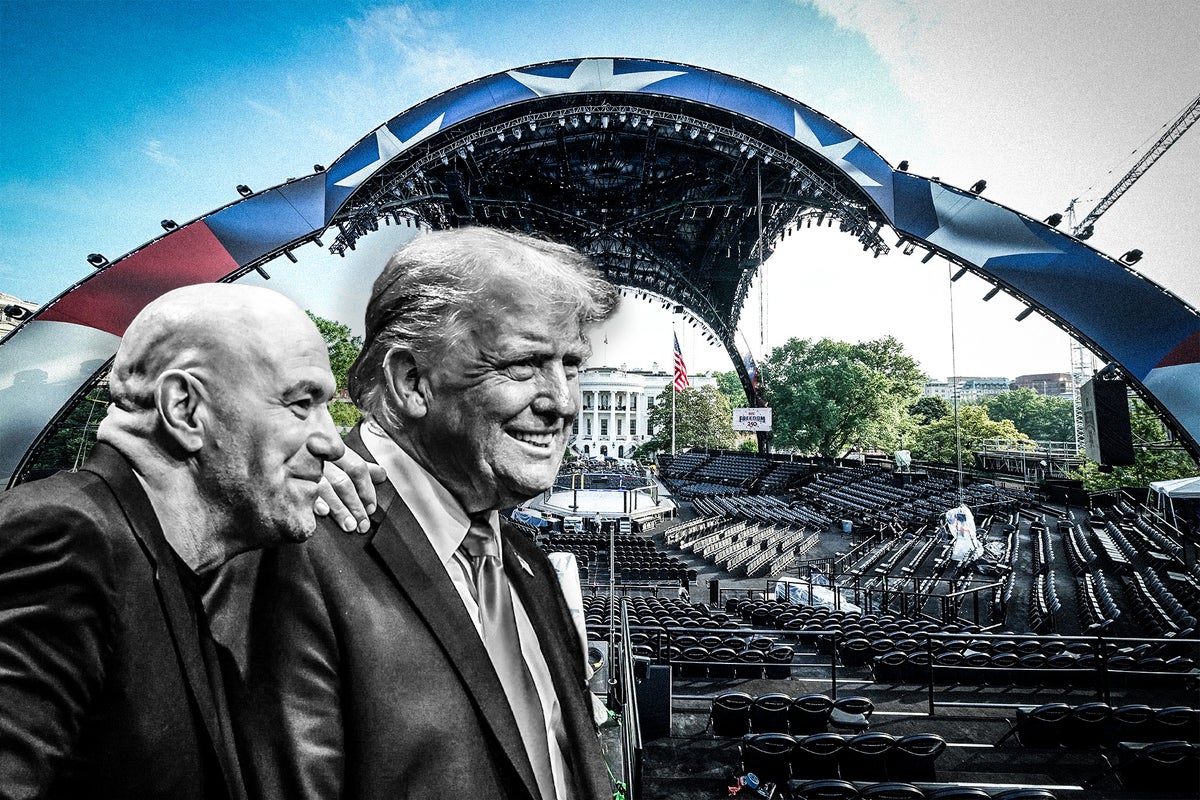
TKO Group Holdings is wagering 60 million dollars that an octagonal cage on the South Lawn of the White House will cement its status as an elite American institution. The sports entertainment conglomerate, which governs the Ultimate Fighting Championship, is sparing no expense to transform the executive mansion into a combat stadium for "UFC Freedom 250." Ostensibly a celebration of America's 250th anniversary, the reality is a raw business play anchored by the decades-long relationship between Donald Trump and UFC CEO Dana White. Yet, this high-stakes integration of corporate power and executive privilege faces severe operational threats that a simple public relations campaign cannot fix.
The immediate logistical hazards go far beyond standard event planning. While critics focus on political optics or a pending watchdog lawsuit from the Public Integrity Project, the physical reality of hosting an elite outdoor sporting event in Washington, D.C., during June presents a different kind of chaos. Staging seven high-profile mixed martial arts bouts under the suffocating summer heat introduces variables that pay-per-view broadcasts rarely encounter. Chief among them is an environmental nuisance that has plagued outdoor political gatherings for centuries, insect swarms attracted by the blinding arena lights. For a different view, check out: this related article.
The Logistics of a Lawn Stadium
Building a temporary arena capable of holding 4,000 spectators on the South Lawn requires precision. The Secret Service is currently screening between 20 and 30 trucks of equipment and nearly 900 production staff members every single day. Seven federal agencies, including the Department of Homeland Security and the Federal Aviation Administration, have shifted significant manpower to accommodate the construction.
The technical demands of the broadcast are immense. The UFC is erecting a massive, claw-like overhead lighting truss directly over the canvas to illuminate the fighters for the global television feed on CBS and Paramount+. Further analysis regarding this has been shared by Business Insider.
This structural intrusion creates an immediate ecological problem. Powerful television lighting arrays deployed in humid, low-elevation river basins like Washington act as a beacon for local insect populations. Swarms of flies, gnats, and nocturnal pests are a certainty. In a sport where traction is everything, a canvas slick with crushed insects or a fighter blinded by a stray fly mid-exchange is not just an aesthetic issue. It alters the outcome of a multi-million-dollar contest.
The financial exposure for TKO Group Holdings is concentrated on this single night. While chief operating officer Mark Shapiro notes that 30 million dollars of the 60-million-dollar price tag is covered by corporate sponsors, the remaining balance is an outright gamble on brand equity. Replacing the historic South Lawn turf alone will drain up to one million dollars from the budget.
The Financial Undertow and Insider Plays
The economic mechanics behind the event expose deeper systemic risks for shareholders. Government transparency advocates are already dissecting the financial ties underpinning the spectacle.
A review of federal financial disclosures revealed that Donald Trump purchased between 15,001 and 50,000 dollars of TKO Group Holdings stock on March 25, 2026. This transaction occurred exactly two weeks after the White House card was officially finalized and announced to the public. Watchdog groups like Citizens for Responsibility and Ethics in Washington have seized on this timeline, arguing that utilizing the executive mansion to heavily promote a private sporting entity while holding its equity creates an unprecedented conflict of interest.
TKO Group Holdings Capital Allocation (UFC Freedom 250)
┌─────────────────────────────────────────────────────────┐
│ Total Projected Budget: $60,000,000                     │
├──────────────────────────────┬──────────────────────────┤
│ Corporate Sponsor Revenue    │ TKO Capital Risk         │
│ $30,000,000 (50%)            │ $30,000,000 (50%)        │
└──────────────────────────────┴──────────────────────────┘
The corporate risk extends to the athletic performance itself. Fourteen elite fighters are currently enduring brutal weight-cutting regimens, dropping up to 20 pounds in the final days through extreme dehydration, saunas, and hot Epsom salt baths. They are preparing to enter a cage where the ambient air temperature and humidity cannot be controlled.
Unlike the climate-controlled environment of the Las Vegas Sphere, where the UFC spent 20 million dollars for a flawless production, the South Lawn offers zero insulation from the elements. If torrential summer storms or technical failures hit the outdoor venue, the 60-million-dollar investment possesses no backup plan.
The reliance on a non-profit vehicle complicates matters further. The Trump administration routed the event logistics through a National Park Foundation entity known as the Freedom 250 organization. This structure allows the private sports promotion to interface directly with federal parklands, bypassing standard congressional oversight.
The Price of Total Access
The strategy driving TKO is absolute market dominance through political alignment. Executive leadership openly states that competitors would kill for this level of access to the ultimate bully pulpit. By embedding the brand into the literal architecture of American governance, the UFC aims to transcend the traditional boundaries of sports entertainment.
This access depends entirely on personal fealty. The alliance dates back to the early 2000s, when Atlantic City casino properties hosted UFC 30 and UFC 31 at a time when major venues refused to associate with the raw violence of early mixed martial arts. That historical debt is being paid back with interest on the South Lawn.
The ultimate danger is that the gamble breaks under its own weight. A legal injunction from the ongoing lawsuit could freeze production hours before the broadcast. A localized weather event could ruin the expensive broadcast equipment. Or, most embarrassingly, the uncontrolled elements of nature could turn a premier corporate showcase into a chaotic spectacle on live television. TKO Group Holdings has pushed all its chips to the center of the table, betting that institutional prestige can be bought with a cage on the grass.