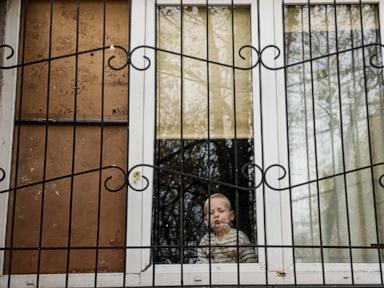
In Ukraine, keeping winter outside begins with a broken window because blast waves shatter glass miles from an impact site, instantly destroying a building’s thermal envelope. Before a municipality can repair a bombed power plant or restore a severed high-voltage transformer, residents and emergency crews must seal millions of square feet of blown-out windows with oriented strand board, plywood, and heavy-duty polyethylene sheeting. Without an intact exterior shell, central district heating systems lose pressure, indoor pipes freeze and burst within hours, and localized power grids collapse under the sudden surge of residents plugging in electric space heaters.
The Physics of the Blast Wave and the Thermal Envelope
Most observers focus on the craters left by ballistic missiles and long-range drones. Engineers on the ground look at the radius of the overpressure wave.
A single detonation in a dense urban neighborhood does not just destroy the targeted substation or apartment block. The resulting shockwave travels outward at supersonic speed, flexing concrete walls and instantly pulverizing standard double-glazed glass across a radius of several blocks. In older Soviet-era panel buildings—known locally as khrushchyovkas and panelkas—window frames are frequently warped or poorly anchored, meaning the entire assembly often blows inward into living rooms and stairwells.
Once that glass is gone, the building’s thermal envelope fails completely.
Modern residential architecture relies on trapped air between panes of glass to slow conductive and convective heat loss. When wind blows unimpeded through a fifth-floor apartment in Kharkiv, Dnipro, or Odesa, indoor temperatures drop from a comfortable 20 degrees Celsius to sub-zero conditions in less than half a day. That rapid thermal drop triggers a secondary, far more expensive structural failure.
Ukraine’s urban centers rely heavily on centralized district heating, a Soviet-legacy infrastructure model where massive combined heat and power plants pump superheated water through miles of underground insulated pipes directly into apartment radiators. This system depends on closed-loop thermal equilibrium. When thousands of apartments lose their windows simultaneously, the radiators inside those exposed rooms act as giant heat sinks, dumping thermal energy straight into the freezing outdoor air.
If the water temperature drops too low, or if power outages halt the circulation pumps for even a few hours during a January cold snap, the water inside the radiators freezes. Water expands by roughly nine percent when it turns to ice. That expansion splits cast-iron radiators and steel risers down the seams. When the power eventually comes back on and the pumps restart, tens of thousands of gallons of water flood through ceilings and walls, turning an apartment block into an uninhabitable ice cavern until spring.
Sealing a window is not cosmetic triage. It is mechanical preservation of the municipal plumbing grid.
Why Plywood and Plastic Beat Glass in a Active War Zone
If you walk through a residential district in Zaporizhzhia forty-eight hours after a strike, you will not see glaziers hauling sheets of triple-pane argon-filled glass up the stairs. You will see municipal workers, volunteer brigades, and pensioners stapling clear reinforced plastic film and screwing thick sheets of oriented strand board (OSB) over empty window frames.
There are three brutal, practical reasons why permanent glass replacement is often deferred until warm weather returns.
First is the supply chain bottleneck. Manufacturing architectural glass requires continuous, high-temperature float furnaces that cannot simply be turned off and on during rolling blackouts. Following the destruction of major domestic glass production facilities in eastern Ukraine early in the full-scale invasion, the country became heavily reliant on imported glass from Poland, Romania, and the Baltic states. Border delays, freight costs, and sheer volume make immediate, nationwide glass replacement physically impossible during peak winter demand.
Second is the installation environment. Structural silicone and expanding polyurethane foam—the chemical adhesives required to seat modern PVC window frames into concrete openings—fail to cure properly when ambient temperatures fall below minus five degrees Celsius. Installing permanent windows in dead winter often results in shrunk seals, structural gaps, and drafts that render the expensive new unit useless.
Third is the mathematical reality of repeat strikes. In frontline cities like Kherson, Nikopol, or Sumy, shelling and drone strikes are recurring weekly events. Spending four hundred dollars per window on custom double-glazed units only to have a mortar shell or interception debris blow them out ten days later bankrupts both homeowners and municipal budgets.
Heavy-duty reinforced polyethylene film—often woven with a nylon mesh grid to prevent tearing—costs a fraction of glass, weighs almost nothing, and can be transported by the roll in the back of a standard passenger van. When stapled tightly to both the interior and exterior sides of a wooden frame, the two layers trap a pocket of still air between them. While it lacks the acoustic insulation and optical clarity of glass, a properly tensioned double layer of agricultural-grade plastic sheeting can retain up to sixty percent of the thermal resistance of a standard single-pane window.
The Hidden Grid Crisis Behind Every Cold Apartment
The connection between a drafty bedroom and a national blackout is direct, measurable, and feared by every grid operator at Ukrenergo, Ukraine’s state transmission system operator.
When district heating falters or indoor temperatures plummet because windows are covered only with thin plastic, citizens instinctively reach for localized heat sources. Every hardware store across the country sells out of convection heaters, oil-filled radiators, and ceramic fan heaters every autumn.
A single residential space heater draws between 1.5 and 2.5 kilowatts of electricity. To put that into perspective, an entire modern apartment running LED lights, a refrigerator, a television, and a Wi-Fi router draws roughly 0.4 kilowatts. Plugging in two space heaters increases that household’s electrical load by more than one thousand percent.
Multiply that behavior across two million cold apartments at six o'clock in the evening, and the electrical grid hits a wall.
[Missiles Strike Substation / Blast Wave Shatters Windows]
                          │
                          ▼
[Buildings Lose Thermal Envelope -> Indoor Temps Plummet]
                          │
                          ▼
[Residents Plug In Millions of 2kW Electric Space Heaters]
                          │
                          ▼
[Massive Demand Spike Overloads Surviving Local Transformers]
                          │
                          ▼
[Emergency Rolling Blackouts Cut Power to Heating Pumps]
                          │
                          ▼
[Unheated Pipes Freeze and Burst -> Structural Collapse]
This is the demand-side death spiral that keeps energy engineers awake at night. Even if repair crews manage to patch a high-voltage autotransformer after a missile attack, the surviving local distribution transformers—those green metal boxes sitting in apartment courtyards—were designed in the 1970s and 1980s for a fraction of modern electrical loads. When an entire neighborhood turns on electric heaters simultaneously the moment power is restored, the sudden inrush current trips circuit breakers, melts underground feeder cables, and burns out neighborhood transformers that take weeks to replace.
Every square meter of insulated OSB board nailed over a broken window directly reduces the megawatts of electricity that Ukrenergo has to generate or import from the European Union during peak evening hours. Window insulation is, in effect, a decentralized power plant operating in reverse.
The Anatomy of an Emergency Winterization Kit
Over four winters of full-scale conflict, humanitarian agencies, international donors, and Ukrainian municipal administrations have standardized what goes into a rapid-response winterization kit. The materials are decidedly low-tech, chosen for shelf life, portability, and ease of installation by untrained civilians working on ladders in freezing rain.
| Material | Primary Function | Thermal Performance | Operational Limitation |
|---|---|---|---|
| OSB (10mm–15mm) | Structural windbreak and physical security for ground floors | Moderate; eliminates convective drafts completely | Blocks 100% of natural daylight, increasing indoor lighting demand |
| Reinforced Poly Film | Light-transmitting weather barrier for upper-story apartments | Low-to-moderate; best when applied in two spaced layers | Degrades under UV exposure; flaps loudly in high winds if loose |
| Expanding PU Foam | Sealing perimeter gaps around warped or cracked frames | High; eliminates thermal bridging at concrete joints | Requires winter-grade formulations to cure below freezing |
| Mineral Wool Batts | Stuffing deep structural cracks and blown-out masonry | Very high; non-combustible and moisture-resistant | Absorbs water and loses insulation value if exposed to direct rain |
| Butyl & Foil Tapes | Securing plastic edges to smooth PVC or painted metal | Negligible alone; critical for airtightness | Fails to adhere to dusty, wet, or frost-covered surfaces |
The trade-offs between OSB and plastic sheeting divide neighborhoods along strictly practical lines. Ground-floor apartments and storefronts almost always receive thick OSB panels. Aside from blocking the wind, wood prevents looting and keeps stray shrapnel from entering ground-level rooms. However, boarding up every window with wood plunges residents into permanent darkness. Living in a cave for four months takes a severe psychological toll, particularly when power outages already knock out indoor lighting for twelve hours a day.
On upper floors, where looting is impossible and natural light is essential for mental health, crews prioritize transparent reinforced film. Yet working from the outside of a ninth-floor window frame without scaffolding or cherry-pickers is lethal. As a result, residents often staple plastic strictly to the inside frame. While fast and safe, an interior-only seal leaves the exterior concrete sill exposed to wind-driven snow and freeze-thaw cycles, which slowly cracks the surrounding masonry and lets damp cold creep into the walls.
How Humanitarian Logistics Transformed Local Hardware Supply Chains
In the first winter of the full-scale war, sourcing enough plastic sheeting and timber to seal damaged cities was a chaotic scramble. Volunteers drove personal sedans to big-box hardware chains like Epicentr K—Ukraine’s equivalent of Home Depot—clearing out shelves pallet by pallet and paying retail prices out of pocket.
By the third and fourth winters, the response evolved into an industrialized, pre-positioned logistics network managed by municipal utility companies, the State Emergency Service (DSNS), and international bodies like the UNHCR and the International Organization for Migration.
Today, major municipalities maintain strategic reserves of winterization materials stored in decentralized warehouses scattered across different city districts so a single strike cannot wipe out a city’s stockpile. When air raid sirens clear after a major barrage, municipal rapid-response teams deploy alongside firefighters. While medics clear the wounded and utility workers shut off ruptured gas mains, dedicated carpentry crews begin measuring window openings before the dust has even settled.
Yet systemic friction remains. Bureaucratic verification often slows down aid to the people who need it most.
To receive state compensation through programs like eVidnovlennya (eRecovery), homeowners must document structural damage, submit digital applications, wait for a municipal commission to inspect the property, and use approved contractors. For minor window damage, the system works reasonably well over a period of weeks. During a blizzard in late January, weeks are a lifetime.
Consequently, a two-tier recovery system has emerged across urban Ukraine:
- Immediate Municipal Triage: City workers slap plastic or OSB over broken windows within 24 to 72 hours to prevent pipes from freezing. This is free, fast, and purely functional.
- Delayed Permanent Reconstruction: Homeowners either pay out of pocket for private window installers or wait months for state vouchers or NGO grants to cover triple-glazed PVC replacements.
In rural villages near the front lines, where municipal crews are stretched thin or entirely absent, elderly residents often fall through the cracks of both systems. Without smartphones to navigate digital aid portals or the physical strength to climb a ladder with a staple gun, pensioners frequently retreat into a single, smallest room of their house—usually the kitchen—hanging thick wool carpets over doorways and burning scavenged firewood in makeshift metal stoves to survive until April.
The Structural Vulnerability Nobody Wants to Discuss
Fixing broken windows keeps people alive through February, but veteran structural engineers warn that temporary winterization masks a creeping, long-term degradation of Ukraine’s housing stock.
Most urban Ukrainians live in mass-produced concrete panel buildings erected between 1960 and 1990. These structures were built with a projected design lifespan of fifty to seventy years. Even before 2022, tens of thousands of these buildings were overdue for major capital renovation.
Repeated exposure to nearby concussive blasts does more than shatter glass. Overpressure waves flex the welded steel joints that hold precast concrete wall panels together, creating microscopic fractures in the exterior waterproofing. When plastic sheeting is stapled over a window frame for two consecutive winters, wind-driven rain and melting snow seep behind the staples and into those hairline concrete cracks.
When temperatures drop below zero at night, that trapped moisture freezes and expands, widening the cracks through spalling—a process where concrete flakes and crumbles away from its internal steel rebar. Once oxygen and moisture reach the rebar, rust sets in, swelling the steel and cracking the concrete from the inside out.
A sheet of plastic film stops the wind today. It does not stop water intrusion into structural joints, nor does it restore the acoustic and thermal integrity of a building whose concrete seams have been shaken loose by neighboring explosions.
The Alternative Heating Gamble
Recognizing that centralized power plants and fragile window seals leave millions exposed, cities and individual homeowners have spent the last two years aggressively decentralizing how they generate heat.
At the municipal level, international donors have poured hundreds of millions of dollars into delivering mobile gas-fired boiler houses and cogeneration units—shipping-container-sized turbines that generate both electricity and hot water locally. If a missile destroys a city’s main thermal power plant, these distributed units can be hooked directly into neighborhood district heating loops, keeping radiators warm for specific hospitals, schools, and residential micro-districts without relying on the national grid.
At the household level, adaptation looks far grittier.
Across high-rise apartment blocks in Kyiv and Lviv, residents have pooled their money to buy lithium iron phosphate (LiFePO4) battery stations and roof-mounted solar inverters. While a battery station cannot power a two-kilowatt electric space heater for more than an hour, it can run the electronic ignition and circulation pump of a gas-fired combi-boiler for days. In buildings equipped with individual gas boilers, keeping that tiny 100-watt circulation pump spinning is the difference between a warm apartment and frozen pipes.
In older buildings without individual gas boilers, the adaptations are starkly medieval. Hardware stores do brisk business selling burzhuykas—small, cast-iron or welded-steel wood stoves named after the makeshift heaters used during the Russian Civil War a century ago. Venting a wood stove out of a sixth-floor apartment window through a sheet of plywood violates every fire code in peacetime Europe. In wartime Ukraine, fire inspectors look the other way because freezing to death is a far more immediate certainty than chimney smoke.
What Actually Determines Survival When the Temperature Drops
When analysts model winter survival in a conflict zone, they tend to build complex spreadsheets tracking megawatts of generating capacity, cubic meters of underground gas storage, and air defense interceptor inventories. Those macro metrics matter. Without gas in the pipelines and air defense batteries overhead, no amount of preparation saves a city.
Down at street level, however, winter resilience comes down to brutally simple geometry and material logistics.
A city survives a winter bombardment campaign when its supply chains can deliver rolls of reinforced polyethylene, sheets of plywood, boxes of staples, and cans of winter-grade polyurethane foam faster than incoming missiles can blow out windows. It survives when municipal workers can seal a shattered apartment block before the residual heat inside the concrete walls bleeds out into the night air.
The window is the front line because it is the thinnest barrier between human habitability and an environment that kills exposed flesh in hours. Every staple driven into a wooden frame is a small, defiant act of civil engineering—buying time for repair crews at the power plant, relieving pressure on an overloaded electrical grid, and keeping water flowing through the iron veins of a city under siege.