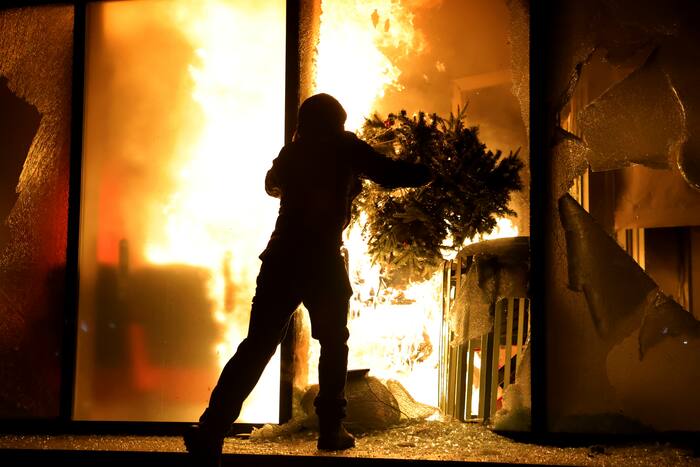
Student-led protests in Albania erupted into violent clashes in Tirana after months of simmering anti-government unrest, turning university grievances into a direct challenge to Prime Minister Edi Rama's authority. What started as a student push over tuition, housing conditions, and bleak career prospects collided with deep public anger over high-level corruption scandals, pushing demonstrators into street battles with police and prompting harsh fines and arrests.
Anyone covering Tirana with a stopwatch and a rock-throwing tally misses the real story. After three decades watching Balkan street politics flare up, burn hot, and leave behind an exhausted public, I know better than to treat a riot as a sudden bolt from the blue. When students outside the Ministry of Education chanted for resignation and threw stones in October 2026, they were not reacting to a single policy memo. They were colliding with a system that has felt airtight for years. For an alternative view, consider: this related article.
How Street Anger Built Before the Clashes
Treat the October street battles as a rupture if you want easy headlines. Treat them as a continuation if you actually want to understand Tirana.
Long before university students marched in force on October 13, 2026, anti-government frustration had been cycling through different faces and banners. Opposition parties mobilized over disputed election claims and corruption allegations tied to senior officials, including former Deputy Prime Minister Belinda Balluku. Left-leaning activists and local residents pushed back over state budgets, coastal and protected-area land disputes, and construction deals seen as favoring connected insiders. Related coverage on this trend has been published by The New York Times.
Then came the Flamingo Revolution, a citizen-led wave that adopted the greater flamingo of the Vjosa-Narta wetland ecosystem as a non-partisan emblem of resistance against entrenched power and environmental and development policies. That movement kept pressure on the government across months of demonstrations, marches, and clashes.
A street movement rarely starts when the first brick flies. It starts when citizens conclude that courts, ballots, and polite petitions no longer move the needle.
When university and high school students stepped forward in mid-October, they plugged fresh urgency into an existing current. Reports of clashes in Tirana quickly rippled to other cities, including Elbasan and Shkodër, while high schoolers joined university students in expanding the footprint of the revolt.
The Breaking Point Behind Student Frustration
Students do not risk tear gas, water cannons, rubber bullets, and steep fines over abstract political theory. They risk it when the math of their own future stops working.
For young Albanians, higher education has long carried a painful bargain. Pay rising costs, endure cramped dormitories and strained campus facilities, graduate into limited prospects, or pack a bag and leave the country. With net migration deeply negative in 2025—estimated at minus 28,531—departure has operated as Albania's quiet pressure valve for years. When staying home feels like signing up for stagnation, street anger looks less reckless and more like a last stand.
Scandals poured gasoline on that resentment. Investigations and controversies around public officials and procurement already weighed heavily on public trust. In September 2026, the Vlora Hyseni affair—involving the suspension and house arrest of the head of Albanian intelligence (SHISH) amid allegations of passing secret information to an organized crime figure—struck a particularly raw nerve.
For a generation already skeptical that rules apply equally to everyone, an intelligence chief entangled with organized crime felt like confirmation of state capture. You can ask students to tighten their belts during tough economic times. It is much harder to ask them to trust a state whose security apparatus looks compromised.
| Pressure Point | What Triggered It | Why It Resonated With Students |
|---|---|---|
| Education and Living Costs | Tuition pressures, residence conditions, and scarce local jobs | Directly threatens whether young people can afford to study and stay in Albania |
| High-Level Corruption | Investigations into senior figures and the September SHISH intelligence scandal | Reinforces the belief that insiders evade accountability while ordinary citizens pay |
| Concentrated Authority | Cabinet reshuffles and personnel changes without perceived shifts in power | Makes reform look cosmetic rather than structural |
| Harsh Crackdowns | Police clashes, mass arrests, and steep fines | Hardens defiance among protesters who already view policing as heavy-handed |
Why Tirana Keeps Recycling the Same Standoff
Watch closely how power operates in Tirana, and a familiar pattern jumps off the page. Ministers get shuffled or dismissed. Commissions get promised. Yet the core concentration of authority around Edi Rama remains intact.
Analysts in Tirana have pointed out a crucial flaw in this dynamic: ministerial turnover without genuine accountability breeds cynicism. If a new face appears in a cabinet seat while the underlying decision-making center stays unchanged, citizens hear different voices without seeing real consequences. Over time, that gap turns every scandal into proof that the system protects its own.
There is an uncomfortable counter-argument that protesters and opposition figures have to wrestle with too. Burning property, hurling stones, and attacking banks or public buildings give the government an immediate moral and security off-ramp. Even when the European Union delegation in Tirana noted allegations of excessive police force against protesters and journalists and urged restraint, it also made clear that violence cannot be justified.
Street violence rarely forces a seasoned leader to quit on its own. Rama has refused to step down, and authorities moved aggressively with arrests, detentions, and a steep $6,000 fine for those present at protests that turn violent. Heavy penalties can deter casual participants, yet they also risk radicalizing students who already chant that peaceful marches achieved nothing.
What Neither Side Wants to Admit
Neither the government nor the protest camp has a clean, painless exit right now.
If Rama relies mainly on force, court cases, and hefty fines, Tirana may look quieter on television for a stretch while resentment festers deeper underground. European integration benchmarks demand credible rule of law, media freedom, and anti-corruption enforcement; heavy-handed policing and mass prosecutions complicate that pitch abroad even as they project strength at home.
On the other side, anger alone is not a governing program. Students have demanded resignation, early elections, and a political alternative unlike what Albania has seen before, and some have pointedly rejected government invitations to talks. Refusing dialogue is understandable when trust is shot. Still, without concrete reforms on university housing, funding transparency, judicial independence, and electoral rules, street energy risks burning itself out—or being co-opted by veteran politicians whose own credibility with young voters is thin.
A hypothetical example makes the trap clear. Imagine a student activist who starts out marching for cleaner dorms and fairer scholarships, gets caught in a chaotic clash outside a ministry building, faces a massive fine or criminal charge, and suddenly spends all their energy fighting legal survival instead of pushing policy fixes. That is how movements lose the middle ground even when their original grievances are completely real.
Where the Pressure Points Lead Next
Keep your eye on three concrete indicators rather than speeches from the podium.
- Campus and High School Staying Power: Watch whether student strikes and marches hold steady across Tirana and regional university towns or fade under exam pressures, winter weather, and legal threats.
- Judicial and Police Conduct: Track how courts handle mass detentions and fines, and whether allegations of police excess against demonstrators and reporters receive real scrutiny.
- Tangible Policy Concessions: Look past rhetoric to see if the government backs down on contested development laws, shifts real budget resources toward students, or delivers measurable anti-corruption follow-through.
Streets in Tirana do not erupt because young people wake up looking for a fight. They erupt when a generation realizes the doors to a fair future feel bolted shut—and decides shouting at closed doors is no longer enough.