A military conflict between the United States and China over Taiwan will likely trigger a nuclear escalation because both supermilitaries are actively built to destroy each other's blind spots. The threat is not the cinematic madness of an unhinged commander firing a missile in anger. It is the cold, calculated logic of modern military doctrine, which dictates that both sides must immediately target the command, control, and intelligence hubs of the enemy. Striking those hubs inevitably means hitting early-warning nuclear infrastructure, forcing a "use them or lose them" dilemma upon leaders in Washington and Beijing.
The International Institute for Strategic Studies (IISS) highlighted this structural danger in its annual assessment ahead of the Shangri-La Dialogue in Singapore. The report warns that the Asia-Pacific sits at the center of a new nuclear arms race. Yet, the public conversation remains fixated on conventional amphibious landings and trade embargoes. The real danger lies in the deep technical reality that conventional war and nuclear war have become structurally inseparable. Expanding on this theme, you can find more in: The Night the Desert Sky Woke Up.
The Blind Spot Trap
Military planners talk about Taiwan in terms of anti-access and area-denial. They map out the missile batteries along the Taiwan Strait and calculate the tonnage of shipping required to sustain an amphibious invasion. They overlook how the electronic brains of these military machines are wired together.
Both the United States and China rely heavily on sophisticated, dual-use networks for command, control, communications, computers, intelligence, surveillance, and reconnaissance. These are the systems that track ships, guide precision missiles, and coordinate air wings. They are also the exact same systems that monitor incoming nuclear strikes and transmit launch orders to strategic ballistic missile submarines and silo-based intercontinental ballistic missiles. Observers at The New York Times have provided expertise on this trend.
If China attempts a blockade or invasion of Taiwan, American military doctrine requires immediate, deep precision strikes against Chinese radar installations, satellite links, and regional command centers to protect American warships and bolster Taiwanese defenses. Conversely, Chinese doctrine requires sweeping operations to blind American carriers and forward bases in Japan and Guam.
When an American Tomahawk missile blows up a Chinese radar station in Guangdong to clear a path for conventional fighter jets, Chinese commanders in Beijing cannot know if that radar was targeted to facilitate a conventional counter-attack or to blind China’s early-warning system ahead of an American nuclear first strike. Under the pressure of a ticking clock, the systemic pressure to launch theater nuclear weapons before the capability is destroyed becomes immense.
The Death of the Firebreak
For decades, Cold War theorists took comfort in the concept of the firebreak, an imaginary, rigid barrier separating conventional combat from nuclear war. The assumption was simple. As long as troops fought with conventional explosives, the nuclear threshold remained uncrossed.
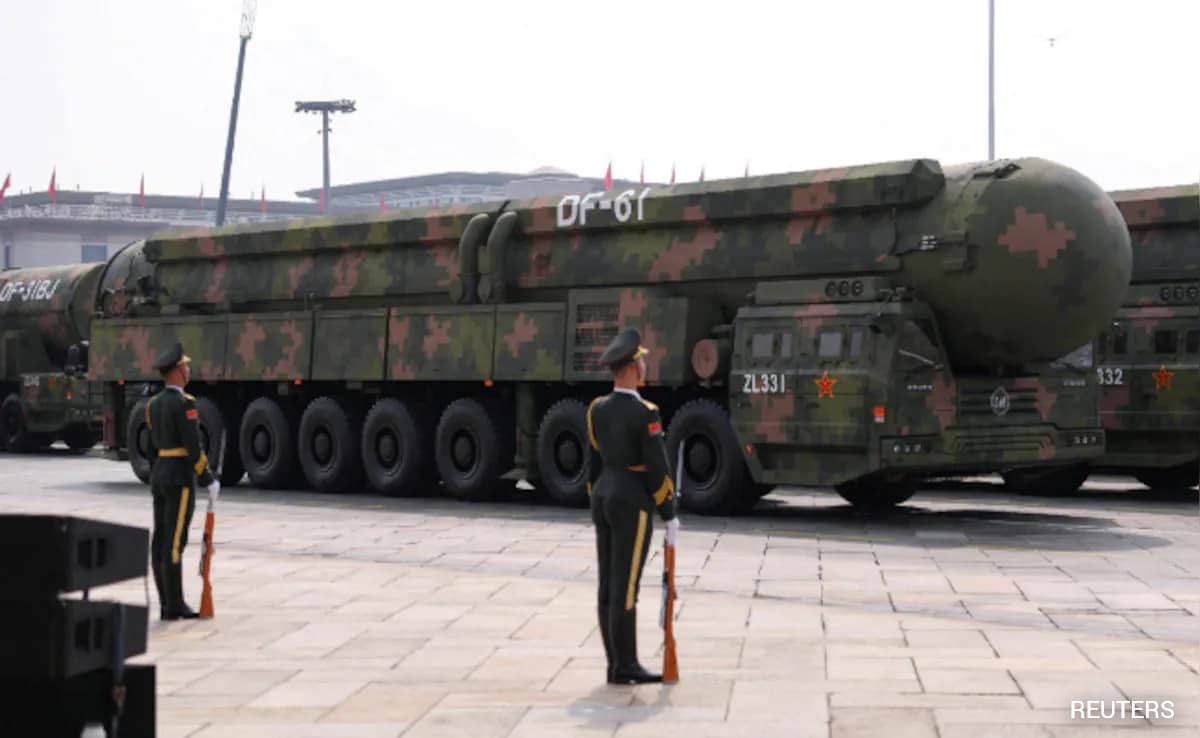
That firebreak is dead. China is expanding and modernizing its nuclear forces faster than any other global power, on track to field 1,000 warheads by 2030 according to recent Pentagon estimates. This expansion is not merely quantitative; it is architectural. Beijing has integrated low-yield, non-strategic nuclear weapons into theater-level forces, shifting the balance of power along the first island chain.
A recent war game conducted by the Heritage Foundation demonstrated the danger of this new reality. In the simulation, when faced with a high-intensity conflict over Taiwan, players did not treat theater nuclear weapons as a desperate act of last resort. Instead, they used them instrumentally to neutralize the opponent's conventional strike capabilities.
The underlying technical mechanics drive this shift.
- Hypersonic dual-capable delivery systems: Missiles like China's DF-26 can carry either a conventional or a nuclear warhead. A defender tracking an incoming missile cannot distinguish between the two until the weapon detonates.
- The parity trap: When both sides possess rough symmetry in theater nuclear options, the illusion of easy deterrence vanishes, leading to competitive escalation.
- Counterforce targeting preference: Both American and Chinese planners heavily favor striking military targets rather than cities, which lowers the initial psychological barrier to detonating a low-yield nuclear device.
The illusion that a theater nuclear exchange can be neatly contained is a dangerous gamble. War games show that while select targeting can temporarily limit a conflict to the immediate maritime region, the destruction of command nodes quickly degrades communication, rendering war termination or negotiated settlements nearly impossible to execute.
The Guard Rail Deficit
The current diplomatic landscape exacerbates these technical vulnerabilities. Following the recent summit between Donald Trump and Xi Jinping in Beijing, public rhetoric has occasionally cooled, but the underlying military friction has intensified. Taiwan's legislature recently pushed through a 25 billion dollar special defense budget to fund massive purchases of American hardware, including HIMARS and anti-armor drone systems. Beijing responded by ramping up its gray-zone military presence around the island, utilizing signal-spoofing operations to disrupt maritime tracking.
Despite this friction, there are virtually no operational guard rails between Washington and Beijing.
There are no agreed-upon rules of engagement to restrict the targeting of strategic intelligence satellites or early-warning radars during a localized crisis. There are no hotlines that military commanders genuinely trust or use during live kinetic operations. The two largest militaries on earth are charging toward a potential confrontation while wearing digital blinders, each assuming they can manage the escalation ladder because they have labeled their operations as purely defensive.
This lack of institutional communication transforms every tactical success into a strategic risk. If the United States successfully disables a Chinese command bunker near Ningbo using a conventional cyberattack, it may inadvertently disable a node responsible for managing part of China's retaliatory nuclear force. Beijing's doctrine leaves no room for such ambiguity. If a strategic asset goes dark during a shooting war, the system is designed to assume the worst.
The Cost of Strategic Ambiguity
For fifty years, strategic ambiguity served its purpose. By keeping both Beijing and Taipei guessing about whether the United States would explicitly intervene in a war, Washington maintained a fragile peace. That policy has run out of runway.
The current strategy forces the United States to prepare for a total conventional defense of Taiwan without providing the clear, undeniable lines of demarcation that prevent nuclear miscalculation. The U.S. military cannot maintain the conventional capabilities required to decisively defeat a Chinese invasion along the first island chain without deep, cross-border strikes into the Chinese mainland. Yet, executing those very strikes is precisely what triggers the nuclear escalation loop identified by the IISS.
We are operating under an obsolete paradigm that assumes conventional victory can be bought without paying a nuclear price. If Washington intends to defend Taiwan, it must reckon with the fact that it is planning for a war where the conventional and strategic thresholds are hopelessly entangled. Pretending otherwise guarantees that if deterrence fails, the transition from a local maritime clash to a theater nuclear exchange will happen in hours, not weeks.