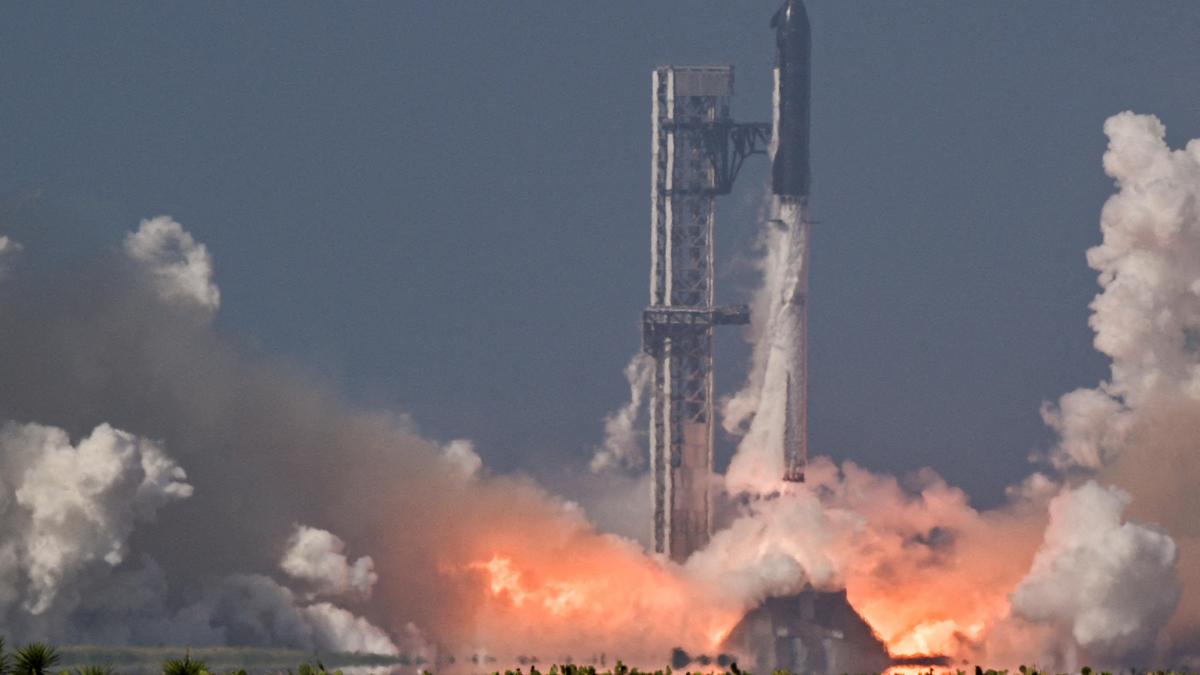
The Federal Aviation Administration officially grounded SpaceX’s Starship program, demanding a formal mishap investigation following the May 22 launch of Flight 12. While casual observers celebrated the upper stage’s successful splashdown in the Indian Ocean, the regulatory hammer dropped because the 236-foot Super Heavy booster suffered catastrophic engine dropouts during its return, slamming into the Gulf of Mexico in a high-velocity, uncontrolled hard splashdown. This regulatory freeze instantly halts Elon Musk's aggressive 2026 launch cadence. More importantly, it exposes a widening structural vulnerability in SpaceX’s hardware development strategy just as the company prepares a prospectus for a planned initial public offering.
For years, the space industry watched in awe as SpaceX built, flew, broke, and rapidly iterated its hardware in the mud of Boca Chica, Texas. The company's "move fast and break things" philosophy worked spectacularly for Falcon 9. But Starship is an entirely different beast, a 400-foot-tall tower of stainless steel and liquid methane that pushes the absolute boundaries of materials science and fluid dynamics.
The Flight 12 anomaly represents a critical turning point. It was the highly anticipated debut of Starship Version 3, an upgraded, stretched iteration designed to carry heavier payloads and eventually serve as the foundation for NASA’s Artemis lunar landings. Instead of demonstrating mature reliability, the flight revealed that SpaceX is still wrestling with the fundamental mechanics of its next-generation propulsion system.
The Raptor Engine Problem
To understand why the FAA stepped in, one must look at the mechanical orchestration required to bring a Super Heavy booster back to Earth. The vehicle relies on 33 Raptor V3 engines, liquid-oxygen and methane-burning powerhouses arranged in a complex concentric ring configuration.
During the ascent phase of Flight 12, the first sign of trouble appeared early. At 1 minute and 42 seconds into the flight, a single Raptor engine shut down prematurely. While a vehicle of this scale possesses engine-out capability during ascent, the real crisis unfolded after stage separation.
When the booster executed its directional flip to begin the boostback burn—the critical maneuver intended to slow the rocket down and guide it toward a controlled aquatic landing—the propulsion system faltered.
- Only 12 out of the 13 center engines ignited as planned.
- As the outer ring tried to relight, a cascade of engine failures crippled the vehicle's thrust profile.
- The booster was forced to cut its boostback burn short, falling into the Gulf of Mexico with only a fraction of its required braking power.
This was not a minor telemetry glitch. It was a fundamental failure of the propulsion system under extreme thermal and dynamic stress. When a rocket that size hits the water at near-terminal velocity, it triggers an immediate FAA investigation because of the sheer volume of high-energy debris it introduces into active commercial aviation corridors.
The Hidden Cost of Commercial Aviation Disruptions
The immediate narrative surrounding Starship test flights usually focuses on whether the rocket exploded or survived. The regulatory reality is far more bureaucratic, anchoring itself firmly to public safety and infrastructure protection.
Every time Starship flies, the FAA must carve out massive Aircraft Hazard Areas and activate Debris Response Areas to ensure falling hardware does not clip a commercial airliner. When Flight 12’s booster suffered its engine failures, the resulting uncontrolled descent forced air traffic controllers to scramble.
The FAA was forced to place five commercial aircraft into holding patterns and directly delayed six departures. While that sounds manageable, historical precedent shows how quickly these anomalies can paralyze American airspace. During Flight 8, a similar anomaly forced the diversion of 28 aircraft, pushed 40 into holding patterns, and delayed 171 departures.
The FAA's tightening leash is not an act of anti-innovation malice. The agency operates under strict federal guidelines, specifically 14 CFR Part 450, which mandates that any commercial launch license is contingent on minimizing risks to public property and the national airspace. If SpaceX cannot guarantee that its booster will land precisely where it says it will, the FAA cannot legally clear the next vehicle for flight.
The Artemis Timeline is Collapsing
While SpaceX engineers pore over telemetry data at Starbase, officials at NASA headquarters are undoubtedly watching the clock with growing anxiety.
Under the current Artemis architecture, NASA is relying entirely on a modified version of Starship to serve as the Human Landing System for the Artemis 4 mission, officially slated for late 2028. To achieve this, SpaceX must not only prove Starship can reach low-Earth orbit reliably, but it must also master orbital propellant transfer—a complex dance requiring up to a dozen Starship "tanker" flights to fuel a single lunar bound vehicle.
[Standard Starship Launch] ──► [Mishap Investigation] ──► [Regulatory Grounding]
                                                                  │
                                                                  ▼
[Artemis Lunar Schedule Delay] ◄── [Reduced Launch Cadence] ◄─────┘
The Flight 12 grounding creates a brutal bottleneck. The seven-month gap between Flight 11 and Flight 12 was already the longest drought since the program's debut in 2023. By stretching the vehicle into the V3 configuration, SpaceX essentially reset its reliability clock.
If every minor engine anomaly on a V3 test flight triggers a multi-month FAA mishap investigation, the math for a late 2028 lunar landing simply evaporates. SpaceX needs dozens of flights per year to mature this technology; currently, they are struggling to achieve more than a handful.
The IPO Dilemma
The timing of this grounding could not be more inconvenient for SpaceX’s financial architects. Just days before the Flight 12 launch, SpaceX filed a prospectus with the Securities and Exchange Commission outlining plans for an initial public offering.
A central pillar of the company's valuation narrative is that Starship will rapidly replace Falcon 9, drastically lowering the cost per kilogram to orbit and unlocking massive commercial revenues through heavy Starlink deployment.
But the prospectus itself contained a telling admission, warning investors that unexpected design modifications, supply chain disruptions, anomalies, and environmental issues could severely delay Starship’s deployment schedule. The FAA's quick grounding order transforms those theoretical prospectus risk factors into concrete financial headwinds. Wall Street institutional capital is notoriously risk-averse when it comes to regulatory standoffs, and an indefinite freeze on the company’s flagship asset introduces a variable SpaceX cannot easily control through raw engineering talent.
The Shortest Path Back to the Pad
SpaceX will likely push for an expedited return-to-flight determination. The FAA has granted these before, notably during the Flight 8 campaign, allowing the company to resume flying before the final paperwork of a prior investigation was signed off. This occurs only when SpaceX can definitively prove that the failure mode poses zero risk to public safety.
Because the Flight 12 booster anomaly occurred far out over the ocean, SpaceX will argue that the public was never in danger. However, the FAA's patience is wearing thin as the sheer size of Starship hazards continues to disrupt domestic flight paths.
For Flight 13, SpaceX will almost certainly have to abandon any immediate plans to attempt a spectacular "chopstick" catch of the booster at the launch tower. The hardware is simply not ready. The company will be forced to repeat the grueling process of soft-testing the booster over open water until the Raptor V3 engines can survive the brutal thermal environment of reentry without shutting down.
Engineering a reusable megarocket requires absolute perfection across thousands of interconnected valves, welds, and software loops. Right now, the hardware is lagging behind the ambition, and the skies above south Texas will remain quiet until SpaceX can prove it has tamed its own creation.


