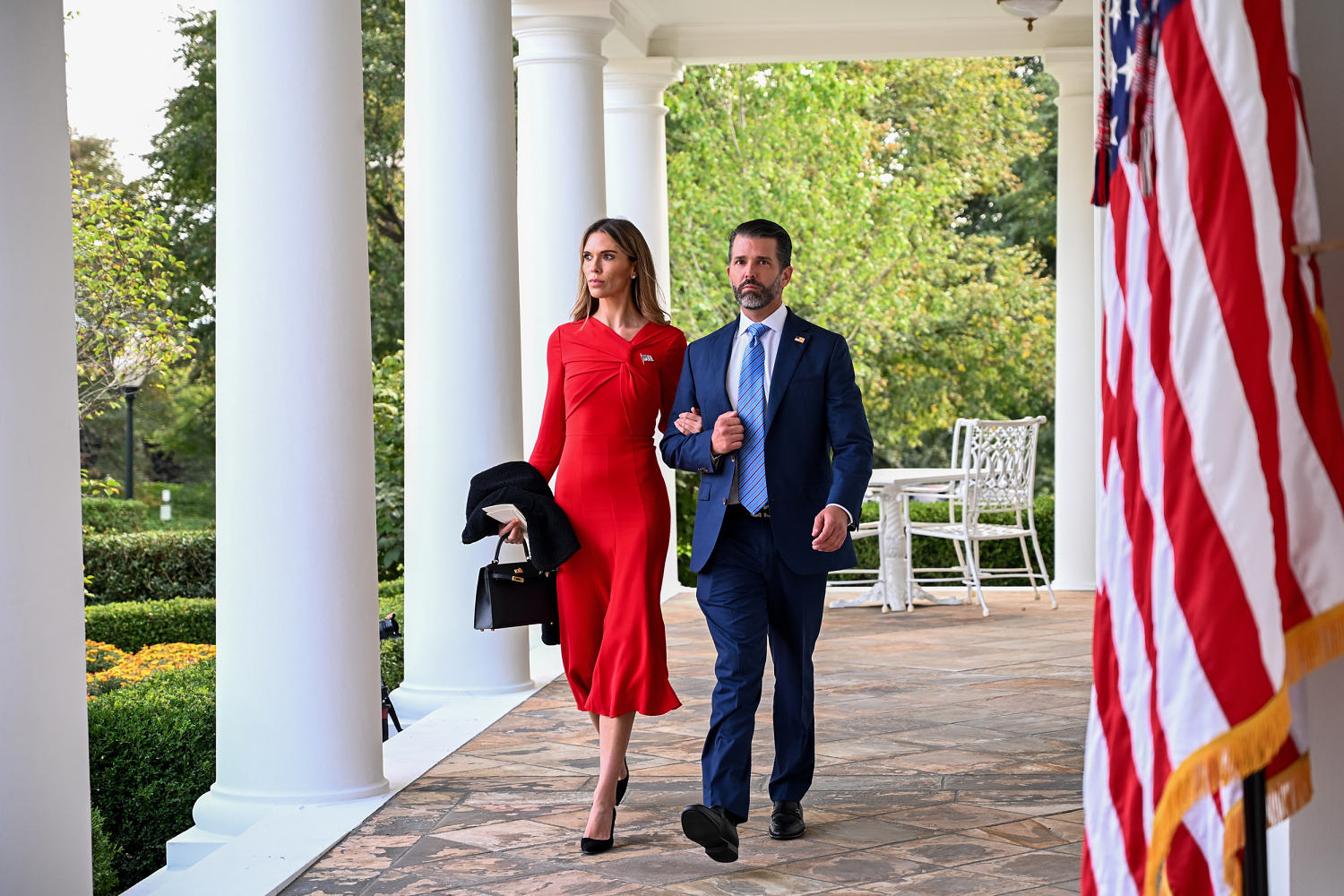
When Donald Trump Jr. married Bettina Anderson during an exclusive multi-day celebration across private islands in the Bahamas, the optics were standard elite fare. Helicopters ferried well-heeled guests to pristine beaches, fireworks erupted from barges over the ocean, and fashion houses spent hundreds of hours hand-embroidering custom attire. Yet behind the champagne toasts and beachside DJ sets lay a financial disclosure that detonated across Washington and international capitals: a significant portion of the luxury weekend was secretly bankrolled by Umar Kremlev, a Russian oligarch with direct ties to Vladimir Putin.
The revelation transformed what should have been a private family affair into a high-stakes geopolitical flashpoint. Donald Trump Jr. and his wife later defended the arrangement as a simple wedding gift between dear friends, arguing that personal relationships should not be filtered through a geopolitical lens. But investigative reports from outlets like ProPublica, followed swiftly by sharp rebukes and calls for congressional inquiries from figures such as Republican Senator John Curtis, exposed a deeper structural reality. This was not merely about a billionaire wedding. It was a glaring window into the subterranean channels where personal patronage, international soft power, and elite political access continually intersect.
To understand why a private island celebration in the Bahamas triggered immediate bipartisan alarm bells, one must look closely at the benefactor himself. Umar Kremlev is not a peripheral figure in modern Russian politics. As the head of the International Boxing Association (IBA)—an organization heavily backed by the Russian state-owned energy giant Gazprom—Kremlev operates firmly within the inner circle of the Kremlin. He has received high-level state honors directly from Putin, and his financial movements are closely scrutinized by Western intelligence and sanctioning bodies. For a prominent member of the American political dynasty currently navigating high-stakes foreign policy tensions, accepting six-figure hospitality from a key Putin ally represents a staggering indifference to protocol and public perception.
The defense offered by the couple relied heavily on the normalization of elite hospitality. In statements posted to social media, they maintained that generosity does not automatically carry a hidden agenda and that friendship transcends borders. Later, reports surfaced indicating that Trump Jr. had repaid the funds following public exposure, an action intended to short-circuit political fallout. But in the ecosystem of investigative analysis, repayment after the fact does not erase the initial transaction. The core issue is accessibility. Wealthy foreign actors do not bankroll American political scions out of sheer altruism. They invest in proximity. They buy entry into an inner circle that commands influence, information, and future leverage.
This dynamic exposes a systemic vulnerability in how modern political families handle foreign money. While statutory campaign finance laws tightly regulate direct political contributions, the personal lives of political figures remain a wide-open backdoor. Weddings, birthday bashes, and private luxury gatherings function as unregulated clearinghouses for soft influence. When an oligarch closely tied to an adversarial government subsidizes a multi-day coastal gala, the return on investment is measured not in policy votes cast the next day, but in the normalization of relations. It bridges the gap between sanctioned actors and the American power elite, turning potential pariahs into welcomed social peers.
The political fallout was immediate and predictable. Critics on Capitol Hill pointed out the striking double standard of past congressional investigations into foreign entanglements, demanding rigorous oversight to determine whether the arrangement violated ethical boundaries or leveraged proximity to the executive branch for private financial gain. Defenders of the Trump family dismissed the uproar as a manufactured political weapon, arguing that private friendships are routinely weaponized by opponents looking for a scandal.
Yet the discomfort reached across party lines for a reason. In an era where trust in institutional integrity is already severely eroded, the visual of a Putin-aligned oligarch paying for fireworks and private island rentals for the president's son touches a raw nerve. It demonstrates a persistent blind spot among political elites who treat global power struggles as background noise while maintaining personal lifestyles funded by international capital networks.
Ultimately, the Bahamas wedding serves as a textbook case study in how global power operates away from podiums and press briefings. It reveals an entrenched elite class that views borders as porous and political loyalties as secondary to personal networking. The checks may have been written, and the repayments may have been tallied, but the underlying machinery of informal influence continues to turn unchecked.
This video provides an overview of the news coverage regarding the financial backing of Donald Trump Jr.'s wedding celebration by a Russian oligarch.


