The United States Department of Justice unsealed a criminal complaint in a Manhattan federal court revealing the capture of Mohammad Baqer Saad Dawood al-Saadi, a senior commander within the Iran-backed Iraqi militia Kataib Hezbollah. He stands accused of directing a sprawling campaign of nearly 20 terror attacks and attempted strikes across Europe, Canada, and the United States, including specific operations targeting Jewish institutions in New York, Los Angeles, and Arizona. His quiet arrest in Turkey and subsequent transfer to American custody marks the most significant capture of an Iranian proxy operative since the conflict with Tehran intensified. While Washington touts this as a major counterterrorism victory, the reality is far more troubling. The arrest exposes a profound intelligence failure, proving that Iran-aligned networks can operate deeply within Western borders, shifting their battlefield tactics from regional skirmishes to global asymmetric warfare.
Western intelligence agencies have long operated under the assumption that Middle Eastern militias focus their kinetic operations within regional theaters like Iraq, Syria, and Lebanon. Al-Saadi smashed that assumption. Operating under the banner of a front group called Harakat Ashab al-Yamin al-Islamiya, al-Saadi allegedly coordinated a campaign that targeted financial institutions in Amsterdam, synagogues in Canada, and individuals in the United Kingdom.
The strategy is clear. By using ambiguous front organizations, Kataib Hezbollah and its handlers in the Islamic Revolutionary Guard Corps Quds Force maintain deniability while stretching Western domestic security infrastructure to its absolute limit.
The Myth of Regional Containment
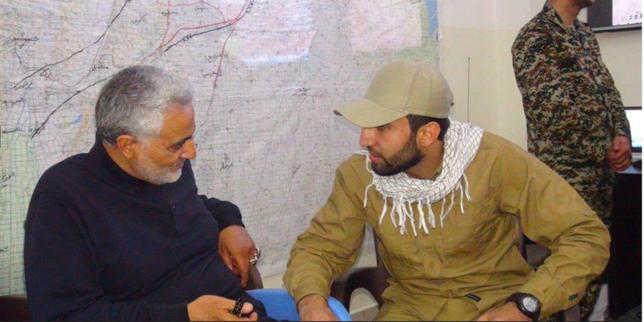
For two decades, American policy toward Iraqi paramilitaries relied on containment through localized airstrikes and economic sanctions. This approach ignored the structural evolution of these groups. Al-Saadi was not a low-level insurgent. Photographs embedded in the federal complaint show him standing alongside Qasem Soleimani, the architect of Iran's regional proxy network who was killed by a American drone strike in 2020.
Al-Saadi inherited Soleimani’s doctrine of transnational asymmetric warfare. The unsealed documents reveal that instead of relying on elite, highly trained cells smuggled across borders, al-Saadi leveraged online platforms and encrypted communications to recruit local actors, provide digital blueprints, and wire operational funds.
In April and May, al-Saadi actively communicated with an undercover law enforcement officer, transmitting maps, detailed photographs of a New York synagogue, and specific instructions for a mass-casualty attack. He promised immediate funding to execute the plot. This method removes the need for complex logistical supply lines. A single handler sitting in Baghdad or Ankara can activate a lone actor in Manhattan with nothing more than a smartphone and a cryptocurrency wallet.
The Turkey Connection and the Diplomatic Blind Spot
The details surrounding al-Saadi’s capture point to a massive diplomatic vulnerability. Though American authorities have remained tight-lipped about the mechanics of the operation, defense sources confirm al-Saadi was apprehended in Turkey.
Ankara’s complex role in regional security remains a thorn in the side of Western intelligence. Turkey frequently positions itself as a NATO ally while simultaneously acting as a safe haven for regional political dissidents, financiers, and militia leaders looking to escape the direct heat of Baghdad or Damascus. Al-Saadi operated with relative freedom across the border, using Turkish infrastructure to manage operations spanning from Paris to Toronto.
The fact that the United States had to execute a sensitive extraction overseas highlights the limits of current international legal frameworks. Relying on host nations to police these actors is a losing game. It requires significant American political capital and clandestine pressure to force an arrest, all while dozens of other commanders continue to manage financial assets and operational cells from similar diplomatic grey zones.
Why Sanctions and Law Enforcement Cannot Stop the Network
The current American playbook relies heavily on a combination of financial sanctions and criminal indictments. Just weeks before al-Saadi's arrest was made public, the United States Treasury Department issued sweeping designations against multiple Iraqi militia commanders from factions including Asaib Ahl al-Haq and Kataib Sayyid al-Shuhada. The measures aim to freeze assets and choke off the siphoning of Iraqi state funds toward Tehran’s external operations.
These measures miss the point. The financial architecture supporting these networks is completely decoupled from the formal global banking system. They rely on local cash-transfer networks, front companies embedded in the Iraqi state apparatus, and digital assets.
"I am a political prisoner, a prisoner of war," al-Saadi declared during his initial appearance in front of a Manhattan judge.
His statement reflects the mindset of the organizations he represents. These groups do not view themselves as criminal enterprises subject to Western domestic law. They view themselves as state-backed entities engaged in an existential war. Treating a senior paramilitary commander as a standard criminal defendant ignores the broader geopolitical reality. For every coordinator the Justice Department manages to place in a federal courtroom, the Quds Force possesses a deep bench of ideologically committed officers ready to step into the vacuum.
The Reality of Western Vulnerability
The threat has fundamentally changed. The cross-border operations attributed to al-Saadi, including the firebombing of a bank building in the Netherlands and a shooting near the United States consulate in Toronto, prove that the battle lines have moved. Security barriers around military bases in the Middle East offer no protection against an adversary targeting civilian infrastructure in Europe and North America.
Domestic law enforcement agencies are poorly equipped to counter this hybrid model. Detecting a radicalized individual purchasing domestic components for an explosive device based on instructions sent from a handler thousands of miles away requires flawless, real-time intelligence sharing between international spy agencies and local police departments. That level of cooperation remains elusive.
Washington's latest arrest offers a fleeting tactical victory, but it underscores a strategic failure. The United States and its allies remain trapped in a reactive cycle, scrambling to intercept individual plots while the apparatus generating those threats remains entirely intact. The infrastructure that allowed al-Saadi to orchestrate twenty attacks across two continents without setting foot in the West is still functional, waiting for the next commander to log on.