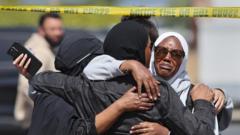
Two teenagers heavily armed with stolen firearms murdered three people outside the Islamic Center of San Diego on Monday morning, a targeted assault that local and federal law enforcement are officially treating as a racially motivated hate crime. The gunmen, identified by federal law enforcement officials as 17-year-old Cain Clark and 18-year-old Caleb Vazquez, opened fire just before midday prayers at the Clairemont Mesa facility, killing a security guard and two school staff members before fleeing and turning their weapons on themselves. This tragedy marks a devastating breakdown in community safety, occurring nearly two hours after a parent explicitly warned police that an armed, suicidal teenager clad in camouflage was on the loose.
The attack exposes a critical vulnerability in how law enforcement prioritizes and tracks fast-moving, radicalized youth threats before they pull the trigger.
Two Hours to Core Failure
At 9:42 a.m. on Monday, the mother of Cain Clark dialed 911. Her report to the San Diego Police Department was definitive, terrifying, and precise. Her son was missing, severely suicidal, dressed in military-style camouflage, and driving her vehicle. Crucially, she informed dispatchers that multiple firearms were missing from her residence.
For the next two hours, local police attempted to locate the vehicle using automated license plate readers and localized searches. It was a race against a clock nobody could see. Clark, a student at nearby James Madison High School who attended classes virtually, had met up with Vazquez. Together, they drove to the largest mosque complex in San Diego County, a facility that also houses the Bright Horizon Academy elementary school.
The intervention came too late. At 11:43 a.m., the first frantic 911 calls originated from the mosque grounds on Eckstrom Avenue.
Witness accounts and initial ballistics data indicate the shooters utilized at least one semi-automatic rifle. They did not hesitate. They targeted adults gathered near the entrance of the building just as worshippers were arriving for noon prayers. After gunning down three men, the pair drove away, firing wild shots at a nearby landscaper—whose helmet miraculously deflected a bullet—before parking their vehicle in the middle of a road two blocks away. By the time tactical units surrounded the car at 1:07 p.m., both teenagers were dead from self-inflicted gunshot wounds.
The Thin Line Outside the Mosque Entrance
Blood shed on the asphalt outside the Islamic Center could have been exponentially worse. Law enforcement officials have confirmed that the fast actions of the mosque’s private security guard prevented the gunmen from advancing into the interior of the complex, where dozens of elementary school children were attending classes.
The guard, whose identity has been withheld pending formal family notification, stood his ground as the armed teenagers approached. He was killed alongside two mosque staff members who worked at the educational academy.
"Undoubtedly, he saved lives today," San Diego Police Chief Scott Wahl stated during an afternoon briefing. "The actions of this guard minimized a threat that was actively moving toward an open school and house of worship."
🔗 Read more: The High Cost of Intelligence Operations in Mexico
Police officers arrived at the scene within four minutes of the initial active shooter broadcast, transitioning immediately into an evacuation protocol. School children and staff members were moved through a rear perimeter to a designated reunification center. While physical safety was secured for the children, the psychological reality of the assault has devastated the local community.
The Digital Undercurrent of Hate
Federal investigators from the FBI have joined local homicide detectives to process a massive volume of evidence retrieved from the suspects' vehicle and digital profiles. The early findings paint a familiar, disturbing picture of rapid youth radicalization.
- Weapon Inscriptions: Hand-drawn messages containing explicit white supremacist rhetoric and anti-Muslim slurs were scrawled directly onto the body of one recovered firearm.
- The Suicide Note: A document recovered by investigators at the Clark residence contained explicit references to racial pride, xenophobia, and a desire to commit a historic act of violence.
- Virtual Isolation: Neighbors and school acquaintances noted that Clark had withdrawn almost entirely from physical social networks over the past year, operating almost exclusively within online subcultures.
This pattern mirrors a broader institutional crisis. The Council on American-Islamic Relations noted that this targeted assault follows a historic surge in anti-Muslim bias incidents, with 2025 recording the highest volume of civil rights complaints since tracking began three decades ago.
Redefining the Active Search Protocol
The immediate political response has followed a predictable script. Local officials issued statements affirming that hatred has no place in the city, while community leaders pleaded for the protection of religious institutions. These sentiments, while valid, ignore the structural breakdown that occurred between 9:42 a.m. and 11:43 a.m.
When a parent reports a missing child with a firearm, the institutional response frequently categorizes the event as a localized mental health crisis or a missing persons case until a secondary crime is committed. In this instance, the transition from a suicidal teenager to an operational domestic terrorist occurred in the blind spot of traditional law enforcement tracking. Automated license plate readers are highly effective at tracking historic routes, but they are inherently reactive. They cannot predict a target.
The Islamic Center of San Diego had received no specific, actionable threats in the days leading up to Monday. There was no intelligence flag outside of generalized online vitriol. This means that even if police had a heightened presence at high-risk sites, a random, unmonitored cell consisting of two radicalized teenagers with access to household weapons will bypass standard threat-assessment matrices every single time.
Hardening targets with armed guards can mitigate casualties, as it tragically did in this case. It does not stop the trajectory of the bullet. The true vulnerability lies in the hours between the initial domestic alarm and the deployment of a tactical response team to a scene already covered in yellow tape.