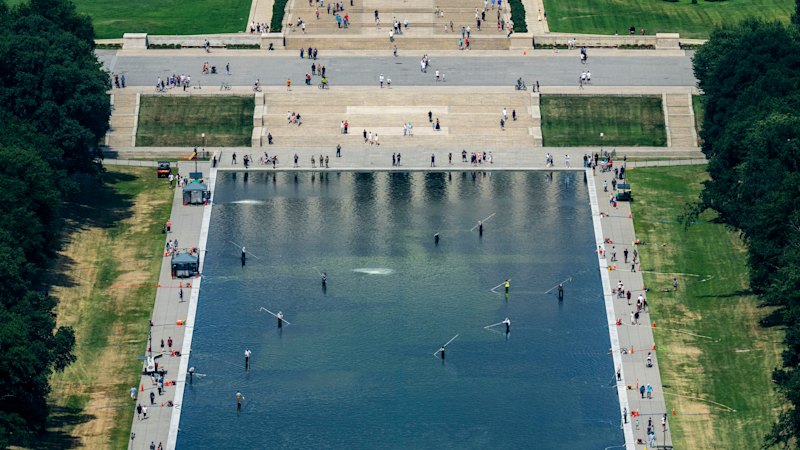
The water between the Lincoln Memorial and the Washington Monument was supposed to mirror American grandeur for the July 4 celebrations. Instead, it is reflecting an expensive construction disaster and an immediate rush to find a political scapegoat. When the National Mall’s historic Reflecting Pool began turning a thick, unappealing green and losing its bottom liner just weeks after a hurried fourteen-million-dollar renovation, the official explanation from the White House did not focus on structural integrity or materials science. It focused on sabotage.
President Donald Trump announced that six people had been arrested for allegedly slicing the pool liner with knives and box cutters. High-tech mobile surveillance trailers with security cameras rolled into position along the water, and armed guards took up positions along the gravel pathways. The administration labeled the suspects deranged political enemies out to ruin a national monument.
The reality on the ground points toward something far more mundane, yet far more systemic. An investigation into the project reveals a story of rushed deadlines, an inappropriate choice of industrial lining material, and a contract linked to a political donor. Rather than a coordinated cell of anti-administration saboteurs, the individuals swept up by United States Park Police include confused tourists and an aging former Olympic athlete who simply noticed the pool floor floating to the surface.
The Blue Liners and the Blame Game
The conflict centers on a specialized polyurea polymer lining applied to the bottom of the two-thousand-four-hundred-foot pool. The coating was intended to give the water a crisp, deep-blue appearance. It failed almost immediately. Within days of the pool being refilled, massive sheets of the blue material detached from the concrete bed, trapping air and water underneath until they bubbled to the surface like giant plastic blisters.
To anyone familiar with commercial pool contracting, the failure looked like a textbook case of improper surface preparation. Concrete must be meticulously dried, blasted, and cured before a polymer lining can adhere permanently. If moisture is trapped beneath the coating, or if the chemical mix is applied during high humidity, the bond fails. The lining peels away in sheets.
The White House took a different view. Press Secretary Karoline Leavitt went on television to declare that seventeen police reports had been filed regarding "deranged individuals" vandalizing the site. The president publicly upgraded his description of the damage, claiming someone had violently cut a three-hundred-and-fifty-foot slit into the bottom of the pool with a knife.
The sudden deployment of security cameras and National Guard units transformed a public park into a monitored zone. The goal appeared twofold. First, it protected the physical site from curious onlookers. Second, it solidified a narrative that the administration’s infrastructure achievements were being actively dismantled by political opponents.
Engineering Shortcut or Political Target
The contract to overhaul the water system tells a highly specific story of modern government procurement. A firm owned by a major campaign contributor, Greenwater Systems, secured a one-point-seven-million-dollar portion of the project to install a new nanobubbler device designed to limit algae growth. This technology relies on microscopic oxygen bubbles to clear water without the heavy use of traditional chemicals like chlorine or copper sulfate.
It is a specialized system. But it has limits.
In high heat with intense sunlight and heavy organic material blowing into an open, shallow basin, nanobubblers cannot keep up. The pool became a warm, shallow petri dish. As the water turned green, the heat absorption increased, which further weakened the experimental polyurea lining on the floor.
Contractors who work on large-scale municipal water features point out that maintaining a perfect mirror effect requires the water to remain completely still. High-velocity filtration grids can disrupt the glass-like surface that tourists expect when looking toward the Washington Monument. To preserve the visual effect, the administration opted for a low-circulation system that prioritized aesthetics over water movement.
When the heat wave arrived, the water stagnated. The polymer baked. The lining peeled.
A former project manager for the Army Corps of Engineers, speaking on the condition of anonymity, explained the fundamental flaw. "You cannot rush a polymer application on a basin that size just to hit a political calendar date. If you don't let the substrate cure, it will lift. Blaming a guy with a pocketknife is a lot easier than admitting you threw millions of dollars of public money at a rushed paint job."
The Case of the Curious Canoeist
The profile of those arrested contradicts the narrative of coordinated political terrorism. Among the six individuals taken into custody by federal authorities was David Hearn, a former Olympic canoeist who has spent decades navigating American waterways.
Hearn was walking past the Reflecting Pool when he noticed a massive flap of blue material floating near the edge. Curious about the strange failure of a highly publicized public works project, he reached into the water to touch the material. A National Park Service employee shouted at him to step back. Moments later, U.S. Park Police officers handcuffed him.
He was charged with defacing public property. Hearn has denied any intent to vandalize the pool, maintaining that the material was already completely detached and floating when he arrived. His upcoming court date in July will likely serve as a test case for how aggressively the Department of Justice intends to pursue these incidents.
The other individuals arrested face similar misdemeanor citations for disorderly conduct or trespassing after stepping into the shallow water. No knives or box cutters have been entered into the public court records as evidence. The administration has promised that photographic proof of the alleged sabotage will be released when the time is right, but the local U.S. Attorney’s office is still reviewing the thin files provided by park police.
The legal stakes are high. The administration has reminded the public that federal laws passed during previous civil unrest carry a mandatory ten-year prison sentence for damaging national monuments. Threatening tourists with a decade in a federal penitentiary for touching a peeling piece of plastic is an extreme legal strategy. It exposes the desperation to keep the public from looking too closely at the structural engineering choices.
Millions in the Water and No Solution
Repairing the Reflecting Pool will not be as simple as patching a slit or arresting more bystanders. If the initial bond between the polymer lining and the concrete floor has failed across the entire structure, the entire basin will need to be drained once again.
The existing fourteen-million-dollar coat must be scraped away entirely. The concrete must be sandblasted down to a clean substrate, and the project must start from scratch under strict environmental conditions that cannot be dictated by campaign schedules or holiday press opportunities.
The mobile security trailers remain parked on the grass, their lenses pointed at the green, murky water. Guards patrol the perimeter, keeping citizens at a distance from a public space that has occupied the center of American civic life for more than a century. The measures are described as counter-vandalism initiatives. In practice, they keep the voters far enough away that they cannot see the blue polymer sheets floating to the surface, breaking apart in the sun.
The administration succeeded in creating a talking point about law and order in the heart of Washington. It failed to build a pool that holds water.