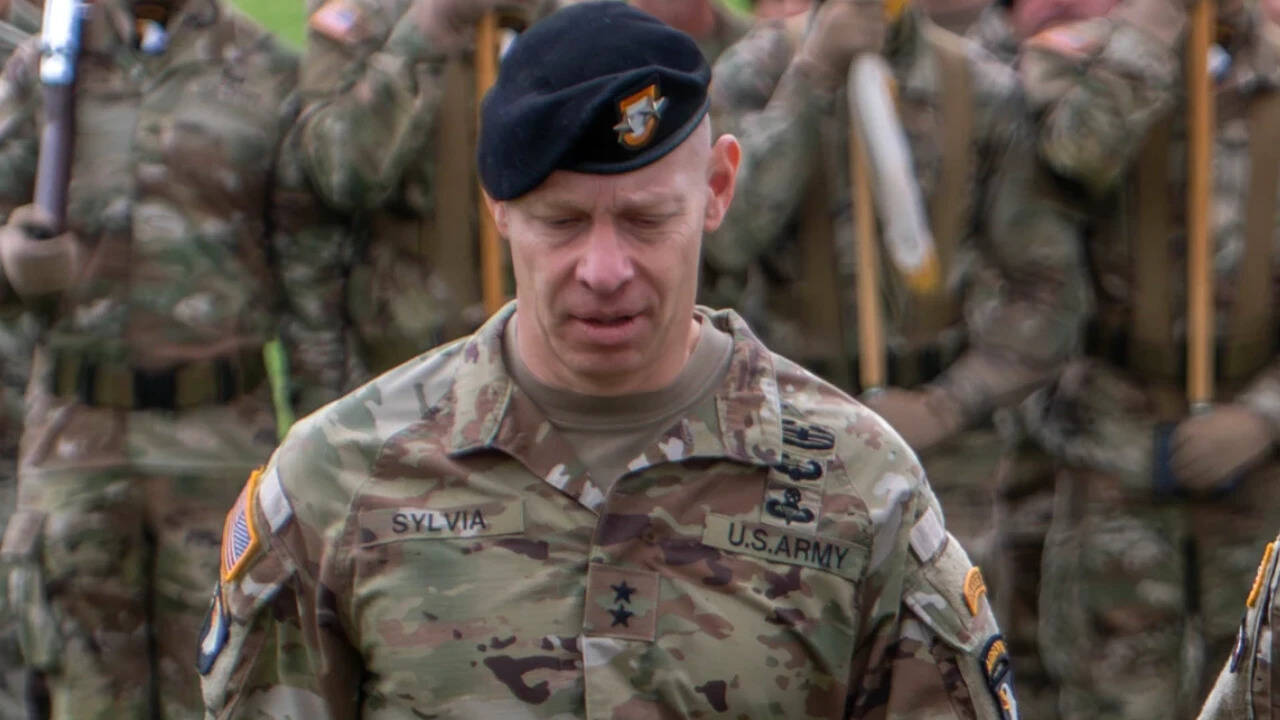
A former high-ranking United States general has formally admitted to leaking classified national defense information regarding Iran and Ukraine to journalists. The admission, entered in federal court, resolves an investigation into unauthorized disclosures of sensitive military intelligence and underscores a widening operational vulnerability inside the Pentagon. While the dismissal from command stripped the officer of his rank and influence, the broader institutional breakdown that allowed strategic secrets to leave secure facilities remains largely intact.
Washington treats leaks as political theater. In reality, they are an operational sickness. When a senior flag officer bypasses classification protocols to feed reporters sensitive assessments on active conflict zones, the damage extends far beyond an embarrassing news cycle. Adversaries in Tehran and Moscow do not read American newspapers for entertainment; they treat them as open-source intelligence dashboards to reverse-engineer Western collection capabilities.
The Anatomy of a Senior-Level Disclosure
Most people picture intelligence leaks as the work of disgruntled junior analysts smearing data onto thumb drives in windowless basements. That is a Hollywood caricature. In practice, the most damaging disclosures in Washington almost always originate at the top of the chain of command.
Flag officers and senior defense officials operate under an entirely different set of unspoken rules than the enlisted personnel they command. A specialist who takes a single classified document home faces immediate arrest, pre-trial confinement, and years in Leavenworth. A general officer, by contrast, lives inside a culture where strategic leaking is routinely used as a bureaucratic weapon.
Officials leak to shape policy debates before they reach the Oval Office. They leak to undercut rival agencies, to lock the White House into a specific military posture, or to burnish their own reputations as sober-minded realists in the eyes of the Washington press corps. By the time a general sits down with a favored defense correspondent, the line between "providing background context" and committing a felony under the Espionage Act has often blurred beyond recognition.
In this instance, the disclosures centered on two of the most volatile theaters in modern geopolitics: Iranian military capabilities and the ongoing conflict in Ukraine. Both subjects represent active, real-time intelligence priorities where the United States relies heavily on signals intelligence, satellite imagery, and human sources that take decades to cultivate.
When classified assessments on these regions appear in print, foreign intelligence services immediately conduct damage assessments. They look at the specific phrasing, the precision of the dates, and the nature of the conclusions. Even if a journalist carefully omits the underlying intelligence methods, the mere fact that the Pentagon knows a specific detail tells an adversary which communication channel is compromised or which asset has been turned.
Why Iran and Ukraine Intelligence Carries Extreme Risk
To understand why these specific leaks triggered an aggressive federal prosecution rather than a quiet administrative reprimand, you have to look at the operational realities on the ground in both regions.
In the case of Ukraine, American intelligence sharing has been the quiet backbone of Kyiv's defensive operations. This includes tracking Russian troop movements, identifying logistical bottlenecks, and warning of impending missile strikes. Maintaining that pipeline requires absolute operational security. If Moscow determines how the United States is acquiring specific battlefield telemetry, Russian electronic warfare units can adjust their frequencies, relocate command posts, or execute deceptive maneuvers designed to feed false data back into Western sensors.
Furthermore, unauthorized disclosures about Ukraine strain the fragile diplomatic consensus among NATO allies. European intelligence services share raw data with Washington on the strict condition that it remains inside secure channels. When a senior American officer hands that information to a reporter, it signals to allies in London, Warsaw, and Berlin that the Pentagon cannot police its own senior leadership.
The Iranian theater presents an equally unforgiving environment. Intelligence regarding Tehran's nuclear ambitions, ballistic missile transfers, and proxy networks across the Middle East is notoriously difficult to verify. Sources inside Iran operate under constant threat of execution.
When classified intelligence regarding Iranian activities leaks to the press, the Iranian Ministry of Intelligence immediately begins hunting for the breach. Sources go dark. Safe houses are abandoned. Decades of painstaking intelligence work can evaporate within forty-eight hours of a single front-page story.
The Double Standard Inside the Security Clearance System
The prosecution of a fired general exposes a glaring contradiction at the heart of the American national security apparatus. For years, critics inside the defense establishment have pointed out a two-tiered justice system governing the handling of classified material.
Consider how the system treats low-level infractions versus high-level disclosures:
- Junior Personnel: Subject to continuous automated monitoring, random bag searches, and strict polygraph schedules. Minor mishandling of classified data routinely results in immediate revocation of clearances and career termination.
- Senior Leadership: Frequently granted waivers for secure communications devices, permitted to transport classified briefing binders outside Sensitive Compartmented Information Facilities (SCIFs), and given wide latitude to engage directly with the media without public affairs minders present.
- The Prosecution Gap: Historically, the Department of Justice has aggressively pursued lower-level leakers like Reality Winner or Jack Teixeira while declining to prosecute senior officials who disclosed vastly more sensitive material to prominent journalists.
This disparity is not an accident. Prosecuting a general officer carries immense institutional friction. It requires navigating the Uniform Code of Military Justice alongside federal criminal statutes, dealing with high-powered defense attorneys drawn from the ranks of former federal prosecutors, and risking the exposure of even more classified information during the discovery phase of a trial.
Under the Classified Information Procedures Act (CIPA), defense lawyers have the right to demand access to classified documents relevant to their client's defense. In many cases, the government chooses to drop charges or offer lenient plea deals rather than allow sensitive intelligence methods to be litigated in open court—a tactic known in legal circles as "graymail."
The fact that this investigation resulted in a formal admission of guilt suggests the evidence gathered by federal investigators was overwhelming. Digital trails, encrypted messaging metadata, and phone logs linking senior officials to reporters have made it vastly more difficult for leakers to hide behind traditional journalistic source protections.
How Modern Leak Investigations Trap Senior Officials
Twenty years ago, catching a high-level leaker required luck, a wiretap, or a confession. Today, the digital architecture of the modern intelligence community functions as a surveillance net that records almost every interaction an official has with classified data.
Every time a general opens a classified file on the Joint Worldwide Intelligence Communications System (JWICS), the system logs the user's credentials, the exact timestamp, and the terminal location. If the document is printed, embedded micro-dots invisible to the naked eye encode the printer's serial number and the user's identity onto the paper.
Federal investigators no longer need to subpoena a journalist's phone records—a politically explosive move that the Department of Justice has largely restricted under updated media guidelines. Instead, they work backward from the published article.
Investigators isolate the exact facts contained in the news report and cross-reference them against the access logs of every individual who viewed the corresponding intelligence cables. In most cases, a specific piece of finished intelligence on a sensitive topic like Iran or Ukraine is restricted to a small distribution list—sometimes fewer than fifty people across the entire government.
From there, the FBI cross-references those names against commercial data brokers, cell tower location logs, and metadata from encrypted messaging applications. Even if the content of a Signal or WhatsApp message is encrypted, the metadata showing that a general messaged a defense reporter twenty minutes after viewing a top-secret cable creates a devastating circumstantial timeline.
Once investigators establish that timeline, they confront the official. Lying to federal agents during an interview triggers a separate felony charge under 18 U.S.C. § 1001, which is often far easier for prosecutors to prove than the underlying Espionage Act violation. Many high-profile national security cases collapse into plea agreements precisely because the target panicked and lied during the initial FBI interview.
The Role of the Washington Press Corps
Any honest examination of Pentagon leaks must also confront the symbiotic relationship between senior military leaders and the reporters who cover them.
National security journalism relies heavily on unauthorized disclosures. Without whistleblowers and anonymous sources, the American public would know virtually nothing about the true cost of foreign interventions, failed weapons programs, or intelligence failures. Reporters have a constitutional mandate to publish information that is in the public interest, and the First Amendment protects their right to do so.
However, the dynamic between beat reporters and flag officers is rarely about exposing government wrongdoing. More often, it is transactional.
A general provides a reporter with an exclusive scoop—a classified detail about Iranian drone shipments or Ukrainian ammunition shortages. In exchange, the reporter frames the story in a way that flatters the general's command, validates their budget requests, or undermines a rival faction inside the Pentagon or the National Security Council.
Reporters rarely pause to ask whether the official leaking the information is doing so out of noble whistleblower instincts or petty bureaucratic self-interest. The scoop gets published, the reporter gets a front-page byline, and the general gets political leverage.
The problem arises when that transactional culture becomes so normalized that senior leaders lose sight of why classification boundaries exist in the first place. When classified intelligence becomes just another currency to be traded for favorable press coverage, operational security ceases to be a priority.
The Structural Flaws in Pentagon Information Security
Firing one general and securing a guilty plea in federal court will not stop the next leak. The underlying structural issues inside the Department of Defense remain untouched.
The first major flaw is over-classification. The federal government classifies millions of documents every year, stamping everything from routine scheduling memos to open-source news summaries as "Secret" or "Top Secret." When everything is treated as a state secret, nothing is treated with genuine reverence. Senior officials become desensitized to classification markings because they spend their entire careers wading through oceans of needlessly restricted paperwork.
The second flaw is compartmentalization failure. During crises like the war in Ukraine or escalating tensions with Iran, the Pentagon rapidly expands access to intelligence products to ensure commanders and policymakers are synchronized. While well-intentioned, this expansion routinely pushes sensitive raw intelligence out to dozens of staffers and flag officers who have no operational need to see the underlying sources and methods.
The third flaw is cultural impunity. Until the Department of Defense enforces the exact same administrative and criminal standards on four-star generals that it enforces on twenty-year-old intelligence specialists, senior leaders will continue to view security rules as optional guidelines.
What Happens Next for the Defense Establishment
The admission of guilt closes the criminal chapter for one former commander, stripping him of his career and standing. Yet inside the E-Ring of the Pentagon, the incentives that drove the leak remain firmly in place.
Congressional oversight committees have repeatedly demanded stricter accountability for senior officials who mishandle classified data, often using high-profile leak cases to score partisan points against whichever administration occupies the White House. Hearings are held, stern warnings are issued, and new compliance training modules are rolled out across the force.
None of it alters the basic reality of Washington power politics. As long as strategic leaks remain the most effective way to win bureaucratic turf wars, senior officials will continue to take the risk, betting that they will never be the one caught in the crosshairs of an FBI counterintelligence probe.
Real reform requires cutting the volume of classified material by half, severely restricting the distribution of raw intelligence to senior political and military appointees, and applying mandatory, automatic clearance revocations the moment an unauthorized disclosure is traced to a command suite. Without those hard structural guardrails, the Pentagon will simply wait for the next crisis, the next headline, and the next disgraced general standing before a federal judge.