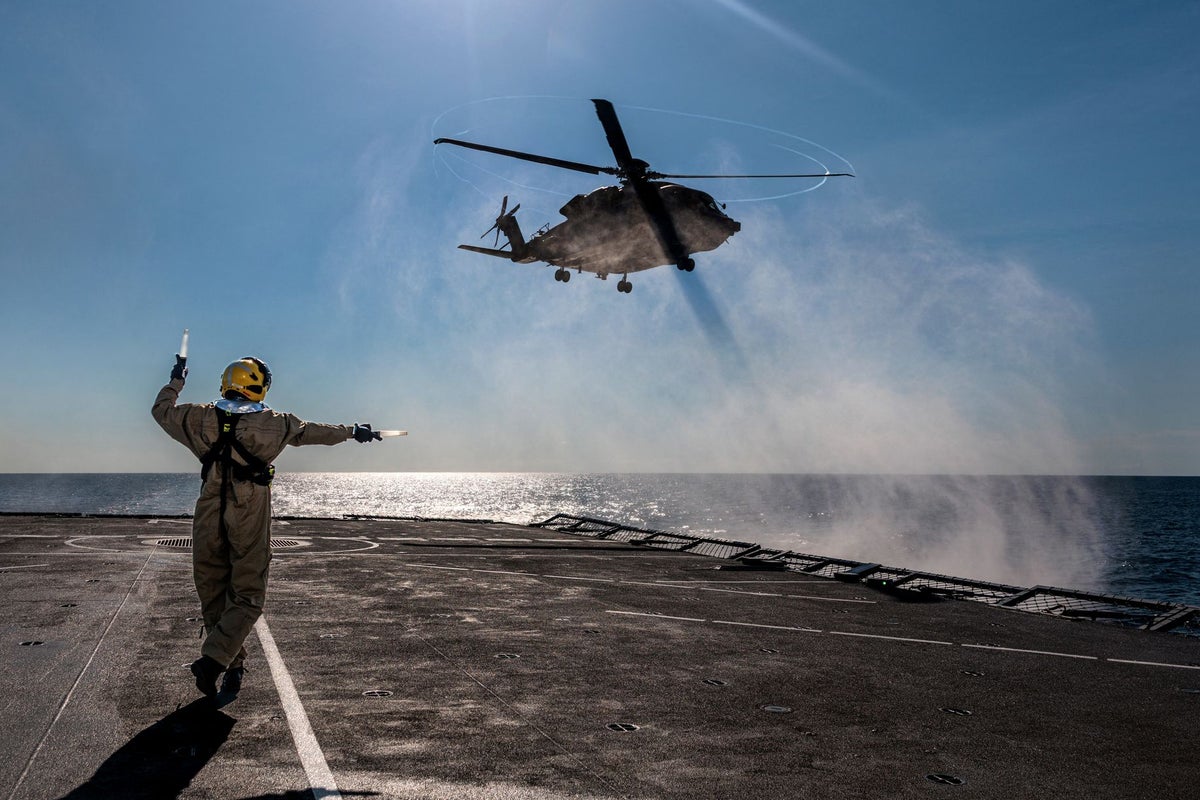
The warships slicing through the gray swells of the Atlantic Ocean this week look like a manifestation of absolute Western unity. Under the gray skies off the American eastern seaboard, European and American hulls are arrayed in formation for FLEETEX 250, a massive naval exercise designed to demonstrate that the North Atlantic Treaty Organization remains an undivided bloc. Norwegian sailors practice boarding operations, Spanish marines storm beaches, and French gunners train alongside American troops at Camp Lejeune. To the casual observer, the message is clear: the alliance is functioning exactly as intended.
But look closer at the command decks and the hallways of the Pentagon, and a far more dangerous reality becomes visible. This massive display of naval cooperation is not a sign of health. It is the final, mechanical reflex of an institutional machine whose political brain has stopped functioning.
While these ships train to defend the American homeland, the political foundation supporting them is actively disintegrating. In Washington, the administration has spent months questioning the core utility of the 77-year-old alliance. The White House is openly reviewing its military presence in Europe, threatening troop drawdowns, and castigating traditional allies for failing to support American military operations elsewhere. The drills happening at sea are not a demonstration of contemporary geopolitical alignment. They are an expensive illusion. They are happening simply because military bureaucracies plan these events years in advance, moving forward on administrative inertia even as the political alliance crumbles beneath them.
The Disconnect Between the Oval Office and the Atlantic Fleet
The friction inside the alliance exploded into the open during a recent Oval Office meeting between President Donald Trump and NATO Secretary General Mark Rutte. Rather than issuing the standard diplomatic platitudes about shared values, the American president used the session to sharply criticize Britain, France, Germany, and Spain. The core of the grievance is Washington’s ongoing military campaign in Iran. The White House expects total compliance and direct military assistance from its European partners, but European capitals, deeply wary of another prolonged Middle Eastern conflict, have hesitated.
"We are disappointed with most of them," Trump stated flatly following the meeting, signaling a profound shift in how Washington views its security obligations.
This is not mere rhetoric. Defense Secretary Pete Hegseth recently announced a comprehensive six-month Pentagon review of the American military posture across the European continent. The message from defense leadership has been blunt. Washington is tired of what it considers "free-riding" partners who rely on American taxpayers to underwrite their territorial security while refusing to align with American strategic priorities overseas.
This creates an unprecedented paradox. At sea, British Commodore Maryla Ingham commands Standing NATO Maritime Group One, directing a multinational fleet that includes frigates from Belgium, Denmark, Germany, the Netherlands, Norway, and Turkey. These crews work together, utilizing deeply ingrained protocols to share radar data, coordinate anti-submarine maneuvers, and integrate complex supply chains. They are operating under the assumption that an attack on one remains an attack on all. Yet, simultaneously, their political masters are debating whether the alliance should even survive the year.
The Shadow War in Iran and the Friction Points
The true strain on the transatlantic relationship is not found in the waters of the Atlantic, but in the Persian Gulf. Washington's aggressive stance against Tehran has become the ultimate litmus test for alliance loyalty, and Europe is failing it in the eyes of the current administration.
Consider the case of Spain. An internal Pentagon email circulated earlier this year revealed that high-level officials floated the idea of suspending Madrid from certain NATO mechanisms entirely. The reason was Spain's refusal to grant overflight and basing rights to American military aircraft participating in operations against Iran. For Washington, blocking access during an active conflict is an act of geopolitical betrayal. For Madrid, avoiding entanglement in an unsanctioned war is a matter of national sovereignty.
Yet, despite this severe diplomatic breach, Spanish marines are still participating in the FLEETEX 250 drills, practicing amphibious ship-to-shore movements alongside the very American forces that discussed punishing them.
France presents a similar contradiction. French President Emmanuel Macron reportedly irritated Washington by suggesting during a diplomatic dinner that French forces would only assist in securing the Strait of Hormuz after active hostilities had concluded. The response from the White House was swift derision, with the American president publicly mocking Macron and dismissing NATO as a weak entity. Yet, French personnel are currently stationed at Camp Lejeune, training with heavy machine guns alongside U.S. Marines.
This operational continuity exists because the military apparatus operates on a completely different timeline than the political executive branch. A major naval exercise involving twenty nations takes years of logistical planning, budget allocations, and diplomatic coordination. Diplomatic notes are exchanged, fuel contracts are signed, and ammunition transfers are scheduled long before a shift in executive leadership occurs. Unless an explicit, written order comes down from the commander-in-chief to halt the ships, the bureaucracy keeps grinding forward. It does what it was built to do, ignoring the political storm outside the windows of the command centers.
The Machinery of Alliance Autopilot
The institutional momentum of NATO is immense. For nearly eight decades, the alliance has built a unified military structure that transcends national boundaries. It has created a common language of warfare, standardized ammunition sizes, integrated radar networks, and established permanent command structures like the Supreme Headquarters Allied Powers Europe.
This deep integration allows a Norwegian frigate like the Fridtjof Nansen to sail into the middle of an American carrier strike group and immediately understand how to receive data, defend the perimeter, and execute complex maneuvers without a single hour of specialized preparation. The technical experts and the deck-level officers value this capability enormously. To them, interoperability is a shield against chaos.
But this technical success masks a profound strategic vulnerability. When the operational level is entirely decoupled from the political level, military exercises become hollow theater.
Former military officials who served during previous periods of political tension warn that this insulation has a shelf life. While working-level ties can survive a few months of angry statements or Twitter posts, they cannot survive a systemic re-evaluation of national strategy. If the ongoing Pentagon review results in a permanent reduction of American forces stationed in Germany or Italy, the logistical backbone of these joint exercises will begin to fracture. The American military provides the heavy lift capabilities, the satellite reconnaissance networks, and the vast logistics chains that make large-scale NATO operations possible. Take those away, or severely restrict them, and the ability of European nations to project power alongside the United States evaporates.
A Post American Alliance Forms in the Shadows
Sensing the shifting winds in Washington, some European leaders are quietly preparing for a future where the American security umbrella is either severely degraded or removed entirely. This is not an abstract anxiety. It is already altering how military exercises are conducted on the European continent.
Earlier this year, NATO executed Steadfast Dart 2026, a massive amphibious assault exercise along Germany’s Baltic coast involving 10,000 personnel from eleven nations. On paper, it was a routine defense drill. In reality, it was historic for what was missing: significant United States military participation.
For the first time in over a decade, a premier NATO training event was conducted almost entirely without American troops, ships, or aircraft. The official explanation from defense planners was that the exercise was designed to test Europe’s capacity to manage a high-intensity crisis autonomously. The unvarnished truth is that European defense officials knew Washington had no interest in sending significant forces to a Baltic exercise while its primary focus was directed toward Iran and the Pacific.
The drill was commanded by German General Ingo Gerhartz and featured high-profile roles for European assets, including the deployment of combat drones from the Turkish carrier TCG Anadolu. German Defense Minister Boris Pistorius attempted to put a brave face on the American absence, calling the maneuver a successful demonstration of European readiness and alliance solidarity.
But behind the official optimism lies a sobering calculation. European defense budgets, while rising, are still nowhere near the level required to replace American capabilities. Spain remains a persistent holdout against Washington's demands to raise defense spending to five percent of gross domestic product. Berlin and Paris are facing severe domestic economic pressures that make massive military expansions politically toxic.
The current naval maneuvers off the American coast are a beautiful distraction. They allow defense ministers to point to photographs of unified fleets and pretend that the transatlantic relationship is secure. But the ships will eventually run out of fuel, the exercise will end, and the European vessels will head back across the Atlantic. When they return to their home ports, they will face a European continent that is increasingly isolated, a Washington that views them as an operational burden, and a security architecture that is running entirely on empty.