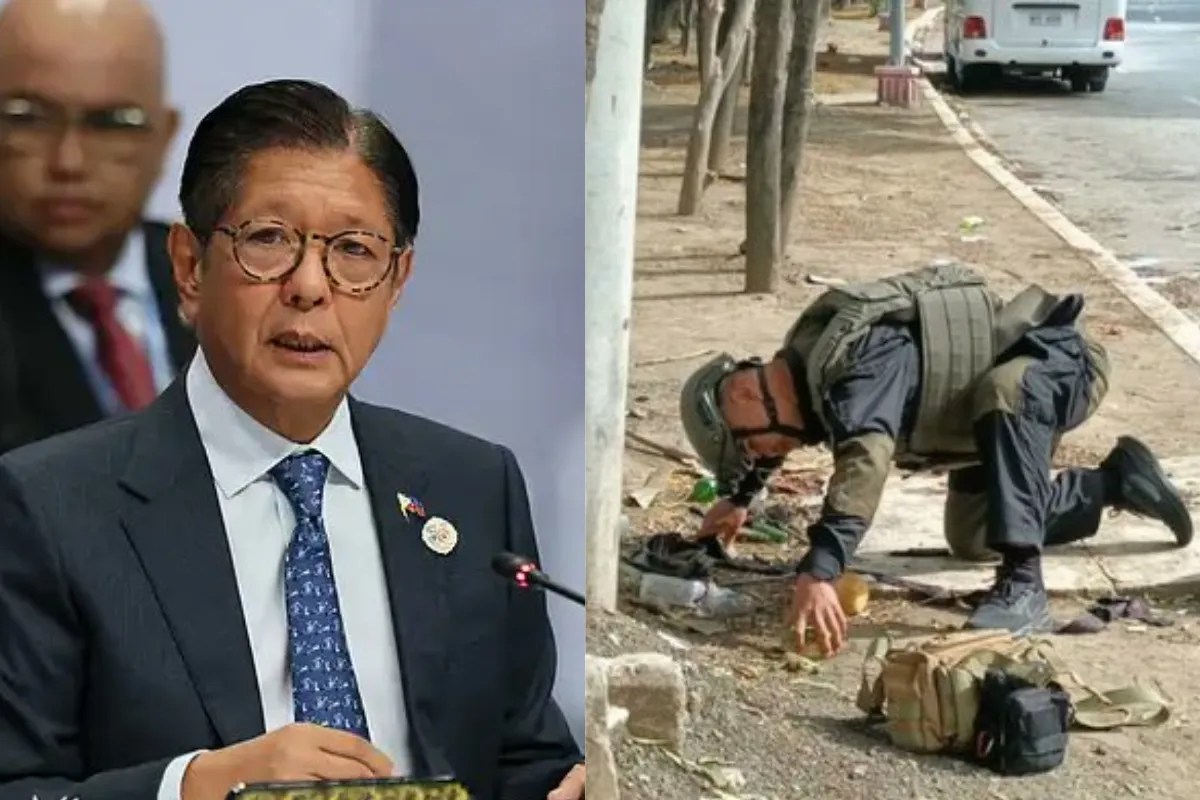
The warning came before the blast shook the pavement. Hours ahead of a high-stakes national address by the president of the Philippines, an explosion tore through a sensitive zone, shattering the fragile illusion of state control. Security forces moved in immediately, locking down transit corridors and sealing off perimeter blocks. Official statements followed the standard playbook: calm down, stay indoors, investigations are underway. But veteran observers reading between the lines understood a different reality. This was not a random act of domestic vandalism. It was a calculated provocation timed precisely to rattle the executive branch at its most vulnerable public moment.
Security alerts do not reach the highest tier by accident. Intelligence agencies operate on thresholds of credibility that require concrete intercepts, verified movement of illicit materials, or direct threats from organized networks. When a blast punctuates a national address, the messaging is unmistakable. Someone wanted to demonstrate that state protection has blind spots.
The Anatomy of a Pre-Address Shock
Timing dictates the gravity of any security breach. A detonation hours before a major presidential speech shifts the strategic objective from physical destruction to psychological warfare. The target was the narrative.
Administrations rely heavily on scheduled addresses to project authority, outline economic milestones, or rally public sentiment behind contentious policies. Interrupting that rhythm forces the executive to pivot from a proactive agenda to reactive damage control.
- The explosion occurred within striking distance of key government installations.
- Intelligence units had already flagged heightened chatter among marginalized militant factions.
- Emergency protocols enacted immediately afterward paralyzed normal urban transit.
Governments under siege often struggle with transparency. When a blast rattles the capital region during a political flashpoint, the information vacuum fills rapidly with panic and speculation. Officials face an impossible choice between admitting intelligence failures and offering reassurance that lacks immediate proof.
Historic Vulnerabilities in the Archipelago
Security architectures in the Philippines carry deep structural scars. Managing an archipelago consisting of over seven thousand islands stretches national law enforcement and military resources to their absolute limits. Regional commands operate with varying degrees of autonomy, intelligence-sharing remains uneven, and fringe groups exploit maritime porousness with alarming consistency.
Decades of counter-insurgency operations across the southern provinces have left a legacy of displaced combatants, hidden weapons caches, and radicalized cells capable of projecting power into urban centers like Metro Manila.
"An intelligence apparatus is only as strong as its weakest provincial link. When porous borders meet decentralized insurgent networks, capital cities become easy stages for high-visibility attacks."
💡 You might also like: Why Friedrich Merz is playing both sides of the Iran war
State responses historically swing between two extremes. The heavy-handed approach deploys massive military presence, suspends civil liberties, and alienates local populations whose cooperation is vital for intelligence gathering. Conversely, lenient engagement policies allow extremist cells to regroup, recruit, and rearm under the cover of legitimate political dissent.
The Intelligence Breakdown
Every security failure post-mortem points back to a fundamental flaw in threat assessment. How did explosive materials bypass checkpoints guarding the capital district? Why did threat monitors fail to connect local surveillance feeds with broader operational chatter?
Modern threat mitigation relies heavily on signals intelligence and human assets on the ground. When these streams fail to synchronize, explosions happen in broad daylight.
- Signal Intercepts: Encrypted messaging apps complicate the task of monitoring active plots.
- Human Intelligence: Informants often demand higher payouts or switch allegiances as political winds shift.
- Logistics Control: Industrial precursors for improvised devices frequently leak from commercial supply chains.
The public demands absolute safety, yet absolute safety remains an illusion in a democracy grappling with deep-seated insurgencies and criminal syndicates. State apparatuses are built for bureaucracy, not instantaneous tactical adaptation.
Economic and Geopolitical Ripples
Unrest in Manila sends immediate shockwaves through foreign investment sectors and diplomatic channels. International markets despise instability. When a high-profile security breach occurs on the eve of a major executive address, currency traders react, tourism projections dip, and foreign embassies issue travel advisories.
The administration cannot afford protracted uncertainty. Foreign direct investment depends heavily on the perception of a stable rule of law. If investors suspect the state cannot secure its own capital district ahead of a planned presidential address, long-term infrastructure commitments face sudden review.
Regional neighbors watch closely. Manila plays a pivotal role in broader Indo-Pacific security alignments, particularly regarding maritime disputes in the South China Sea. Internal distractions weaken the administration's hand at international negotiating tables, signaling domestic vulnerability to external rivals.
The Path Forward for State Security
Preventing future disruptions requires more than temporary curfews and heightened street patrols. Intelligence units must modernize their data integration capabilities, bridging the communication gap between local police precincts and national security councils.
Investments in forensic technology and border surveillance must accelerate. Yet, technology alone cannot replace deep community engagement. Law enforcement agencies need the trust of local populations to intercept explosive materials before they reach urban centers.
The smoke cleared from the blast site hours after the event, but the political fallout continues to settle across the capital. As investigators sift through the wreckage and pore over recovered fragments, the administration faces a sobering reality. High alerts are symptoms of a deeper disease. Until the structural gaps in intelligence and regional policing find permanent resolution, the next warning may not come with advance notice.