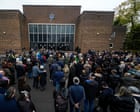
The British government is moving aggressively to shield internal security files from public scrutiny regarding the October 2025 Manchester synagogue attack, triggering sharp pushback from grieving families and legal representatives. Lawyers acting for Home Secretary Shabana Mahmood formally notified a pre-inquest review that releasing specific intelligence documents held by MI5 and counter-terrorism police would inflict severe damage on national security. This legal maneuver places state secrecy directly against demands for accountability following the tragic events at the Heaton Park Hebrew Congregation Synagogue in Crumpsall.
The attack unfolded on October 2, 2025, during Yom Kippur, the holiest day in the Jewish calendar. Jihad al-Shamie, a 35-year-old Syrian-born British citizen, drove a vehicle into the synagogue gates while wearing what appeared to be a suicide vest. Armed with a knife, al-Shamie began his assault before police intervention ended his life. Melvin Cravitz, aged 66, died from multiple stab wounds inflicted by the terrorist. Adrian Daulby, aged 53, was killed when a stray police bullet struck him as he bravely helped hold the building doors shut against the intruder. Ten shots were fired by armed officers during the chaotic response, a detail that has added intense scrutiny to the state's operational footprint during the crisis.
Chief Coroner Judge Alexia Durran is now tasked with weighing the Home Office application to withhold a discrete body of security-sensitive material from the upcoming public inquest. Representing the Home Office, Neil Sheldon KC argued that the restriction is a targeted, well-analyzed necessity rather than an extreme blanket refusal. Conversely, legal teams for the victims' families maintain that the government's sudden suppression of documents threatens the core principles of open justice.
The Credibility Gap
At the heart of the legal friction lies a profound discrepancy between initial official statements and the emergence of classified intelligence. Immediately following the bloodshed, high-ranking state officials assured the public and Parliament that al-Shamie was entirely unknown to counter-terrorism police and security services. Home Secretary Mahmood and local counter-terrorism chiefs repeated these assertions in the House of Commons and through formal press briefings.
Families of the deceased argue that the government's current bid to lock away MI5 files suggests a very different reality. Anna Morris KC, representing the family of Adrian Daulby, pointedly told the court that the move hints at a demonstrable lack of candour by security agencies, drawing direct parallels to historical disclosure fights seen during the Manchester Arena bombing inquiry. Victoria Ailes, counsel for the Cravitz family, emphasized that public confidence depends entirely on transparency, noting that official statements minimizing prior contact with the attacker make the demand for open records much more acute.
If the withheld files reveal prior intelligence flags, missed warnings, or unexamined associations, the political fallout for the Home Office will be immense. State agencies routinely invoke Public Interest Immunity to prevent the exposure of sensitive methodologies or informants, but this tool frequently collides with the inquisitorial mandate to uncover preventable failures.
Echoes of Past Inquiries
The procedural battle unfolding in Manchester carries heavy historical weight. The trajectory mirrors the early legal skirmishes of the 2017 Manchester Arena bombing proceedings, where protracted battles over secret intelligence material eventually forced authorities to transition standard coroner inquests into a full statutory public inquiry.
A standard coroner's court in England and Wales possesses narrow legal boundaries and cannot legally review evidence presented behind closed doors in secret sessions. Recognizing this structural limitation, Judge Durran is actively weighing whether to ask the government to convert the current inquest framework into a formal public inquiry. Such a transition would grant a designated chair sweeping powers to compel witnesses, examine classified documents in private via closed hearings, and issue binding recommendations.
Yet, public inquiries are notoriously slow, expensive, and emotionally grueling for victims' families. While a public inquiry can legally ingest secret MI5 files away from public view, it also risks extending the timeline for closure by years, trading immediate public accountability for behind-closed-doors judicial review.
The Web of Accomplices and State Blind Spots
Beyond the core argument over secret files, the wider investigation has exposed troubling operational links that complicate the narrative of a lone-wolf actor. Court revelations have shown that just two months before the synagogue attack, al-Shamie traveled by car to the UK Defence Academy in Shrivenham, Wiltshire, accompanied by another man named Mohammad Asim Bashir. Bashir was later identified after counter-terrorism investigators scrubbed through digital devices seized from al-Shamie.
Separately, authorities charged 49-year-old Hekmat Omar Ali Hakim with failing to disclose critical information regarding the terrorist plot. Hakim entered a not-guilty plea at Westminster Magistrates' Court. These developments demonstrate that al-Shamie operated within a network, raising persistent questions about whether local surveillance or intelligence sharing adequately mapped these connections before the deadly strike on Heaton Park.
Legal teams are also preparing to scrutinize the actions of the Independent Office for Police Conduct, which has faced significant delays in finalizing its independent review of the police response and the use of lethal force. With multiple investigative tracks intersecting, the pressure on the state to justify its veil of secrecy continues to mount.
Judge Durran will issue a formal written ruling on the Home Office non-disclosure application at a later date, setting the procedural baseline for what promises to be a grueling examination of state competence, intelligence sharing, and community safety.


