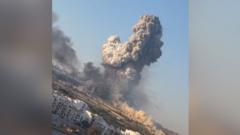
The ground shock that rolled through northern Malta at 6:35 AM on Monday did more than shatter windows across the Magħtab and Naxxar area. It obliterated the Ta’ Lourdes fireworks factory, sending a thousand-foot plume of black smoke into the Mediterranean sky and hospitalizing two nearby farmers. Coming less than forty-eight hours after Prime Minister Robert Abela secured a historic fourth term for the Labour party, the blast serves as a blunt reminder of an ongoing crisis. Malta is trapped between an centuries-old cultural tradition and the realities of modern industrial safety.
Every summer, the Maltese archipelago transforms into a competitive theater of pyrotechnics. Local band clubs and parish societies spend hundreds of thousands of euros to outdo neighboring villages during the traditional festa season. Yet, the supply chain behind these spectacular displays relies on a network of volunteer-run, structurally vulnerable compounding facilities that are increasingly incompatible with Malta's rapid urbanization.
The Ta’ Lourdes incident is not an isolated piece of bad luck. It is the predictable outcome of an industry operating on high-risk chemistry, legacy infrastructure, and a regulatory framework that prioritizes cultural preservation over modern chemical risk management.
The Chemistry of a Blast Wave
To understand why the Ta’ Lourdes facility was instantly reduced to a crater of twisted metal and pulverized limestone, one must look at the specific formulas used in Maltese pyrotechnics. Unlike commercial fireworks factories in mainland Europe, which rely heavily on automated machinery and standardized black powder mixtures, Maltese artisans specialize in heavy, color-changing aerial shells known as beraq.
These shells require highly volatile chemical mixtures. Potassium perchlorate and barium nitrate are ground and blended by hand with aluminum and magnesium powders to create brilliant strobes and thunderous acoustic reports.
The primary vulnerability in this manufacturing process is the sensitivity of these flash powders to external stimuli.
- Friction: Microscopic sliding friction generated during the hand-mixing or packing of shells can create localized hot spots.
- Static Electricity: Malta's high summer temperatures paired with dry atmospheric shifts can cause static charges to build up on plastic utensils, clothing, or ungrounded work benches.
- Spontaneous Decomposition: If moisture enters a storage room containing sulfur and chlorate mixtures, a slow exothermic reaction begins. Once the internal temperature of a storage magazine breaches a critical threshold, thermal runaway occurs.
Because the licensed pyrotechnicians were not on site when the first detonation occurred on Monday morning, the investigation is heavily targeting spontaneous chemical decomposition or a structural failure within the storage magazines. When a primary storage cell detonates, the blast wave triggers a sympathetic detonation in adjacent holding rooms, ensuring the complete annihilation of the facility within milliseconds.
Encroachment and the Illusion of Safety Distance
Historically, Malta’s fireworks factories were built in isolated rural pockets, surrounded by sweeping rocky terrain and agricultural garrigue. This isolation provided a natural buffer zone. If a facility exploded, the energy dissipated safely into the open air.
That buffer zone no longer exists.
A decades-long construction boom has pushed residential developments, modern bypasses, and commercial farms right up to the legal boundaries of these hazardous sites. The Ta’ Lourdes blast dislodged facade material and broke glass kilometers away at Kennedy Grove, demonstrating that the statutory safety distances specified in Malta's Explosives Ordinance are dangerously outdated.
Consider the physical reality of a large-scale pyrotechnic detonation. The blast wave propagates as a supersonic shock front, generating intense peak overpressure.
$$P_{over} = \frac{E}{V}$$
Where $P_{over}$ is the overpressure, $E$ is the explosive energy released, and $V$ is the volume of the expanding blast sphere. In an open field, this pressure drops exponentially with distance. However, when the expanding wave hits modern concrete apartment blocks or industrial structures built on the periphery of the safe zone, the pressure waves reflect and amplify.
The two men hospitalized on Monday were not even inside the complex; they were simply working in adjacent agricultural fields. The fact that the shockwave shook buildings across multiple northern parishes proves that the nominal buffer zones fail to account for the sheer volume of explosive material stored inside these complexes ahead of the peak summer season.
The Volunteer Conundrum and Regulatory Hesitancy
The underlying structural flaw of the Maltese fireworks sector is its financial and organizational model. The vast majority of the island’s factories are owned and operated by voluntary band clubs and social societies. The individuals mixing highly unstable metal powders are not corporate employees managed by industrial health and safety officers. They are passionate hobbyists, working after hours in the pursuit of village pride.
This amateur status creates a steep barrier to implementing modern safety technology. Industrial automation, climate-controlled storage magazines with automated telemetry, and spark-proof environmental controls require capital investments that small volunteer organizations cannot sustain.
Furthermore, enforcement remains a political minefield. The Maltese festa is deeply tied to national identity and local voting blocs. Any administration that attempts to enforce sweeping, restrictive safety overhauls—such as banning certain high-risk chemical combinations or mandating commercial-grade industrial zoning—faces immediate, fierce backlash from powerful band club committees.
Following the latest incident, political leaders from both major parties quickly issued standard statements of solidarity and praised the rapid response of the Civil Protection Department. What was glaringly absent from the political rhetoric was any commitment to structural reform or legislative tightening.
A Path Forward or Continued Attrition
The survival of Malta’s pyrotechnic tradition depends on transitioning away from the current decentralized, volunteer-heavy manufacturing model. Relying on luck and the hope that factories only explode when workers are absent is an unsustainable strategy for a densely populated European island.
A viable solution requires centralized, state-subsidized compounding facilities. By shifting the initial, high-risk chemical mixing processes to a singular, heavily fortified industrial complex equipped with remote monitoring, automated deluge systems, and professional chemical engineers, the risk to human life can be systematically reduced. Local band clubs could then transition to assembly-only operations, handling stabilized components rather than raw, friction-sensitive flash powders.
Without a fundamental shift in how these materials are mixed and housed, the cycle of destruction will continue. The next detonation may not happen at dawn in an empty building. It will happen when the mixing rooms are full.