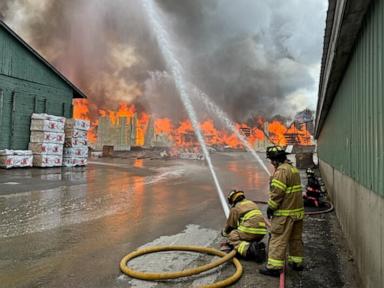
The official ruling on the catastrophic May 15 explosion at the Robbins Lumber mill in Searsmont, Maine, arrived with the standard vocabulary of bureaucratic finality. State fire investigators declared the incident "accidental," pointing to a mechanical failure in the unloader mechanism at the base of a five-story sawdust storage silo.
For the small community of 1,000 residents, the official report provides a timeline but obscures a much more pressing structural reality. A volunteer firefighter lost his life, a dozen other people were severely burned, and multiple emergency vehicles were reduced to charred frames. To classify this disaster simply as an unavoidable accident ignores the physics of combustible dust that industrial safety experts have warned about for decades. The tragedy at Searsmont was not a freak occurrence. It was a textbook demonstration of how standard industrial infrastructure can inadvertently bypass modern safety systems with fatal consequences.
The Spatial Blindspot of Fire Suppression Systems
State fire marshal investigators revealed a critical detail that explains why the fire escalated from a routine industrial malfunction into a fatal blast. The mill facility utilized an automated fire suppression system designed specifically to protect the silo. However, this system was installed near the roofline of the structure, reflecting a traditional assumption that rising heat would trigger the mechanisms early in an emergency.
The fire originated at the very bottom of the structure within the mechanical unloader. Because the silo stood roughly 50 feet tall, the thermal energy generated by the initial burning mass remained trapped at ground level. The air at the top of the structure never reached the temperature threshold required to activate the suppression system.
This design flaw creates a deadly spatial blindspot. While the fire smoldered out of sight in the lower machinery, the safety systems remained dormant. Industrial facilities frequently rely on zone-specific suppression that assumes a fire will rapidly engulf a space uniformly. When a fire remains localized at the base of a towering, fuel-filled column, the safety infrastructure is rendered useless until the environment undergoes a catastrophic transition.
The Physics of Suspended Particulates
The critical turning point in the Searsmont disaster occurred when volunteer firefighters and mill staff attempted to suppress the baseline fire. The moment water or compressed air introduced turbulence into the sealed environment, the structural dynamics shifted violently.
[Image of dust explosion pentagon]
Sawdust in a compact, settled pile burns relatively slowly due to limited oxygen availability. This is a surface-level fire. The hazard changes exponentially when those microscopic wood particles become airborne. By agitating the interior of the silo, the firefighting operations inadvertently suspended large volumes of fine particulate material into the air.
To create a devastating dust explosion, five specific conditions must be met simultaneously, often referred to by safety engineers as the dust explosion pentagon
- A combustible dust acting as fuel.
- An ignition source.
- An oxidizing agent, typically oxygen in the air.
- The dispersion of dust particles in a high concentration.
- The confinement of the dust cloud within an enclosed structure.
The Robbins Lumber silo fulfilled all five criteria perfectly. When the suspended dust cloud contacted the active fire at the unloader mechanism, the rate of combustion accelerated instantly. The flame front expanded through the suspended dust at supersonic speeds, creating a pressure wave that the steel and concrete foundation could not withstand. The explosion literally lifted the five-story structure off its foundation before toppling it into an adjacent warehouse containing five million board feet of dry lumber.
The Limits of Mutual Aid in Rural Infrastructure
When the silo detonated, it sent a horizontal wave of fire across the mill yard, engulfing first responders who were stationed nearby. The subsequent crisis exposed the inherent vulnerabilities of rural emergency response systems that rely heavily on mutual aid networks.
Volunteer fire departments from across multiple counties—including Morrill, Belfast, Camden, and Rockland—raced to the scene. Because small towns cannot maintain the massive water infrastructure required to fight a multi-building industrial fire, tankers were forced to draft water directly from the St. George River behind the mill complex.
[Silo Base Fire]
       │
       ▼ (Air Agitation / Firefighting Operations)
[Dust Dispersion] + [Confinement] + [Oxygen]
       │
       ▼ (Instantaneous Ignition)
[Pressure Blast & Deflagration]
       │
       ▼ (Structural Toppling)
[En-Masse Facility Fire]
This reliance on rural mutual aid creates an operational paradox. While the bravery and coordination of these regional departments prevented the total destruction of the surrounding town, the decentralized nature of volunteer forces means that personnel are often placed in high-risk industrial environments without the specialized, heavy-containment training that dedicated urban industrial fire brigades possess. A volunteer firefighter from a town of a few hundred residents faces the same chemical and physical hazards as an industrial specialist, but without the benefit of highly specialized, facility-specific defensive infrastructure.
Reevaluating the Cost of Mechanical Wear
By labeling the unloader failure as accidental, the investigation closes a legal loop but leaves an operational question wide open. Sawmill operations are brutal on machinery. The continuous friction of moving tons of abrasive wood shavings creates constant thermal hazards.
A mechanical failure in an unloader mechanism usually means a bearing seized, a belt slipped and overheated, or a foreign object introduced a spark via friction. In a standard manufacturing environment, a failed bearing trips a circuit breaker or causes a minor smoke condition. In a lumber mill, that same failed bearing operates inside a chamber filled with highly volatile fuel.
The lesson from Searsmont is that mechanical maintenance in high-dust environments cannot be treated as a matter of simple operational efficiency. It is a matter of life and death. If the mechanisms responsible for moving combustible material are not equipped with continuous thermal monitoring, vibration sensors, and isolated, lower-level suppression loops, the next "accidental" fire is already writing itself into existence somewhere else in the industrial landscape.
The ruins of the Robbins Lumber silo have been cleared away by heavy cranes, and the mill will eventually rebuild its lost capacity. The family-owned business has a deep history of community support in midcoast Maine, and the regional grief over the loss of a volunteer firefighter remains palpable. If the industrial sector treats this event merely as an unfortunate accident caused by a random mechanical failure, the true systemic flaws will remain unaddressed. The explosion was the predictable result of physics meeting an outdated safety layout, a reality that no official designation can change.