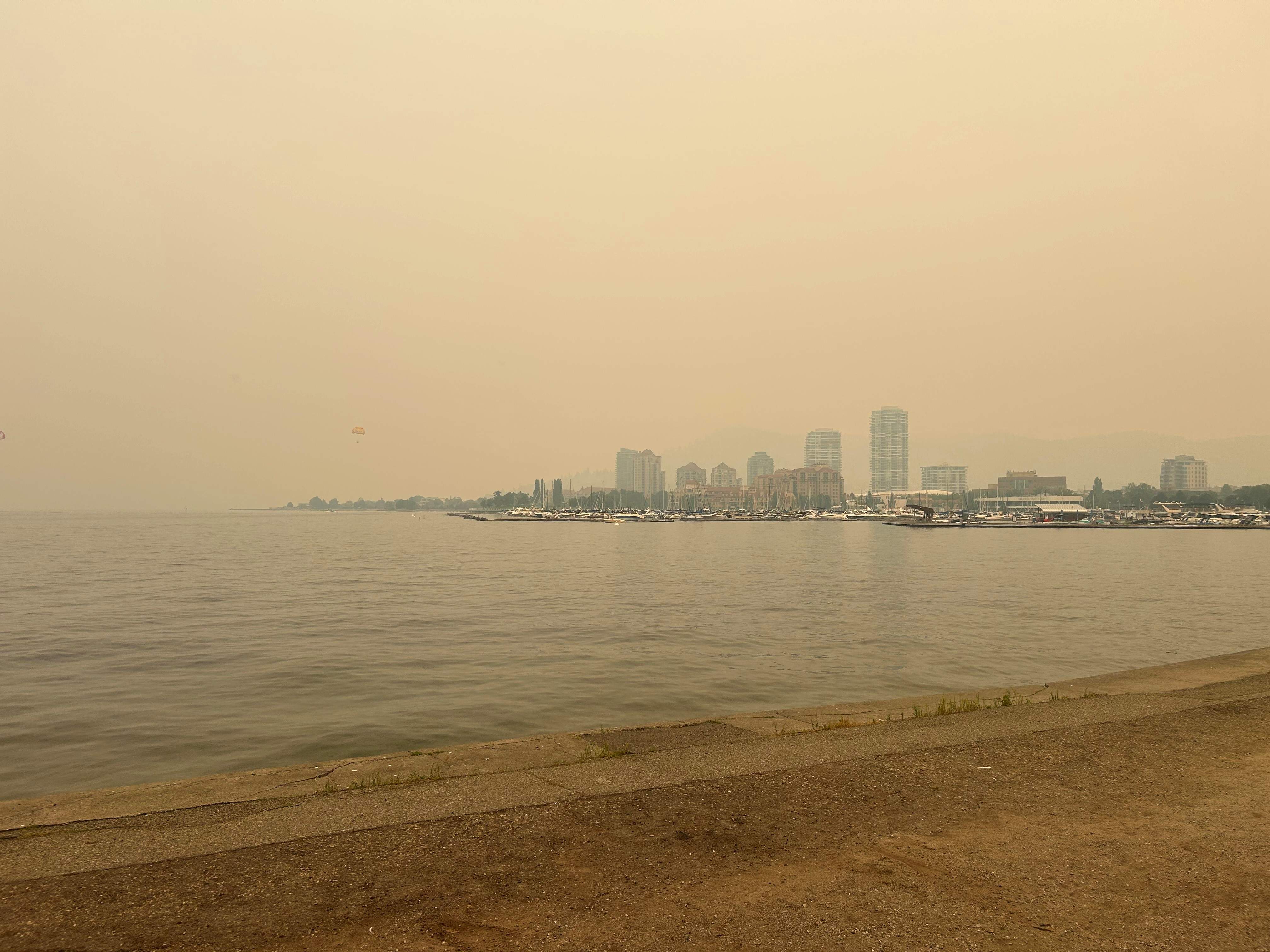
A suffocating wall of wildfire smoke has buried Kelowna, British Columbia, pushing the regional Air Quality Health Index to the maximum hazard rating of 10+ and forcing thousands of residents and tourists indoors during the peak of summer. Fine particulate matter, driven by roaring regional blazes, has pushed PM2.5 concentrations past 300 micrograms per cubic meter—more than twenty times the safety threshold established by global health organizations. Outdoor events across the Central Okanagan have vanished from the calendar, patio reservations sit empty, and local emergency rooms are seeing a predictable surge in respiratory complaints. Yet behind the immediate panic lies a predictable disaster built on decades of short-sighted land management, geographic bad luck, and political hesitation.
This annual ritual of toxic air is not an act of God. It is the direct consequence of human decisions made over more than a century.
The Geography of a Natural Smoke Trap
Kelowna sits inside a geographic funnel. The Okanagan Valley, bounded by the Monashee Mountains to the east and the Thompson Plateau to the west, creates an ideal basin for atmospheric inversion layers.
During midsummer heatwaves, hot air aloft acts like a heavy lid over the cooler air sitting near the surface of Okanagan Lake. When wildfire smoke enters this basin, it has nowhere to go. Winds stall against the mountain ridges, locking dense particulate pollution directly over the city's residential neighborhoods.
       [ Warm Upper Air Layer (Atmospheric Lid) ]
--------------------------------------------------------
   /\                                              /\
  /  \    [ Trapped Toxic Smoke & PM2.5 ]         /  \
 /    \                                          /    \
/      \______  [ Kelowna & Okanagan Lake ] ____/      \
 Monashee Mts.                                Thompson Plateau
Smoke does not merely sit in the air. It bakes under intense solar radiation, triggering secondary chemical reactions that produce ground-level ozone. This creates a cocktail of air pollutants far more dangerous than simple wood ash.
Residents breathing this air are not just inhaling burnt pine. They are inhaling complex organic compounds, volatile organic chemicals, and microscopic heavy metals released from burning soil and structural materials.
Anatomy of Microscopic Dust
The primary killer in wildfire smoke is invisible to the human eye. Fine particulate matter measuring 2.5 microns or smaller, known as PM2.5, bypasses the body's natural defense systems entirely.
Where larger dust particles get trapped in nose hair or upper mucus membranes, PM2.5 travels deep into the alveoli of the lungs. From there, these ultra-fine particles cross directly into the bloodstream.
"Wildfire PM2.5 is significantly more toxic than urban traffic pollution because it contains high concentrations of reactive oxygen species and polycyclic aromatic hydrocarbons," notes clinical environmental toxicology research. "When inhaled, it triggers systemic inflammation throughout the vascular system, not just the pulmonary tract."
| Particle Size | Biological Impact | Primary Health Risks |
|---|---|---|
| PM10 (Dust, Pollen) | Trapped in upper airways | Coughing, nasal irritation |
| PM2.5 (Wildfire Smoke) | Penetrates deep lung tissue | Asthma attacks, reduced lung capacity |
| Ultra-fine (<0.1 microns) | Enters bloodstream directly | Systemic inflammation, heart attacks, stroke |
The acute health consequences manifest immediately. Emergency rooms report spikes in cardiac arrhythmias, acute asthma attacks, and severe bronchitis during extended smoke events. Long-term exposure carries even darker implications, including accelerated cognitive decline, low birth weights in newborn infants, and structural damage to lung tissue equivalent to chronic tobacco smoking.
The Staggering Financial Toll on the Okanagan
The economic impact extends far beyond medical bills. Kelowna's economy relies heavily on summer tourism, drawing hundreds of thousands of visitors to its wineries, beaches, and resort properties.
Smoke destroys that economy overnight.
When smoke concentrations spike, cancellation rates at local hotels shoot upward within hours. Boating rentals sit tied to docks along Okanagan Lake because visibility drops below safe navigation standards. Wineries, which depend on outdoor tasting patios overlooking vineyards, are forced to shutter operations or attempt to move guests into cramped indoor cellars.
The financial damage cascades across several key sectors:
- Hospitality and Lodging: Mass cancellations leave hotel rooms vacant during the single quarter that generates the majority of annual profit.
- Agriculture and Viticulture: Severe smoke can cause "smoke taint" in wine grapes, where volatile phenols bind to sugars in the fruit, ruining entire vintages of wine before harvest even begins.
- Service and Retail: Outdoor festivals, farmers markets, and athletic competitions are forced to cancel, stripping millions of dollars in direct spending from the regional economy.
- Labor Force: Outdoor construction workers, agricultural laborers, and municipal crews face forced work stoppages to prevent occupational lung damage.
For small business owners in the Okanagan, a single week of heavy smoke can spell the difference between annual profitability and insolvency.
Centuries of Forest Mismanagement Catching Up
To understand why British Columbia burns so violently every summer, one must look back at more than a century of forestry policy.
For over a hundred years, government agencies operated under a doctrine of total fire suppression. Every natural blaze ignited by lightning was aggressively extinguished to protect timber reserves. While this policy saved commercial trees in the short term, it created a catastrophic ecological imbalance.
Historical Natural Cycle:
[ Small Frequent Fires ] ---> [ Clears Underbrush ] ---> [ Healthy, Open Forest ]

Modern Suppression Cycle:
[ Total Suppression ] ---> [ Massive Fuel Accumulation ] ---> [ Megafire Explosion ]
Without frequent, low-intensity natural fires clearing out underbrush, dead fallen wood, and overcrowded saplings, the forests surrounding Kelowna became dense powder kegs. Forestry experts call these fuel accumulations ladder fuels—vegetation that allows ground fires to climb easily into the upper tree canopy, transforming manageable surface fires into uncontainable crown fires.
Simultaneously, the outlawing of Indigenous cultural burning practices severed a millennia-old land management system. First Nations communities across the interior of B.C. historically conducted controlled, low-intensity burns during wet spring and autumn months. These intentional burns cleared dangerous fuel loads while rejuvenating plant life and maintaining natural firebreaks across the valley. Removing this practice left the landscape unchecked.
Policy Inertia at the Wildland Urban Interface
The political debate surrounding wildfire mitigation remains paralyzed by bureaucracy and public pushback.
Everyone agrees that forests require extensive fuel reduction treatments, including mechanical thinning and prescribed burns. Yet implementing these measures at the scale required meets fierce resistance. Prescribed burns produce smoke, and local communities often complain when forestry crews intentionally ignite controlled fires during spring or autumn windows, even though that controlled smoke prevents apocalyptic summer blazes.
"You have a choice," explains one senior wildland fire scientist. "You can take a small, controlled amount of smoke in April under managed conditions, or you can choke on toxic megafire smoke for three weeks in August. There is no zero-smoke option in a dry forest ecosystem."
Furthermore, municipal zoning laws continue to permit real estate development deep into high-risk forest zones, known as the Wildland-Urban Interface (WUI). As housing developments push further up the mountain slopes around Kelowna, the risk to human life and property skyrockets. Protecting homes built in dense brush forces wildland firefighters to defend static structures rather than applying tactical counter-fires that could stop a wildfire's advance.
+-----------------------------------------------------------------------+
|                       THE SMOKE CYCLE PARALYSIS                       |
|                                                                       |
| [ Dense Fuel Loads ] ---> [ Megafires Erupt ] ---> [ Toxic Smoke ]   |
|         ^                                                 |           |
|         |                                                 v           |
| [ Public Resistance ] <--- [ Ban Prescribed Burns ] <--- [ Public Outcry ]
+-----------------------------------------------------------------------+
The Reality of Living in the Burn Zone
Until provincial and municipal authorities commit to sweeping structural reform, residents of Kelowna are left to adapt on an individual level.
Relying on government emergency warnings is reactive. Real protection requires structural modifications to homes and workplaces. Standard furnace filters are useless against fine wildfire smoke; homes require high-efficiency MERV 13 filtration or dedicated HEPA purification systems capable of scrubbing fine particulates from indoor air.
Community planning must also evolve. Public infrastructure needs air-filtered cooling shelters for vulnerable populations who lack modern HVAC systems at home. Building codes in fire-prone regions must mandate non-combustible roofing materials, FireSmart defensible space around structures, and hardened air intake systems.
The smoke covering Kelowna is not an unpredictable natural disaster. It is the predictable outcome of a fire-dependent ecosystem pushed to its limits by climate anomalies and flawed land policy. Until British Columbia shifts its budget priorities from reactive fire suppression toward aggressive, year-round forest restoration and cultural burning, the Okanagan Valley will continue to burn, and its residents will continue to choke on the results.


