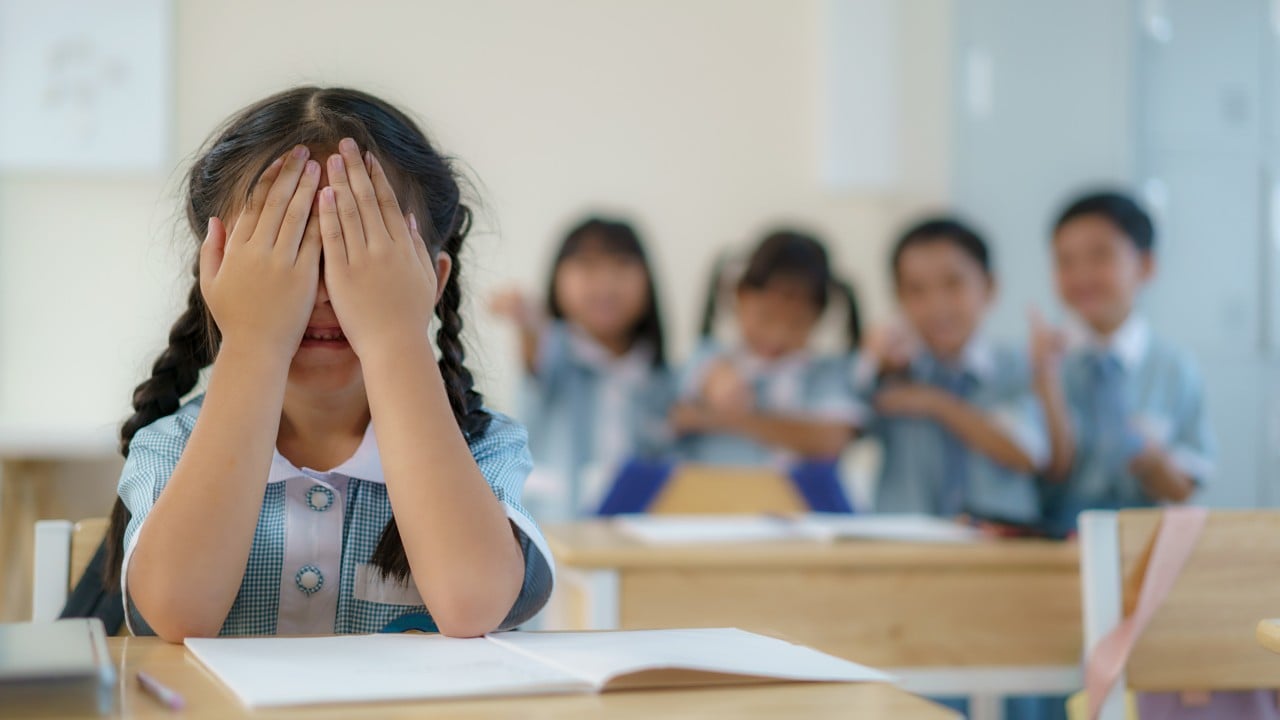
Official figures show reported school bullying cases in Hong Kong jumped 32 percent to nearly 500 cases a year, a statistical spike driven by post-pandemic classroom friction, unchecked smartphone harassment, and a long-overdue willingness by parents to file formal complaints. Yet anyone who has spent time auditing education bureaucracy in this city knows that 500 is a floor, not a ceiling. When an Education Bureau spreadsheet suddenly registers a one-third surge in misconduct across primary and secondary campuses, the real story is rarely a sudden overnight collapse in adolescent morality. The real story sits inside the reporting mechanisms, the reputational anxieties of school principals, and the quiet behavioral fallout of keeping an entire generation locked behind screens for three years.
Numbers lie by omission. In a city with roughly 700,000 primary and secondary students spread across more than a thousand schools, an official tally of nearly 500 bullying incidents averages out to less than half a case per school per academic year. Ask any frontline guidance counselor in Sham Shui Po, Kwun Tong, or Shatin if that matches reality on the ground. They will laugh, and it will not be a happy sound.
The Anatomy of a Statistical Surge
To understand why the official tally climbed by 32 percent, you first have to examine how Hong Kong’s Education Bureau (EDB) defines and collects these numbers. The bureau relies entirely on self-reported figures submitted by individual schools. There is no independent external inspectorate conducting randomized student victimization surveys across every district. A school principal decides what crosses the threshold from "normal peer conflict" into "formal bullying."
That distinction matters enormously. For years, the prevailing administrative culture inside Hong Kong's aided and direct subsidy schools favored quiet internal resolution. Principals operate in an intensely competitive market. With birth rates plummeting and school closures looming over under-enrolled campuses, reputation is currency. A campus publicly associated with behavioral dysfunction loses prospective Primary One and Secondary One applicants during discretionary admission rounds.
Consequently, incidents that would trigger mandatory incident logs in London, Toronto, or Sydney were routinely downgraded in Hong Kong to "interpersonal misunderstandings." Parents were invited in for tea, apologies were extracted under duress, and the file never left the vice-principal’s cabinet.
Two forces broke that containment dam. First, the sheer severity of post-pandemic behavioral regressions made quiet containment impossible. Students who spent their formative upper-primary years isolated in subdivided flats or cramped housing estates returned to full-day schooling without basic conflict-resolution muscle memory. Minor playground friction escalated rapidly into physical altercations and coordinated exclusion. Second, parents stopped accepting verbal assurances. Armed with screenshots from WhatsApp groups and bruised arms photographed on smartphones, families began bypassing school administrators entirely, filing complaints directly with the EDB or District Council offices. Once a complaint hits the bureau’s central registry, the school can no longer omit it from the annual count.
What Three Years of Isolation Did to Adolescent Socialization
The pandemic is an easy scapegoat, often used by bureaucrats to absolve institutional failure, yet its neurological and social damage on Hong Kong youth is undeniable. Hong Kong enforced some of the longest and strictest school closures in the developed world. Between early 2020 and late 2022, in-person classes were repeatedly suspended, truncated to half-days, or replaced by Zoom grids.
Socialization is a contact sport. Children learn empathy, boundary-setting, and emotional regulation by reading micro-expressions in real time and experiencing immediate social consequences when they cross a line. Remove that physical feedback loop for thirty months, and developmental arrest follows.
Consider a hypothetical example of a student entering Secondary One in 2023. At age nine, when they should have been learning how to share space and negotiate rules on a basketball court, they were staring at a tablet screen in a 300-square-foot apartment while stressed parents worked nearby. By age twelve, they were thrust into a hyper-competitive secondary environment with the emotional regulation skills of a fourth-grader and the hormones of a teenager.
Frontline social workers report a distinct shift in the nature of campus aggression since full-day classes resumed. Traditional, hierarchical bullying—where an older or physically larger student extorts lunch money or dominates a corridor—still exists, particularly in Band 3 schools facing acute resource shortages. What has exploded, however, is impulsive, dysregulated peer aggression. Students lash out violently over trivial slights because they lack the vocabulary or patience to de-escalate.
At the same time, high-performing Band 1 schools are seeing a spike in relational and academic sabotage. In an education system built around the high-stakes Hong Kong Diploma of Secondary Education (HKDSE) examination, stress does not dissipate; it curdles. High-achieving students weaponize social exclusion, spread rumors to destabilize academic rivals, and freeze peers out of study groups. Because no punches are thrown, these cases almost never make the official 500-case tally, even though their psychological toll is devastating.
The Digital Blind Spot in Campus Governance
Physical bullying ends when the final bell rings at 3:30 PM. Digital harassment never clocks out.
Hong Kong boasts one of the highest smartphone penetration rates among minors globally. Virtually every secondary student, and a massive proportion of upper-primary pupils, carries an unrestricted portal to peer networks in their pocket. Yet school disciplinary frameworks remain stubbornly analog, designed for an era when misconduct happened in stairwells and behind gymnasiums.
Modern bullying in Hong Kong operates across encrypted messaging apps, ephemeral Instagram stories, and anonymous confession pages dedicated to specific schools. A student can be humiliated in a Telegram channel of four hundred classmates at midnight, forcing them to walk into a classroom at 8:00 AM knowing every peer has seen the doctored image or leaked chat log.
When parents bring these digital trails to school administrators, they frequently hit a bureaucratic wall. Principals routinely argue that off-campus, after-hours smartphone activity falls outside school jurisdiction. Teachers, already crushed under administrative paperwork, exam preparation, and national security curriculum updates, lack both the legal authority and the technical training to police private social media ecosystems.
Even when schools attempt to intervene, the architecture of modern platforms defeats them. Perpetrators use burner accounts, disappear behind VPNs, or delete messages before a disciplinary committee can convene. By treating cyberbullying as a separate, external issue rather than an extension of the classroom dynamic, schools leave victims entirely exposed while the official bullying statistics fail to capture the true scale of the abuse.
The Flawed Economics of Student Support
If you follow the money inside Hong Kong’s education budget, the root cause of the crisis becomes obvious. The government spends tens of billions of dollars annually on education, yet student mental health and behavioral intervention remain chronically under-resourced at the point of delivery.
Under the "One School Social Worker for Each School" policy, every secondary school has access to dedicated social work support. On paper, this looks adequate. In practice, a single social worker—or a pair in larger institutions—is expected to manage crisis intervention, special educational needs (SEN) coordination, family counseling, and anti-bullying programming for up to 1,000 students.
The workload is math-defying. When a social worker is spending sixty percent of their week managing acute suicidal ideation cases—another crisis plaguing Hong Kong youth—preventative anti-bullying workshops and early peer-mediation programs get pushed to the bottom of the calendar. Intervention becomes purely reactive. Staff only step in once blood is drawn, property is destroyed, or a parent threatens to go to the press.
Furthermore, the integration of students with Special Educational Needs into mainstream classrooms has outpaced teacher training. Children on the autism spectrum or those with Attention Deficit Hyperactivity Disorder (ADHD) are disproportionately targeted by bullies because their social cues differ from neurotypical norms. Conversely, without adequate classroom shadow support, neurodivergent students experiencing sensory overload can react aggressively, leading to them being labeled as the perpetrator rather than a child in distress. Teachers managing classes of thirty to thirty-five students simply do not have the bandwidth to referee subtle social dynamics while delivering a dense syllabus.
Why Zero Tolerance Policies Fail in Practice
Whenever bullying numbers hit the front pages of local newspapers, politicians and parent groups inevitably demand stricter punishments. They call for zero-tolerance policies, mandatory suspensions, and permanent marks on student conduct records.
Decades of global criminological and educational research show that pure zero-tolerance frameworks backfire. In Hong Kong’s rigid academic culture, a permanent black mark on a student’s conduct sheet—known locally as a "major demerit"—can ruin university admission prospects and wreck family standing. Because the stakes of formal punishment are so catastrophic, teachers hesitate to pull the trigger on borderline cases. They look the other way until the behavior escalates into something undeniable.
Meanwhile, for students already alienated from academic success, suspension is not a deterrent; it is a vacation. Sending a troubled teenager home for three days to play video games unsupervised does nothing to alter the underlying behavior. When they return to campus, resentment toward the victim who reported them often fuels harsher, more covert retaliation.
True accountability requires restorative justice mechanisms—structured, facilitated confrontations where perpetrators must face the human impact of their actions and repair the harm done to the community. Yet restorative practices are time-intensive. They require skilled facilitators, parental buy-in, and administrative patience. In an exam-factory environment obsessed with efficiency and syllabus coverage, patience is the scarcest commodity on campus.
The Unspoken Cultural Barrier
There is a final, uncomfortable truth that policy papers rarely address: adults model the behavior children replicate.
Hong Kong is a high-pressure, hyper-hierarchical society where power imbalances are normalized from an early age. Children watch how authority is wielded at home, in tutoring centers, and in public life. When academic achievement is treated as the sole measure of human worth, empathy becomes an optional extra.
Parents, terrified of their children falling behind in a brutal economy, inadvertently reinforce zero-sum thinking. When a child is accused of bullying, affluent or well-connected parents frequently deploy legal threats or exert pressure through school governing boards to scrub their child’s record clean. Conversely, working-class parents working twelve-hour shifts in retail, logistics, or catering often lack the time, English proficiency, or institutional confidence to advocate effectively for a victimized child. The system bends toward whoever shouts loudest or threatens litigation first.
Until the Education Bureau strips principals of the incentive to hide bad news, the numbers will remain a political fiction. Replacing self-reported administrative tallies with mandatory, anonymous, territory-wide student victimization surveys conducted by an independent body would likely double or triple that 500-case figure overnight. That surge would look terrible in a press release, trigger uncomfortable questions in the Legislative Council, and bruise the carefully curated image of Hong Kong’s elite academies—which is precisely why it needs to happen before another school year begins.