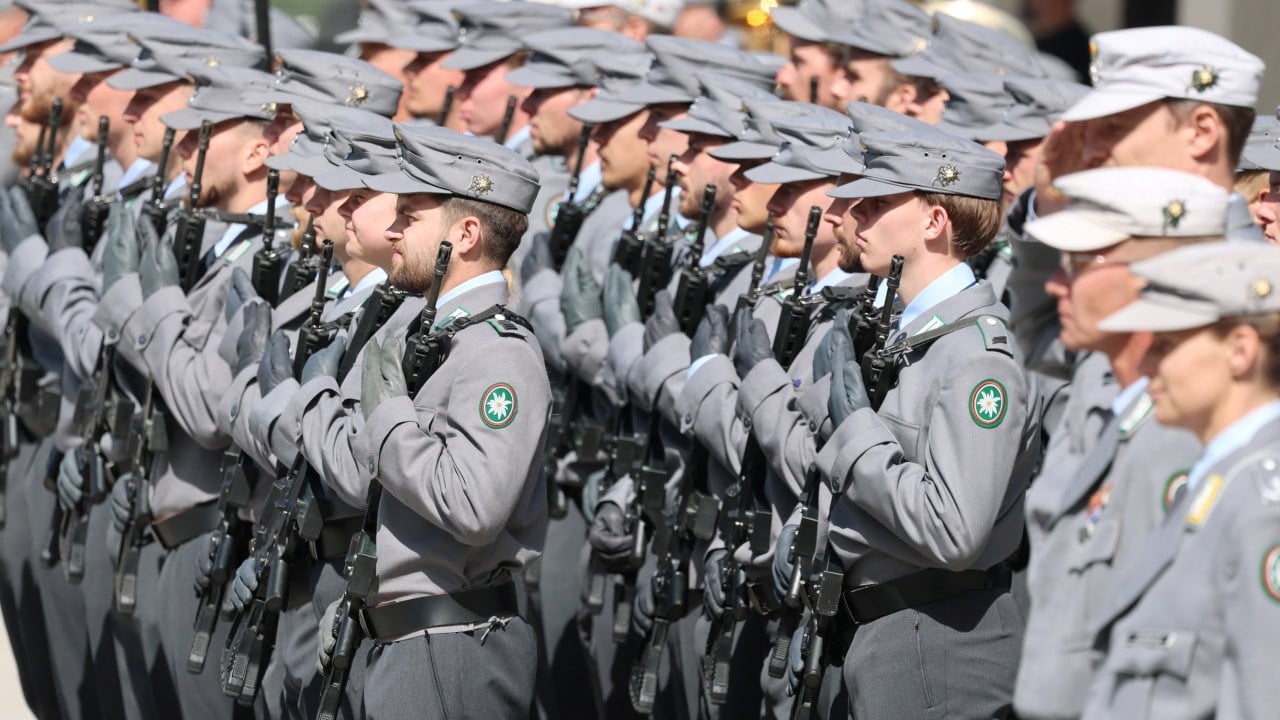
Berlin is no longer apologizing. Chancellor Friedrich Merz made that clear on Friday, standing alongside Baltic leaders to flatly reject Donald Trump’s public mockery of German defense policy. By announcing that Germany will double its defense budget over the next four years to reach 3.5 percent of gross domestic product by 2029, Merz is attempting to rewrite the rules of European security ahead of next week’s critical NATO summit in Ankara.
The move marks a definitive break from decades of post-Cold War passivity. Trump took to Truth Social earlier in the week to lambast Berlin’s historical spending from 2014 through 2025 as one-sided and ridiculous. Merz responded not with diplomatic platitudes, but with raw numbers, asserting that the nation has nothing to be ashamed of.
The Berlin Ultimatum to Washington
The verbal sparring reveals a deeper systemic rupture within the transatlantic alliance. Trump’s erratic foreign policy, characterized by his unilateral actions against Iran and surprise declarations regarding Danish territory, has fundamentally shaken European trust in the American security umbrella. European leaders are realizing that verbal assurances from Washington are no longer currency they can trade on.
Merz is playing a calculated political hand. By accelerating spending targets well ahead of the 2035 timeline agreed upon during the previous NATO summit in The Hague, he aims to insulate Germany from accusations of freeloading. The strategy is designed to shift the balance of power within NATO, making the alliance more European in operational execution while maintaining its transatlantic framework.
This is a defensive reaction to American isolationism. European defense strategists have watched with growing alarm as the White House quietly pulls key military assets and specialized capabilities out of the continent without prior consultation. Berlin’s aggressive spending push is a frantic attempt to plug those gaps before the security structure collapses entirely.
The Math Behind the 152 Billion Euro Spree
Rebuilding a military requires cash on a scale Germany has not seen since the height of the Cold War. The numbers are staggering. The country will see its defense expenditures climb from the current base toward a projected 152 billion euros by 2029.
German Defense Spending Projections (2026-2029)
2026: €83 Billion
2027: €93 Billion
2028: €136 Billion
2029: €152 Billion
This sudden influx of cash was made possible by an unprecedented domestic political alignment. The Christian Democrats and Social Democrats effectively bypassed the country’s strict, constitutionally enshrined debt brake by declaring it inapplicable to national defense. This legislative maneuver unlocked a structural borrowing mechanism that allows Berlin to spend at levels that would have been politically impossible just two years ago.
The initial wave of modernization relied heavily on the 100 billion euro special fund established under the previous administration. That fund is rapidly drying up. The regular federal budget must now absorb these massive financial commitments, forcing a redistribution of state resources that will inevitably strain the German social safety net.
Cash Alone Cannot Fix a Hollowed Army
Throwing billions at an institution does not instantly yield battlefield readiness. The Bundeswehr has spent thirty years decaying into a bureaucratic entity where administrative compliance outranks combat capability. Recent internal audits revealed that certain land forces operate at less than 50 percent operational readiness due to missing spare parts and delayed maintenance cycles.
Manpower remains the hidden structural bottleneck. Merz has stated his intention to build the strongest conventional military force on the European continent, aiming for 240,000 active personnel supported by a combat-ready reserve of 200,000. Recruiting that many citizens in an aging society with historically low interest in military service is an extraordinary challenge.
"Money cannot buy a martial tradition or instantly train a division of specialized drone operators."
The difficulty in securing voluntary enlistment has revived a fierce debate within the ruling coalition regarding the return of general conscription. Without some form of mandatory service, the ambitious personnel targets required to field a credible deterrent against eastern threats will remain entirely on paper.
Moving the Assembly Lines From Cars to Missiles
The industrial side of this military buildup is fraught with economic friction. Defense contractors are struggling to scale their production lines, creating an inflationary spiral where more money simply buys more expensive equipment rather than a higher volume of weapons. There is growing concern in Berlin that public support for this military renaissance will evaporate if the effort looks like a corporate windfall for arms manufacturers.
To counter these supply chain bottlenecks, German planners are looking to redirect spare capacity from the nation's struggling automotive sector. Car manufacturing plants, currently facing reduced global demand, possess the precision tooling and advanced engineering workforce needed to build subcomponents for defense systems.
This domestic pivot is already visible in high-profile international programs. Rather than relying solely on American defense exports, Germany is deeply involved in a joint long-range cruise missile project with British partners, executed by the multinational consortium MBDA. This initiative is designed to deliver a cheaper, mass-produced alternative to American hardware, ensuring Europe retains a strike capability even if future administrations in Washington decide to restrict weapons transfers.
The strategic imperative for Europe has changed. Merz’s aggressive counter-offensive against Trump’s rhetoric proves that the continent's largest economy is finally adjusting to a world where American protection is a variable, not a constant. Berlin must now prove it can convert raw financial data into actual, deployable military power before the geopolitical environment shifts again.