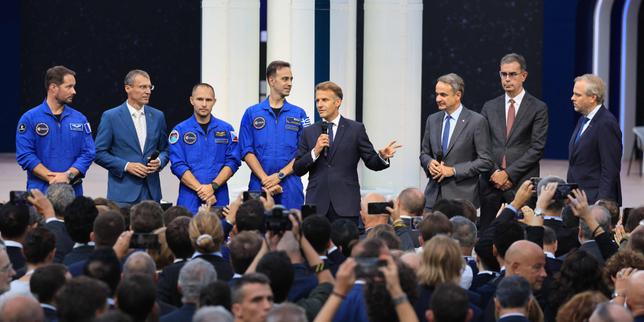
For decades, the old continent has looked up at the stars with a mixture of academic pride and industrial fragmentation. French President Emmanuel Macron recently stepped onto the podium in Paris to demand a radical shift, calling for shared governance and a sovereign European space ambition backed by a staggering twenty-billion-euro injection. Yet, behind the grand rhetoric of powerful constellations and autonomous rockets lies a harsher operational reality. Brussels and Paris can pledge billions, but structural inertia threatens to ground these ambitions before they clear the stratosphere.
The core premise of Macron's appeal rests on an uncomfortable truth. Europe remains dangerously vulnerable in orbit. While commercial upstarts across the Atlantic and state-backed programs in Asia launch reusable hardware at a blistering cadence, European institutional procurement remains bogged down by bureaucratic red tape and national egoism. Every member state wants a manufacturing slice of the pie, leading to splintered supply chains that drive up costs and delay timelines. When payloads miss their windows, orbital dominance slips further away.
The Myth of Shared Ambition
Shared governance sounds democratic on paper. In practice, multilateral decision-making within the European Union often translates to paralysis. Consider the hypothetical example of a multi-nation satellite constellation designed for secure continental communications. Country A builds the propulsion systems, Country B handles avionics, and Country C manages ground stations. If geopolitical tensions spike and immediate software patches are required, consensus must be forged across twenty-seven capitals. Bureaucracy moves at the speed of committees. Orbital threats move at the speed of telemetry.
This structural friction creates a massive capability gap. Macron outlined a timeline featuring cargo capsules docking at the international station, lunar landers touching down on the regolith, and crewed flights launching from Kourou over the next decade. Achieving these milestones requires more than cash injections. It requires an aggressive centralization of authority that historic European treaties were never built to accommodate.
Industrial Realities and the Cost of Fragmentation
Look closely at the European launcher ecosystem. The heavy-lift delays that plagued recent years exposed an over-reliance on legacy models and an inability to pivot quickly when supply chains fracture. Private capital markets in Europe are notoriously risk-averse compared to their venture-backed counterparts in California or Shenzhen. Founders seeking seed money for deep-tech orbital manufacturing find themselves drowning in compliance forms while competitors are already testing prototypes in vacuum chambers.
The twenty-billion-euro package announced in Paris is substantial, but money without accountability is merely a subsidy for inefficiency. Unless procurement rules change to favor agile, competitive bidding over guaranteed national quotas, the funds will dissipate into administrative overhead. Industrial output must replace diplomatic compromises.
The Geopolitical Stakes of Orbital Neglect
Space is no longer a neutral scientific frontier. It is the ultimate high ground for global intelligence, navigation, and economic survival. If European satellites go dark or lack maneuverability during a crisis, critical infrastructure on the ground fails within minutes. Financial markets, power grids, and secure military communications depend entirely on assets floating hundreds of kilometers above the surface.
Relying on foreign partners for routine heavy launches or critical components is a strategic failure. Macron's push for a preference european policy is an overdue acknowledgment of this vulnerability. Protecting domestic industries from predatory foreign pricing is essential, but internal protectionism must not become an excuse for mediocrity. European aerospace contractors must face genuine market pressure to innovate.
The next decade will determine whether Europe becomes an independent space superpower or a second-tier orbital tenant watching history unfold from the ground. The declarations have been made, the checks are written, and the deadlines are ticking. Only execution will separate the rhetoric from the reality.
Macron Unveils €20 Billion Plan for European Space Power in Paris - Watch the full announcement detailing the financial commitments and strategic timeline presented in Paris.
http://googleusercontent.com/youtube_content/1