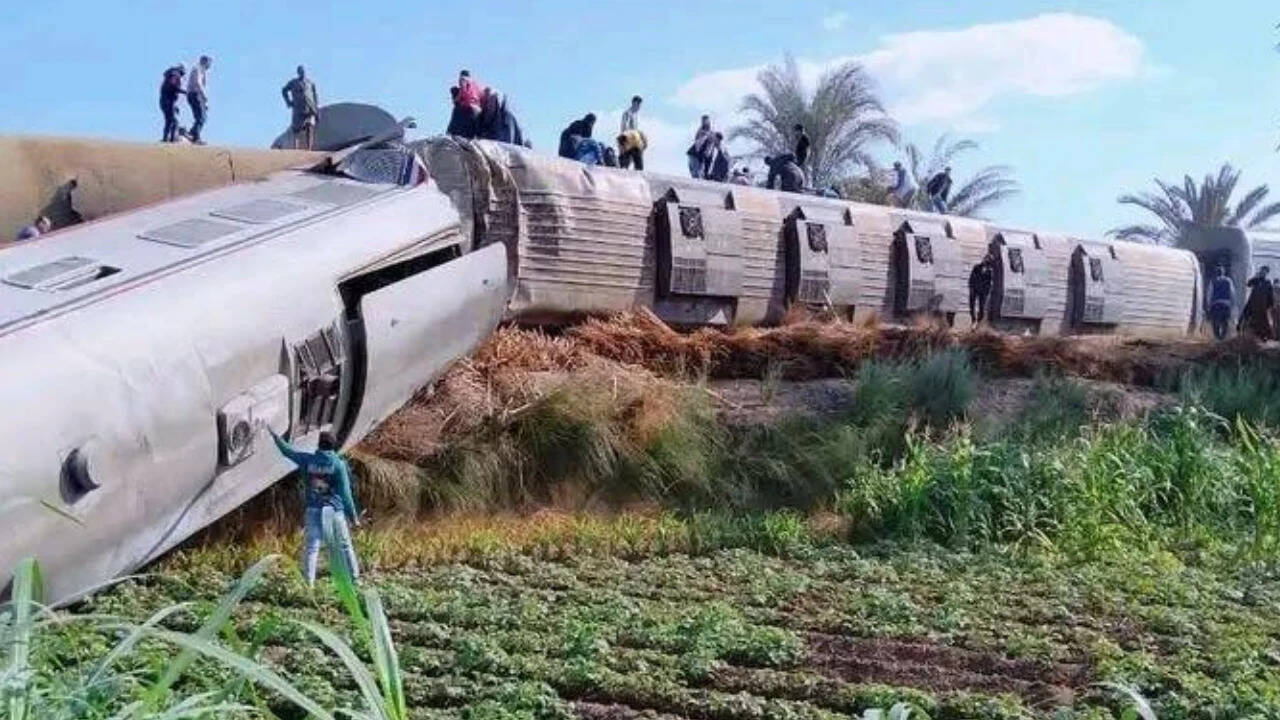
Another week, another shattered carriage on the Nile Valley line. When reports broke of the latest Egypt train collision leaving several passengers injured after a locomotive slammed into the rear of another train and derailed, the official response followed a script worn smooth by decades of repetition. Emergency crews cleared the twisted steel, health ministry officials tallied the wounded at local hospitals, and transport authorities promised a swift investigation into human error.
That narrative is convenient. It is also dangerously incomplete.
To understand why trains keep crashing into each other across Egypt's sprawling rail network, you have to look past the immediate wreckage and examine a system trapped between nineteenth-century infrastructure, twenty-first-century passenger volume, and half-finished modernization projects.
The Anatomy of a Rear-End Derailment
In modern railway operations, two trains should never occupy the same stretch of track at lethal speeds. Preventing that exact scenario is the entire purpose of block signaling. Under a properly functioning automated block system, a rail line is divided into distinct segments. Sensors detect the presence of a train's axles on the steel rails, automatically turning the signal behind it red and triggering physical or electronic brakes on any approaching locomotive that ignores the warning.
On major stretches of the Egyptian National Railways (ENR) network, that safety net has historically existed only on paper or through manual human relay.
When a train loses power, slows down unexpectedly, or stops unscheduled on a main line, the margin for error shrinks to zero. If the signaling system along that corridor still relies on mechanical semaphores, aging copper wiring, or verbal confirmation between stationmasters via radio and telephone, an approaching driver may have no warning until the tail lights of the stationary train appear through the dust or morning fog.
By the time an engineer pulls the emergency brake on a heavy passenger train moving at 90 kilometers per hour, physics takes over. Steel wheels lock and slide along steel rails with minimal friction. A fully loaded passenger train requires well over a kilometer to come to a complete halt. The impact compresses the rear carriages like accordions, forcing bogies off the tracks and sending heavy rolling stock sideways into adjacent lines or drainage canals.
Why Modernization Has Created a Dangerous Transition Zone
If you listen solely to press releases from Cairo, the Egypt train collision problem should already be solved. Over the past decade, the Egyptian government has poured billions of dollars into overhauling the railway sector, purchasing hundreds of new locomotives from General Electric, importing passenger coaches from Russia and Hungary, and contracting international giants like Thales, Siemens, and Alstom to install electronic signaling.
Here lies the paradox that rarely makes the evening news. Upgrading a live, heavily congested railway network without shutting it down creates a treacherous hybrid environment.
Faster Engines on Fragile Foundations
New locomotives accelerate faster and pull heavier loads than the aging diesel engines they replaced. Yet on corridors where track bed rehabilitation and electronic signaling installations remain incomplete, those modern machines are essentially running blind on legacy infrastructure. Putting a high-performance engine on a track governed by outdated manual protocols increases kinetic energy without proportionally increasing stopping foresight.
The Signal Integration Bottleneck
Installing electronic interlocking systems across thousands of kilometers of track along the Nile is not a plug-and-play operation. Contractors must lay fiber-optic cables, build relay rooms, and test automated axle counters while more than a million passengers ride the network every single day. During construction phases, signal switches are frequently taken offline for testing or calibration. Station crews revert to temporary manual operating rules, issuing paper movement authorities to drivers. One misread form, one delayed phone call, or one distracted operator in a signal box is all it takes to put two trains on a collision course.
The Human Factor Is a Symptom, Not the Root Cause
Whenever an Egypt train collision occurs, prosecutors swiftly arrest the train drivers, assistant drivers, and signal tower operators. Charging low-level staff satisfies public demand for immediate accountability, yet seasoned rail safety investigators view recurring human error as a diagnostic marker of systemic design failure.
Consider the working conditions inside the cab and the signal box.
- Cab Distraction and Unauthorized Access: Past investigations by Egyptian authorities themselves have revealed instances where unauthorized personnel entered driver cabs, or where drivers disabled rudimentary vigilance alarms—known as dead-man switches—because the devices malfunctioned or sounded incessantly due to track vibrations.
- Chronic Fatigue: Rail operations run around the clock, and chronic staffing shortages in specialized technical roles often push crews into grueling shift rotations. Cognitive fatigue slows reaction times by critical seconds, turning a recoverable operational hiccup into a derailment.
- Inconsistent Training on New Tech: Transitioning a workforce accustomed to mechanical levers and visual flags onto computerized dispatch consoles requires rigorous, continuous simulation training. When hardware rolls out faster than deep institutional habit changes, operators under stress fall back on informal shortcuts.
Blaming a driver for failing to stop in time ignores the fundamental principle of modern transport safety. Aviation and advanced rail networks operate on the assumption that humans will eventually make mistakes; the infrastructure is engineered to catch those mistakes before metal meets metal.
The Economic Pressure Cooker
Why not simply slow the trains down or reduce the number of daily departures until every single signal tower is automated?
The answer sits on the platforms of Cairo's Ramses Station every morning. Egypt's population has surpassed 110 million, concentrated heavily along a narrow ribbon of habitable land flanking the Nile. For millions of working-class Egyptians, intercity rail is not a leisure option. It is an economic lifeline.
Tickets on standard and upgraded ENR lines remain heavily subsidized compared to private intercity buses or personal vehicles. Raising fares aggressively sparks immediate social and political backlash, while cutting train frequency strands commuters, students, and workers who have no affordable alternative.
This demographic pressure forces the railway authority into an impossible balancing act. It must move maximum passenger volume on tight schedules while simultaneously rebuilding the tracks beneath those very trains. Maintenance windows—the sacred overnight hours when track crews inspect rails, tighten fastenings, and test switches—are routinely compressed to keep trains running.
What History Tells Us About This Pattern
The latest derailment and collision is not an isolated statistical anomaly. It sits along a long, documented timeline of incidents that expose the exact same vulnerabilities.
In March 2021, two passenger trains collided near Tahta in Sohag governorate after emergency brakes were allegedly triggered on the lead train, causing it to stop abruptly before the following train slammed into its rear carriages. Weeks later, in April 2021, a train derailed in Toukh, north of Cairo, killing dozens and injuring nearly a hundred more. Going further back, the 2002 Al Ayyat disaster, the 2006 Qalyub collision, and the 2017 Alexandria crash each triggered waves of ministerial resignations, emergency funding pledges, and solemn vows that safety standards would finally be enforced.
Each time, external factors—whether a pulled emergency brake cord, a malfunctioning switch, or an unguarded crossing—acted as the spark. The fuel, however, remained unchanged: an overstretched network operating without universal, fail-safe automated train protection.
Where the Fix Actually Begins
Hardware alone will not stop the next Egypt train collision. Buying shiny new locomotives and laying fresh ballast are visible achievements that photograph well for ribbon-cutting ceremonies, yet true rail safety lives in the unglamorous details of operational discipline and independent oversight.
First, automated train protection systems must be fully commissioned and locked into active service before speed limits are raised on upgraded corridors. If an electronic signal is under maintenance, strict, enforced speed restrictions—not optimistic schedule targets—must govern every train passing through that sector.
Second, rail accident investigation in Egypt needs genuine institutional independence. Currently, the entities responsible for running the trains, maintaining the tracks, and investigating crashes operate under the same overarching ministry umbrella. Until an autonomous safety board holds the legal authority to audit operations, publish unredacted technical findings, and halt service on unsafe lines without political interference, structural blind spots will persist.
A railway does not care about press releases, budget announcements, or political timelines. It obeys only physics, maintenance schedules, and the integrity of the signal directly ahead of the locomotive.