The World Health Organization just declared the Ebola outbreak in the Democratic Republic of Congo and Uganda a public health emergency of international concern. If that headline sounds familiar, the danger underlying it is entirely new. This is not a retread of the epidemics that the world learned to fight over the last decade. A rare, vaccine-resistant strain is moving rapidly through major urban centers, and the global health apparatus is caught completely empty-handed.
As of mid-May 2026, the outbreak centered in the DRC’s Ituri province has claimed at least 80 suspected lives, with 246 suspected infections and eight laboratory-confirmed cases. These numbers vastly underrepresent reality. The virus has already breached containment, appearing in the Ugandan capital of Kampala and the DRC's mega-city capital of Kinshasa, home to 20 million people.
The true crisis is not just the geographic spread. It is the specific pathogen driving it. This outbreak is caused by the Bundibugyo virus, a distinct strain of Ebola for which there are absolutely no approved vaccines, no specialized therapeutics, and no stockpiled defenses. The medical arsenal built at a cost of billions since 2014 has been rendered effectively useless overnight.
The Blind Spot in Global Biosecurity
For the past decade, the international community congratulated itself on defeating Ebola. Scientists developed highly effective countermeasures, including Merck’s Ervebo vaccine and targeted monoclonal antibodies.
Those breakthroughs apply almost exclusively to the Zaire ebolavirus strain.
The Bundibugyo strain is structurally and immunologically distinct. The vaccines currently sitting in international stockpiles offer zero cross-protection against it. If an individual inoculated with the standard Ebola vaccine is exposed to the Bundibugyo strain, the body recognizes nothing.
The global response mechanism treated Ebola as a monolithic threat. It was an existential error. By focusing funding, manufacturing, and clinical trials almost entirely on the Zaire strain, international health agencies left the door wide open for its genetic cousins.
The initial data out of Ituri underscores the severity of this oversight. Health officials collected 13 random samples from individuals exhibiting hemorrhagic symptoms across various zones. Eight came back positive. That staggering positivity rate indicates deep, unmonitored community transmission that occurred weeks before the international community even realized a new outbreak had begun.
From Gold Mines to Mega-Cities
The epicenter of this crisis explains how it spread so fast. Transmission is concentrated around Mongbwalu, a major gold-mining hub in eastern Congo.
Mining economies are inherently transient. Laborers migrate constantly between remote, jungle-insulated extraction camps and dense, chaotic regional trading centers. They live in crowded, temporary housing with substandard sanitation, creating an ideal environment for a viral hemorrhagic fever to jump from wild reservoirs into human networks.
Once the virus entered these mobile populations, regional transit corridors did the rest.
- The Kampala Breach: Two travelers from the DRC arrived in Uganda's capital within 24 hours of each other, testing positive after being admitted to intensive care units. One has already died.
- The Kinshasa Escalation: A single traveler returning from Ituri brought the virus directly into Kinshasa, a sprawling metropolis where contact tracing is a logistical nightmare.
When Ebola strikes a remote village, the geography acts as a natural quarantine. When it strikes an urban informal settlement in a city of millions, containment requires an entirely different order of operations.
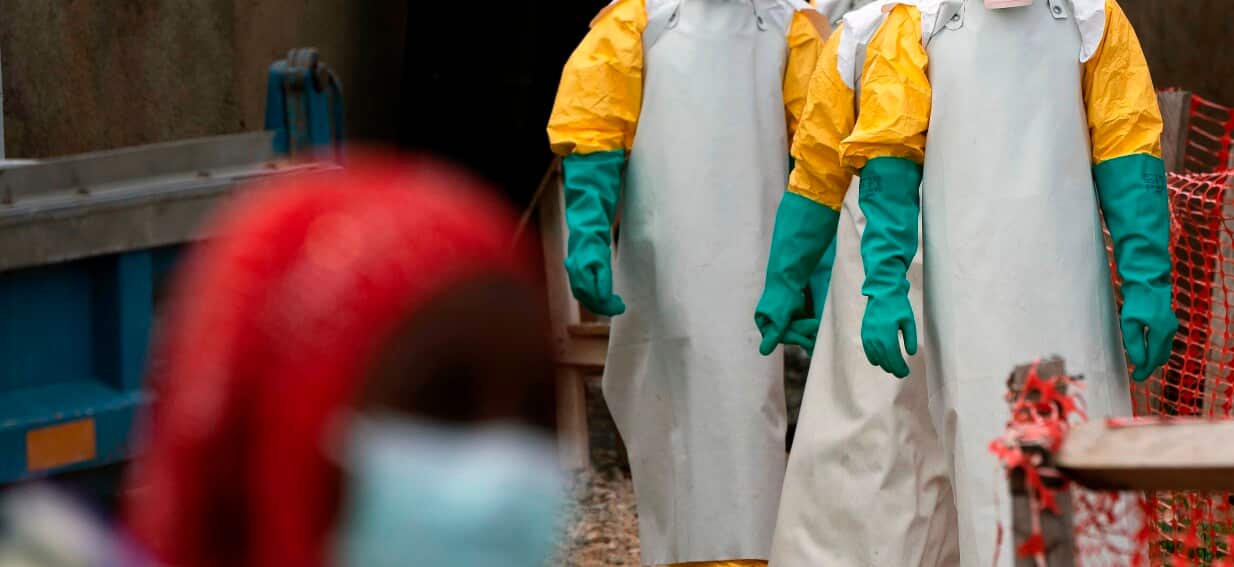
The situation is further complicated by the collapse of local medical infrastructure. At least four healthcare workers in Ituri have already died after treating patients. When doctors and nurses become vectors, hospitals cease being treatment centers and become amplification hubs. The informal, unregulated clinics that patch the gaps in the DRC’s formal healthcare system are currently operating completely blind, lacking the basic personal protective equipment required to stop a filovirus.
The Broken Playbook of Containment
The standard international response to a public health emergency relies on rapid ring vaccination—vaccinating everyone around a confirmed case to choke off transmission. Without a vaccine, that playbook is discarded.
Health workers are forced to rely on nineteenth-century isolation tactics: physical containment, fluid replenishment, and broad-spectrum antivirals like remdesivir, which have never been definitively proven to cure Bundibugyo infections.
The WHO has explicitly warned against closing international borders or restricting trade. It sounds counterintuitive to the public, but historical precedent proves that closing official border crossings simply forces desperate people into unmonitored jungle tracks. If trade stops, the informal economy goes underground, making health screenings and temperature checks completely impossible.
Yet, keeping borders open requires immense trust and local cooperation, two commodities in short supply. Eastern Congo is currently experiencing a severe humanitarian crisis driven by armed conflict and systemic insecurity. Local populations view international health interventions with deep suspicion, a legacy of previous campaigns where heavily armed security forces escorted medical teams.
If the response relies on militarized quarantine measures rather than building trust with community elders and local market leaders, tracking contacts will fail.
A Depleted Global Safety Net
This outbreak hits at the worst possible moment for global health governance. Over the last two years, deep cuts to international development budgets and foreign disease-surveillance programs have hollowed out early-warning networks.
Funding for the frontline laboratories that sequence viral genomes and flag anomalies has withered. The fact that the Bundibugyo virus circulated silently in Ituri long enough to establish multiple chains of infection across two nations is a direct consequence of those cuts.
The international community is currently trying to assemble an emergency response on the fly. The WHO is pushing for immediate clinical trials of experimental monoclonal antibodies that might show efficacy against the Bundibugyo strain. Even under optimal conditions, manufacturing these compounds and deploying them to active conflict zones takes months.
Time is a luxury the regional health system does not have. The virus is moving along established trade routes, carried by individuals who cannot afford to stop working or traveling.
The immediate priority must shift away from the search for a non-existent silver-bullet vaccine. Instead, international resources must flood into the region to secure the fundamentals: providing basic protective gear to every informal clinic in Ituri, training local youth networks in safe burial practices to prevent transmission during funerals, and establishing aggressive, non-punitive screening protocols at every major transit hub between Bunia, Kampala, and Kinshasa. The world can no longer rely on a medical miracle to save it from its own short-sighted planning.