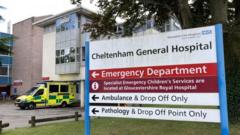
The triage doors at Cheltenham General Hospital closed to major emergencies at eight o'clock last night, transforming a full-scale Accident and Emergency department into a part-time minor injuries clinic. This is the fourth time in three years that regional health officials have quietly downscaled emergency services under the cover of industrial action. While the public is told these temporary closures are necessary measures to maintain patient safety during the British Medical Association strikes, the reality on the ground is far more alarming. These interventions are not emergency contingency plans. They are dress rehearsals for a permanent reduction in local emergency healthcare access.
Decades of covering the health service teaches you that nothing happens in isolation during a labor dispute. When resident doctors walk out, the immediate political theater focuses on salary percentages and historical inflation matching. Behind the closed doors of Whitehall and NHS England headquarters, however, the strikes are being used to fast-track structural modifications that would otherwise trigger public outrage and lengthy consultation battles. Also making waves in this space: The Fifteen Minute Window and the True Cost of Routine.
The Myth of Emergency Consolidation
The standard playbook for hospital executives during a strike is consolidation. By shutting down Cheltenham’s major emergency intake and diverting ambulances to Gloucestershire Royal Hospital, managers claim they can pool remaining senior staff to maintain a safe service.
It is a calculation that looks pristine on a spreadsheet but disintegrates on the highway. Further details into this topic are covered by Everyday Health.
Gloucestershire Royal was already operating at over ninety-five percent bed occupancy before the walkout began. Forcing a single hospital to absorb the acute trauma and emergency intake of an entire region does not create safety. It creates a bottleneck.
The mechanism at play here is simple queue shifting. By reclassifying an A&E department as a Minor Injuries and Illness Unit, a hospital trust instantly resets its waiting-time metrics. Patients with sprains and minor cuts are treated quickly during the day, while those experiencing strokes, cardiac events, or severe trauma are forced into longer ambulance transits to a centralized hub. The hidden cost is measured in minutes, and in emergency medicine, minutes govern myocardial infarction outcomes and brain tissue survival.
What the Five Hundred Million Pound Plan Actually Buys
The Department of Health recently heralded a massive capital injection aimed at expanding Same Day Emergency Care units and urgent treatment centers across England. The stated objective is to divert one in five A&E attendees to alternative settings, theoretically ending the crisis of corridor care where elderly patients spend days on gurneys.
The strategy ignores the fundamental bottleneck of modern medicine. You cannot divert your way out of a staffing deficit.
Building a new clinic or a specialized psychiatric assessment center requires the exact same pool of labor currently walking the picket lines. When a trust opens an off-site urgent care facility, it frequently staffs it by offering premium locum rates to the same doctors and nurses who are burnt out from their main hospital shifts. This creates a parasitic internal market where the NHS effectively bids against itself for its own staff’s time.
Consider a hypothetical example. A local hospital trust builds a modern, well-equipped minor injury center three miles down the road from its main campus to relieve pressure on the main emergency room. To staff it on a Saturday night, the trust offers double-time pay. The registrar who was scheduled to cover the main hospital's acute medical intake calls in sick or takes a shift at the new clinic instead. The main emergency room becomes dangerously understaffed, forcing ambulances to divert, while the new minor injury center treats minor burns and sprains in an empty, pristine building.
The system has spent money to move the problem, not solve it.
The Failure of Virtual Wards
The most sophisticated illusion in contemporary healthcare policy is the virtual ward. Under this initiative, patients who would otherwise occupy a hospital bed are monitored at home using wearable tech, biometric sensors, and remote consultations.
The numbers look impressive when presented to select committees. Thousands of virtual beds have been created on paper, allowing ministers to claim they are expanding capacity without pouring a single bucket of concrete.
The data reveals a different story. Virtual wards are frequently used to artificially accelerate hospital discharges to hit flow targets rather than because a patient is clinically ready. When a hospital is under intense pressure during a strike, the threshold for what constitutes a stable patient drops.
Elderly patients are sent home with a box of electronic sensors and a phone number to call if their condition deteriorates. The burden of care is shifted entirely onto unpaid family members or already collapsing community nursing teams. When those remote monitoring systems flag a spike in blood pressure or a drop in oxygen saturation, the patient doesn't get a home visit. They get an ambulance sent to their house, returning them right back to the bottom of the A&E queue.
The Core Dispute is Not About Salaries
Every press release from the Department of Health emphasizes that resident doctors have received significant salary adjustments over the past four years. They paint the British Medical Association as stubborn, unyielding, and indifferent to patient disruption.
The focus on pay is a deliberate distraction from the real crisis driving the exodus of medical professionals, which is the total erosion of training quality and professional dignity.
Junior doctors are no longer part of functional clinical teams that look out for their education and career progression. They have been turned into shift-working functionaries, moved from ward to ward to plug rotas, spending their days filling out bureaucratic paperwork and performing basic tasks that should be handled by administrative staff.
The introduction of thousands of additional specialty training posts sounds like a solution, but it creates a secondary bottleneck. There are not enough consultants with the time or resources to train them. A doctor cannot learn complex surgical procedures or advanced diagnostic reasoning through osmosis. They need hands-on, supervised experience. When consultants are pulled from training duties to cover basic service delivery during strikes, the educational pipeline freezes completely.
The current strategy relies on the hope that the workforce will eventually break under financial pressure or public scrutiny. It is a profound misjudgment of the collective mood. The doctors walking out today are not the senior consultants of yesterday who enjoyed comfortable pensions and institutional respect. They are debt-burdened professionals who see their colleagues leaving for Australia, New Zealand, or the private sector every single week.
The Real Intent Behind Temporary Closures
The long-term danger is that temporary service reductions during crises have a habit of becoming permanent fixtures. When a hospital trust proves it can close an A&E department overnight for a week without a catastrophic surge in mortality figures, Treasury officials take note.
The argument becomes inevitable. If the region survived six days with a single centralized emergency department, why are we funding two?
This is the quiet rationalization of healthcare delivery in rural and semi-urban communities. The strikes are providing the data points required to justify a permanent retreat from localized emergency care. It is a managed decline disguised as emergency planning, and the closures we are seeing this week are merely the opening salvo in a much larger restructuring of how and where citizens are permitted to access emergency medicine.