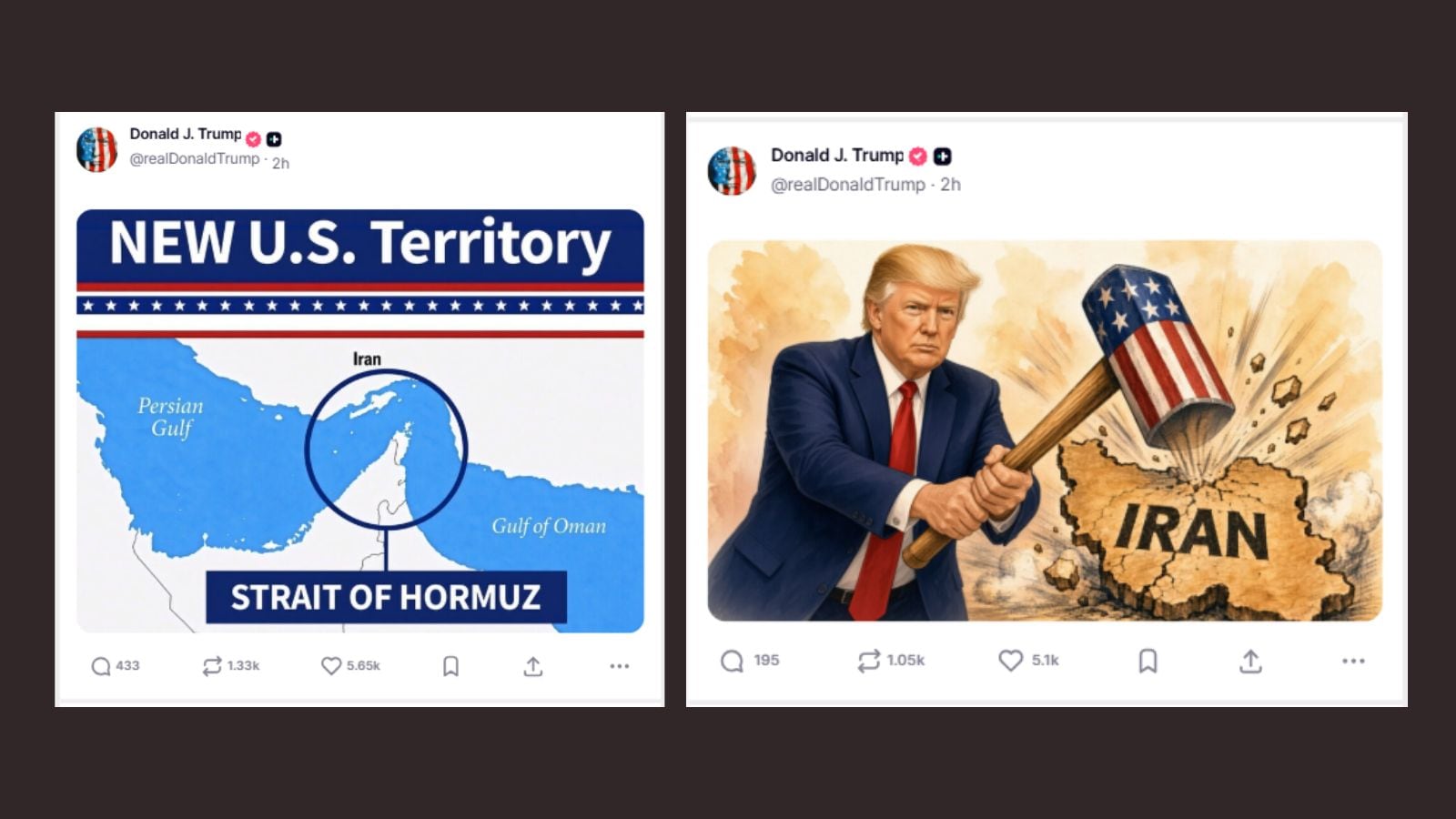
The screen glows in the West Wing, casting a harsh amber light over a room where diplomacy is routinely discarded in favor of digital warfare. Donald Trump’s recent barrage on Truth Social—featuring over forty rapid-fire posts targeting Canadian Prime Minister Mark Carney, foreign adversaries, and domestic critics alike—is often dismissed by conventional pundits as mere late-night noise.
That dismissal is a dangerous mistake.
When a sitting American president uses artificial intelligence imagery to depict himself standing over a prone Canadian leader on a hockey rink with the caption "Get up, governor," it signals a fundamental shift in statecraft. This is not unhinged venting. It is a calculated weaponization of social media designed to batter foreign resolve, shift market expectations, and rewrite the rules of international trade negotiations in real-time.
The Anatomy of a Digital Offensive
To understand why Washington is trading traditional diplomatic channels for meme-tier provocation, one must look at the mechanics of modern leverage. Trade talks between the United States and Canada have deteriorated past standard diplomatic friction into an outright economic struggle. With billions of dollars in retaliatory tariffs looming, the White House has bypassed ambassadors and trade representatives to speak directly to the citizenry of its northern neighbor.
The objective is psychological attrition. By repeatedly referring to Canada as a future state and its prime minister as a provincial governor, the administration aims to demoralize the Canadian public and fracture their political alignment.
Mark Carney stepped into office warning that middle powers would soon face intense economic coercion from superpowers. He likely did not anticipate that coercion arriving packaged as digital satire shared at midnight.
Traditional political analysts argue that such tactics degrade the office of the presidency. They miss the point entirely. Within this ecosystem, degradation is the strategy. By keeping foreign leaders perpetually off-balance, reacting to absurd mapping decrees like the unilateral renaming of shared water bodies or AI-generated sports graphics, Washington forces its counterparts to spend critical bandwidth managing public relations crises rather than coordinating unified economic defenses.
Beyond the Northern Border
While the feud with Ottawa dominates the immediate news cycle, the wider digital barrage reveals a broader geopolitical doctrine. Targets shift rapidly from North American trade partners to Middle Eastern adversaries, creating a relentless multi-front pressure campaign.
Consider the timing. These posting sprees frequently coincide with critical economic deadlines or legislative standoffs. When structural negotiations stall, the digital output spikes. It functions as an alternative communication loop that bypasses traditional press corps filters entirely, delivering unmediated threats directly to financial markets and foreign capitals simultaneously.
Foreign ministries from London to Tokyo are currently rewriting their playbooks to account for this variable. How do you negotiate a bilateral trade pact when your counterpart's primary negotiating tactic involves digital mockery designed to incite domestic unrest? There is no chapter in the classic diplomatic manual for countering a head of state who treats international borders and geographic nomenclature as fluid concepts to be altered via smartphone apps.
The Cost of Manufactured Chaos
This approach yields short-term tactical wins by dominating media cycles and forcing opponents onto the defensive. However, the long-term structural costs are mounting. Permanent economic coercion erodes the institutional trust required for long-term treaties. When trade agreements are treated as temporary truces written in pencil rather than ink, multinational corporations hesitate to invest across borders.
Supply chains require predictability. They wither when a single late-night post can upend currency valuations or trigger sudden tariff spikes. Canada's response—shifting manufacturing home and preparing aggressive retaliatory levies—shows that economic nationalism breeds counter-nationalism.
The digital war room will continue to churn out provocations because, within the current political paradigm, the noise works. It mobilizes a domestic base, demoralizes external rivals, and keeps every global actor staring anxiously at their screens, waiting to see what posts tomorrow brings


