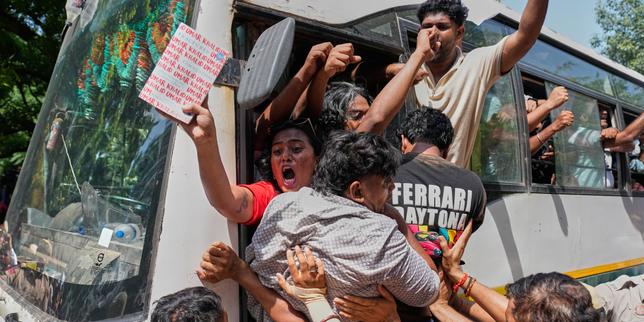
Nearly a third of New Delhi’s electorate vanished from the draft voting rolls overnight, sparking street protests, legal battles, and widespread fear that a routine administrative cleanup has mutated into mass disenfranchisement. Under the Election Commission of India’s Special Intensive Revision (SIR), approximately 4.76 million names—roughly 32.78 percent of the capital's 14.5 million registered voters—were struck from the draft electoral list published on August 31, 2026. While officials insist the purge merely clears out duplicate entries, deceased individuals, and out-of-state migrants, the sheer scale of the omissions has left living residents scrambling to prove their right to exist in the world's largest democracy.
Numbers tell only half the story. Behind the bureaucratic jargon of "ASDD lists"—short for Absent, Shifted, Dead, and Duplicate—lies an administrative trap that disproportionately punishes the urban poor, daily-wage laborers, and religious minorities. Don't forget to check out our recent article on this related article.
How a Routine Roll Audit Became an Exclusion Machine
To understand why Delhi is on edge, you have to look at the mechanics of the Special Intensive Revision. Unlike standard annual updates that rely on citizens voluntarily reporting changes, an intensive revision flips the burden of proof onto the resident. Booth Level Officers (BLOs) conduct door-to-door verifications. If a family is away at work during a daytime visit, or if a tenant lacks a formal lease agreement from a cautious landlord, the officer flags the household as "absent" or "shifted."
The numbers in Delhi expose how violently this dragnet operates. When the SIR process began in the capital on June 30, 2026, the rolls stood at roughly 1.45 crore (14.5 million) electors. By the time the draft roll dropped at the end of August, that figure had plummeted to around 97.5 lakh (9.75 million). In some densely populated working-class constituencies, local community leaders reported exclusion rates approaching half the neighborhood. If you want more about the history here, NPR provides an informative summary.
This is not an isolated metropolitan glitch. Across India, the nationwide SIR campaign—launched under Chief Election Commissioner Gyanesh Kumar—has stripped more than 130 million names from draft rolls across multiple phases. In earlier phases across states like Maharashtra and Telangana, over a fifth of the electorate was initially excluded. Yet Delhi’s nearly 33 percent reduction stands out as the steepest single-jurisdiction drop in the country.
The Election Commission maintains that a booming, transient metropolis naturally accumulates bloat. Millions move into and out of the National Capital Territory every year for construction, domestic work, and service jobs. Leaving ghost voters on the books invites impersonation and skews turnout statistics. On paper, pruning deadwood protects electoral integrity.
In practice, the execution has been a logistical wreck. When millions of active citizens find themselves lumped together with the deceased, the margin for bureaucratic error swallows entire communities whole.
The Bureaucratic Catch-22 Trapping Deleted Voters
If your name is missing from the draft roll, the official remedy sounds straightforward. You fill out Form 6—the standard application for new voter registration—submit proof of residence and identity, and wait for re-inclusion.
Except thousands of deleted Delhi residents are terrified to touch the form.
Here is the catch. Form 6 requires the applicant to declare that their name has not already been included in the electoral roll for that or any other constituency. Many citizens whose names were abruptly dropped—despite having voted in elections for decades—fear that signing a fresh Form 6 declaration could expose them to criminal prosecution for making a false statement, or worse, trigger an inquiry into their citizenship status.
That fear is hardly paranoid. In its June 2025 directive initiating the revision, the Election Commission explicitly cited the removal of "foreign illegal immigrants" alongside duplicate and deceased voters. In states like West Bengal, civil rights groups and court filings have documented cases where citizens whose names vanished from the rolls were detained by police or pushed across borders on suspicion of being undocumented migrants, despite possessing decades of family records.
As of November 11, 2026, only slightly more than 300,000 Form 6 applications had been filed across Delhi—a tiny fraction of the 4.76 million people struck off the draft list. West Delhi led with 37,140 applications, followed by North East Delhi at 29,470, while central New Delhi recorded a mere 5,487. Even if every single one of those applications came from an excluded voter rather than a newly eligible eighteen-year-old, more than 4.4 million missing voters remain unaccounted for.
Judicial Pushback and Street Fury
The vacuum left by administrative confusion has rapidly filled with political rage and judicial intervention.
In early November 2026, senior advocate Prashant Bhushan brought the Form 6 dilemma directly before the Supreme Court of India, arguing that the Election Commission's verbal assurances against prosecution contradicted earlier court directives and left deleted voters paralyzed. Chief Justice of India Surya Kant urged residents not to panic, assuring petitioners that the bench was actively monitoring the Delhi revision ahead of a scheduled November 19 hearing and had already ordered authorities to publish deleted lists in local languages at every polling booth.
Still, the court declined to issue an immediate stay on the process, leaving the burden of filing claims before the extended November 25 deadline squarely on the shoulders of confused citizens. The final electoral roll is slated for publication on December 22, 2026.
Outside the courtroom, patience has evaporated. Throughout October and November, tens of thousands of demonstrators—led by opposition parties alongside the youth-driven Cockroach Janta Party (CJP)—flooded the avenues of central New Delhi demanding the resignation of Chief Election Commissioner Gyanesh Kumar. Authorities responded by barricading central districts, suspending public transit, throttling mobile internet connections, and detaining student organizers.
To understand the stakes, consider a hypothetical example of how this plays out at the street level. Imagine a daily-wage tailor renting a single room in East Delhi without a formal written lease. He pays rent in cash, sends money home to his village, and works twelve-hour shifts. When the Booth Level Officer knocks at noon, nobody answers. Neighbors, wary of landlord tax disputes, tell the officer the room is empty. Two months later, the tailor discovers he cannot renew a welfare card or verify his address because his name has disappeared from the voter list. To get back on, he must take unpaid days off work, gather utility bills in a landlord's name he cannot obtain, and sign a government form he believes could land him in a detention cell.
Multiply that scenario by millions, and the political math shifts dramatically.
The Structural Flaw Nobody Wants to Own
Defenders of the Election Commission point out a genuine vulnerability in India's electoral infrastructure. Rapid urbanization has broken the link between traditional paper-based registries and mobile populations. In previous decades, electoral rolls in major Indian cities routinely carried 10 to 15 percent ghost entries. Without aggressive cleaning, local political machines can exploit unverified names to pad margins in tightly contested assembly seats.
Moreover, supporters argue that the appeals process works when citizens engage with it. Data from earlier SIR phases indicates that when excluded voters successfully file formal appeals, roughly 80 to 90 percent are reinstated.
Yet that very statistic indicts the entire operation. If nine out of ten people who challenge their deletion turn out to be legitimate, living citizens, the initial screening mechanism was never a scalpel—it was a wrecking ball.
An election authority's primary constitutional duty is maximum enfranchisement, not administrative tidiness. When a verification drive forces millions of verified citizens to re-prove their right to vote under tight deadlines, confusing paperwork, and implicit threats of prosecution, the cure becomes far more dangerous than the disease.
With the November 25 objection window closing fast and millions of Delhi residents still absent from the revised registry, the credibility of India's upcoming elections hangs on a simple question. If a democracy makes voting harder than disappearing, who actually wins when the ballots are cast?


