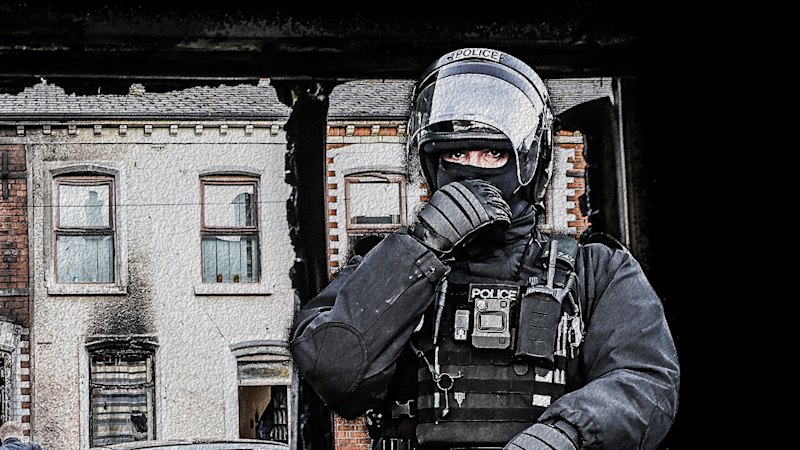
The fires illuminating the Belfast skyline this week are not a sudden outburst of modern anti-immigrant sentiment, nor are they a simple consequence of a viral video. When masked men marched through working-class neighborhoods on Tuesday night, torching a public bus, attacking homes, and forcing twenty-seven people into homelessness, the immediate trigger was clear. A horrific knife attack on Monday evening, allegedly carried out by a Sudanese asylum seeker with leave to remain in the United Kingdom, had been weaponized across social networks within hours.
Yet treating this explosion of violence as a mere copycat of last week’s unrest in Southampton misses the foundational mechanics of the crisis. Belfast is not experiencing a standard wave of contemporary European far-right rioting. Instead, digital disinformation pipelines have successfully hijacked a pre-existing, deeply entrenched paramilitary infrastructure that has remained largely intact since the 1998 Good Friday Agreement.
The crisis nobody is talking about is how old-world sectarian enforcement mechanisms—the very structures that managed the darkest days of the Troubles—have been seamlessly retrofitted to target ethnic minorities.
The Digital Fuse and the Paramilitary Engine
To understand how a city can be placed on a total lockdown by Wednesday morning, with cafes, gyms, and cinemas shutting doors on the back of anonymous online threats, one must look closely at how information moves through Belfast.
On Monday night, a forty-four-year-old disabled man was brutally attacked with a kitchen knife on Kinnaird Avenue. Early police messaging incorrectly stated the suspect was Somali. Within hours, right-wing accounts globally, amplified significantly on X, bypassed the traditional media gatekeepers. The graphic video of the attack spread alongside instructions to gather, hunt, and evict.
But an algorithm cannot light a petrol bomb. It cannot coordinate a door-to-door sweep of an eastern Belfast neighborhood to identify houses occupied by immigrants while explicitly sparing properties verified as belonging to "locals." That level of tactical execution requires boots on the ground, local intelligence, and a culture of enforced silence.
For three consecutive summers, Northern Ireland has seen localized, organized anti-immigrant violence. In June 2025, it was Ballymena, where rioting broke out after an alleged sexual assault, driving out two-thirds of the local Roma population. This year, the scale has expanded dramatically. Royal College of Nursing officials confirmed that healthcare workers attempting to reach their shifts on Tuesday night were stopped by masked men demanding to see their credentials before allowing passage through specific enclaves.
This is not recreational rioting by disenfranchised youth. This is territorial control, executed by shadowy networks that have held sway over these streets for generations.
The Re-purposed Tactics of the Ghetto
The methods used in the recent violence—arson, door-to-door intimidation, the distribution of hit lists featuring specific residential addresses—are identical to the intimidation tactics used forty years ago to expel mixed-marriage families or those of a differing Christian denomination from segregated communities.
What has changed is the target. The historical friction between unionist and nationalist working-class communities is being actively redirected outward.
A major component of this mobilization relies on economic anxiety and deep-seated institutional neglect. In neighborhoods where social housing waitlists stretch into years and youth unemployment remains stubbornly high, the arrival of asylum seekers placed in local hotels or private rentals becomes an easy focal point for rage. Agitators exploit this scarcity, convincing young men that their socio-economic marginalization is the direct fault of the new arrivals rather than a failure of governance from Stormont and Westminster.
Furthermore, the physical geography of Belfast ensures these tensions remain high. The city is still bifurcated by more than twenty miles of peace walls, fences, and security gates. These structures do more than just divide communities; they maintain a siege mentality. When an external threat—in this case, framed as "unregulated migration"—is introduced via digital channels, the psychological reflex within these walled enclaves is immediate defense and aggressive counter-offense.
The Backdoor Border Debate
The fallout from the riots has quickly transitioned from a policing crisis to a constitutional battleground, exposing deep fractures within the Northern Ireland Executive.
Populist and unionist politicians have immediately seized on the suspect's background to launch a fierce critique of British-Irish border policy. Because the suspect entered Northern Ireland from Dublin before being granted refugee status, the Common Travel Area has come under intense political scrutiny. Critics argue that the open, porous nature of the land border between the Republic of Ireland and Northern Ireland serves as an unmonitored transit corridor for asylum seekers attempting to access the United Kingdom.
This presents a profound dilemma for the British government. Any attempt to introduce rigid immigration checks or infrastructure along the Irish border to placate anti-immigration sentiment risks unraveling the delicate political equilibrium established by the peace process. Conversely, leaving the border entirely unchecked provides a continuous supply of rhetorical ammunition to far-right actors who claim the state is failing to secure its territory.
The Limits of a Depleted Police Force
While politicians debate the macro-politics of the Common Travel Area, the Police Service of Northern Ireland faces a structural emergency.
Chief Constable Jon Boutcher has repeatedly warned that the police force is critically underfunded and severely understaffed. The scale of the coordination required to suppress simultaneous outbreaks of arson and street violence across Belfast, Glengormley, and surrounding towns has pushed local resources to the brink. The deployment of water cannons and the arrival of hundreds of mutual aid backup officers from Great Britain highlight the reality that local law enforcement cannot contain sustained, coordinated civil unrest on its own.
When a city relies on external police forces to maintain basic order, the underlying message to paramilitary elements is clear: the state's grip on these neighborhoods is fragile.
The clean-up operations that followed Tuesday's violence have left the streets quiet, but the silence is deceptive. The underlying grievances, the digital pipelines of radicalization, and the active paramilitary structures remain entirely untouched. Until strategy moves beyond short-term containment and directly confronts the armed gangs managing these neighborhoods under the guise of community defense, the cycle of summer violence in Belfast will continue to accelerate.