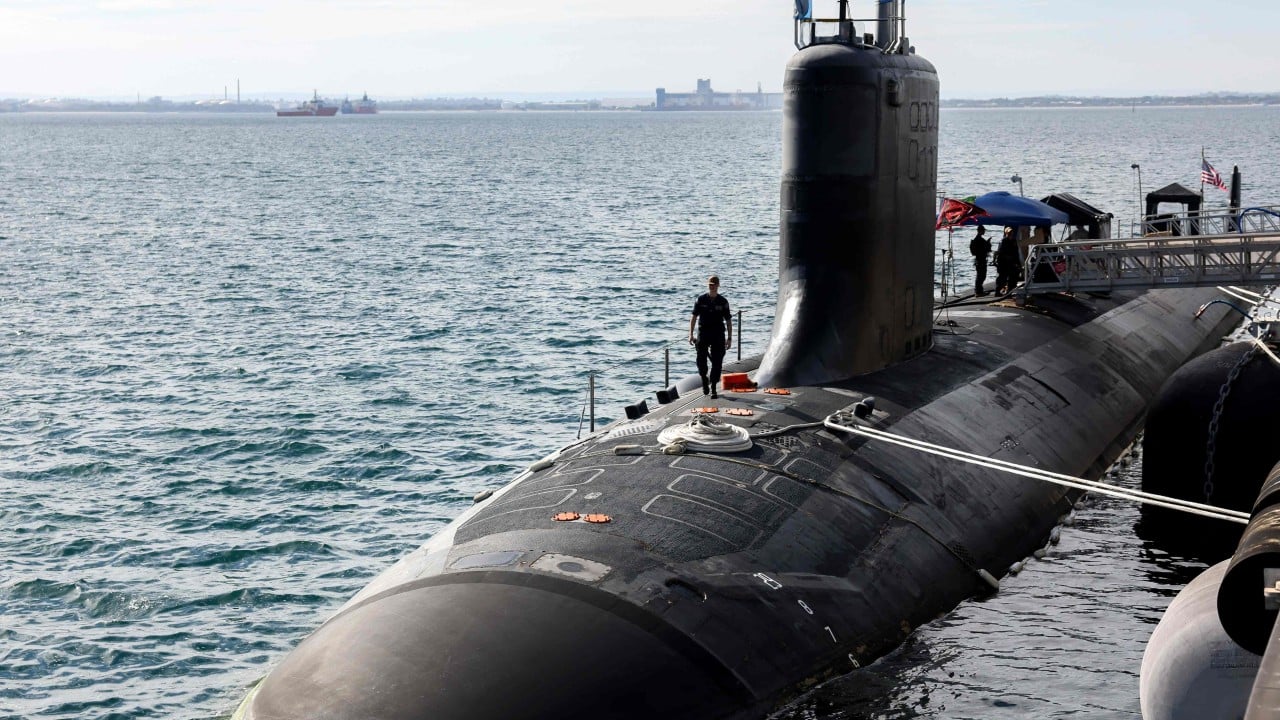
Australia’s decision to inject 4.6 billion Australian dollars (3.2 billion U.S. dollars) into its Osborne shipyard in South Australia is a massive down payment on the most ambitious military industrial project in the nation’s history. The funds target civil engineering, site clearing, power infrastructure, and training facilities needed before construction can start on SSN-AUKUS, a new class of nuclear-powered attack submarines. On paper, Canberra is laying the foundation for sovereign defense capability. In reality, this capital injection exposes a dangerous reality: Australia is tying its long-term security to an overburdened Anglo-American defense industry that cannot currently build enough submarines for its own navies, let alone supply a new ally across the Pacific.
The official narrative presents AUKUS as a seamless security partnership among Australia, the United Kingdom, and the United States. By the late 2030s, Australia plans to operate three to five American-built Virginia-class submarines while building its own fleet of British-designed, nuclear-powered attack submarines in Adelaide. The 3.2 billion dollar commitment to Osborne is supposed to prove that the Australian timeline is intact. Yet a close examination of shipyard output in Groton, Connecticut, and Barrow-in-Furness, England, reveals that the foundational assumptions of the entire deal are sitting on thin ice.
The Bottleneck in American Yards
The core of the short-term AUKUS plan relies on the U.S. Navy selling off second-hand or newly built Virginia-class attack submarines to the Royal Australian Navy starting in the early 2030s. This agreement rests on a specific requirement. U.S. shipyards must produce Virginia-class submarines at a rate of at least 2.0 to 2.3 hulls per year.
They are nowhere near that figure.
For the past five years, the combined industrial efforts of General Dynamics Electric Boat and Huntington Ingalls Industries have produced nuclear attack submarines at an average rate of roughly 1.2 to 1.3 vessels per year. Supply chain breakdowns, severe shortages of specialized welders, and chronic cost overruns have bogged down American production lines. The U.S. Navy itself faces a growing attack submarine deficit as older Los Angeles-class boats retire faster than new Virginia-class hulls hit the water.
To hand over three operational Virginia-class submarines to Australia during the 2030s, the Pentagon would have to deliberately shrink its own attack fleet. United States lawmakers have made their terms explicit in congressional hearings. Washington will not approve the transfer of nuclear submarines to Australia if doing so degrades American operational readiness.
This creates a stark structural problem. If American shipbuilders fail to achieve their target build rates over the next five years, the United States Congress will face immense pressure to block the sale. Australia could easily spend tens of billions of dollars preparing bases and upgrading Osborne, only to find itself blocked at the U.S. legislative gate.
Building a Nuclear Workforce from Scratch
While political friction looms in Washington, an equally daunting challenge exists on home soil. Australia is attempting something no nation without a domestic nuclear power sector has ever done before: building, operating, and maintaining nuclear-powered military vessels.
The scale of the industrial ramp-up required at the Osborne yard is staggering.
- Over 4,000 workers are required merely to build the shipyard infrastructure, including high-capacity fabrication halls, radiological shielding, and heavy lift systems.
- An additional 5,500 specialized personnel will be needed to manufacture and assemble the SSN-AUKUS submarines when production peaks.
- The construction site itself covers a footprint three times larger than the previous conventional submarine design project.
Finding this labor force in a tight national employment market is a profound logistical headache. Australia does not possess an established pool of naval nuclear engineers, certified nuclear technicians, or industrial shipbuilders familiar with high-yield steel hull fabrication for deep-submergence vessels.
The Australian Submarine Agency and state officials in South Australia have committed hundreds of millions to specialized technical training academies. However, training a qualified nuclear technician is not like training an electrician for residential housing. It takes a decade of education, rigorous certification, and hands-on experience under strict regulatory supervision to develop the safety culture required for military reactor systems.
To bridge this gap, Australia is poaching technical talent from Britain and the United States, alongside domestic manufacturing sectors. This strategy risks sparking a zero-sum bidding war for specialized talent. Every British nuclear engineer who moves to Adelaide is one less engineer available at the BAE Systems shipyard in Barrow-in-Furness, which is already struggling with its own construction delays on the Astute and Dreadnought submarine programs.
The Looming Conventional Capability Gap
The financial outlay for AUKUS—projected to reach up to 368 billion Australian dollars over the next three decades—comes with an immediate operational hazard. That risk is the capability gap facing the Royal Australian Navy today.
Australia’s existing fleet of six Collins-class diesel-electric submarines is aging rapidly. Designed in the late 1980s and commissioned throughout the 1990s, these boats are reaching the absolute limit of their structural fatigue lives. To keep them operational into the late 2030s, the Department of Defence has launched a life-of-type extension program.
This extension program requires pulling each Collins-class submarine out of service for exhaustive overhaul work, replacing engines, diesel generators, and combat systems.
It is a high-wire act with zero margin for error.
If the life-of-type extension encounters major technical failures, or if the delivery of American Virginia-class boats slips past 2035, Australia will face a disastrous scenario. Its conventional submarines will be forced into retirement before any replacement nuclear vessels arrive. A nation surrounded by ocean trade routes could be left with a severely depleted submarine force at the exact moment regional security dynamics reach peak volatility.
Defense strategists outside government have repeatedly raised this point. Had Canberra selected an advanced conventional submarine design—such as the Japanese Soryu-class or an upgraded German Type 212—the first new vessels could have entered service by the early 2030s at a fraction of the cost. Instead, Australia chose the maximum-risk, maximum-complexity option.
Sovereign Capability or Strategic Dependency
Government communications consistently emphasize that Australia will exercise complete command over its future nuclear fleet. Ministers insist that purchasing American hulls and building British-designed boats does not compromise national sovereignty.
The physical reality of nuclear propulsion tells a different story.
The reactors inside both the Virginia-class and the planned SSN-AUKUS run on military-grade highly enriched uranium. Australia has no capability to enrich uranium, fabricate nuclear fuel rods, or reprocess spent fuel. The reactors for the Australian fleet will arrive pre-sealed from factory production lines in the United States or the United Kingdom, designed to run for 30 years without refueling.
If a technical flaw develops in the reactor design, or if an Australian submarine requires deep maintenance on its propulsion plant, local engineers will lack the authority or technical capability to modify the sealed reactor module without direct intervention from Washington or London.
This places Australia in a permanent state of strategic dependency. While the country will own the physical hulls, its operational deployment of those hulls will depend entirely on foreign supply chains, foreign software support, and foreign nuclear technical approvals.
The Escalating Financial Strain
A 3.2 billion dollar commitment for early civil engineering at Osborne is only a tiny down payment. The ultimate bill for the Osborne yard buildout alone is projected by government agencies to exceed 30 billion dollars over the coming decades.
When stacked against competing budget priorities, the defense burden becomes stark.
Australia’s health systems, aged care networks, and civil infrastructure projects are demanding unprecedented fiscal support. The defense spending budget is set to climb toward 2.4 percent of gross domestic product, largely driven by the unrelenting cost curve of nuclear submarine acquisition.
Economic shocks, inflationary pressure on raw materials, and wage escalation in specialized manufacturing are already driving up early estimates. Structural steel for the massive 420-meter assembly halls at Osborne, specialized radiological monitoring systems, and deep-water dredging operations are costing significantly more than initial 2023 forecasts.
History shows that complex naval defense procurement programs rarely run on budget. The original French conventional submarine deal, which AUKUS abruptly replaced in 2021, saw its estimated cost balloon from 50 billion dollars to 90 billion dollars before it was canceled. The scale of the AUKUS enterprise dwarfs that project by a factor of four.
What Must Change for AUKUS to Work
The 3.2 billion dollar allocation proves that Australia is committed to the path it set in 2021. But throwing capital at concrete and steel in Adelaide will not solve the structural flaws at the heart of the tripartite pact.
If the Australian government wants to avoid an industrial and military train wreck over the next decade, it must enact immediate, radical changes to its execution strategy.
First, Canberra must directly subsidize American industrial capacity. Rather than sending cash solely to local shipyard works, Australia needs to co-invest directly in secondary supply chain nodes inside the United States. Expanding casting facilities, forge capacity, and specialized valve production in the U.S. rust belt is the only way to accelerate Virginia-class output to the 2.0-per-year threshold required to unlock the sale.
Second, Defence officials must establish an operational "Plan B" for the submarine force. Assuming the Collins-class life-of-type extension will proceed without fatal delays is irresponsible. Australia needs to secure an interim capability—such as acquiring off-the-shelf conventional submarines or expanding crewed-uncrewed hybrid underwater systems—to guarantee maritime domain awareness if the nuclear timeline slips past 2040.
Finally, the Australian government must cut through domestic political posturing regarding nuclear technology. Building a nuclear military capability without an aligned industrial ecosystem is an unprecedented gamble. Establishing an independent, fully empowered nuclear regulatory authority was a necessary step. Now, government must forge direct pipelines with civil science institutions and universities to create thousands of nuclear physics and engineering graduates every single year.
The 3.2 billion dollar investment at Osborne is a point of no return. Australia has placed its national security, its defense budget, and its industrial future on a single, extremely fragile roll of the dice. If American shipyards fail to deliver, or if Australian technical workforce targets collapse under the weight of unrealistic expectations, the country will end up with the most expensive empty shipyard in history—and an ocean it can no longer defend.


