You likely believe that eating farmed salmon helps protect wild fish populations from over-harvesting. It is a comforting thought. It is also entirely false. The global aquaculture industry actively relies on the continuous plundering of our oceans, vacuuming up billions of small, wild-caught forage fish like anchovies and sardines. These fish are ground into fishmeal and pressed for their oils to provide the essential omega-3 fatty acids that captive salmon require to survive and remain nutritious for human consumption. We are emptying the oceans to feed the farms.
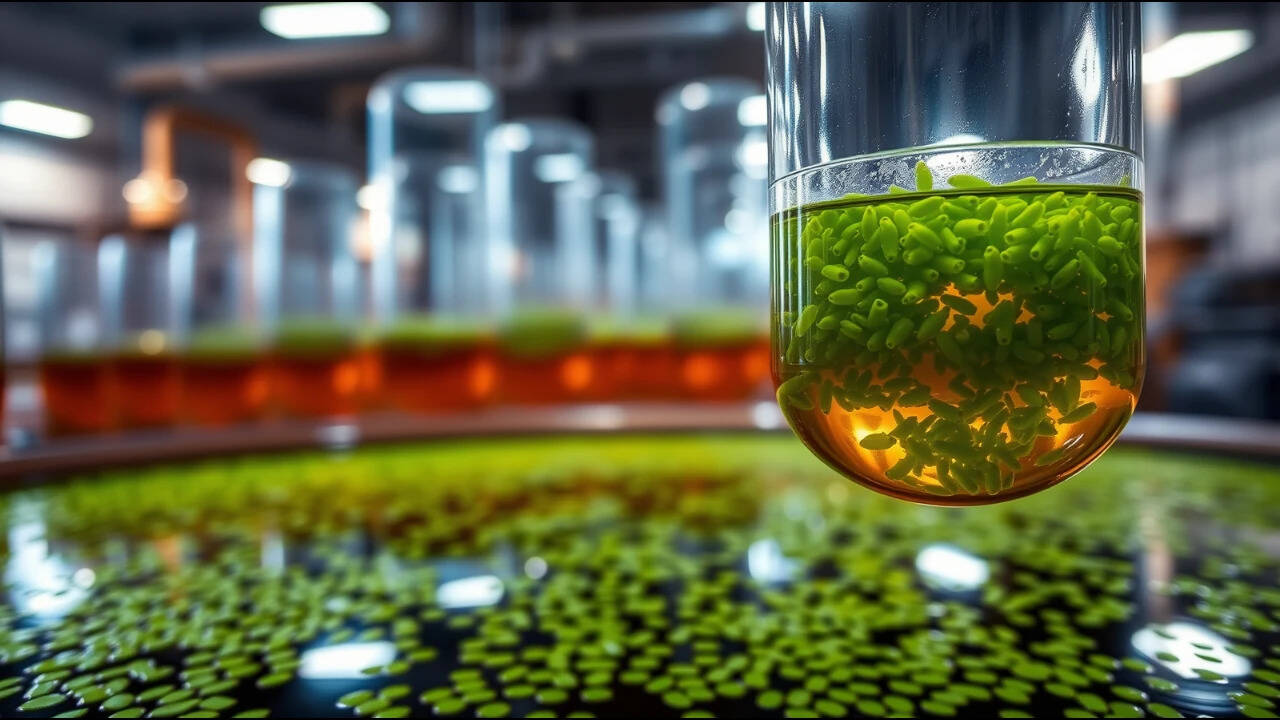
Now, a Scottish biotech initiative has engineered a pragmatic alternative. They are taking the massive volumes of biological wastewater generated by whisky distilleries and using it to cultivate omega-3-rich microalgae. By feeding industrial distillery waste to algae, they are bypassing the marine food web entirely and producing a direct, sustainable source of fish feed. This addresses two massive industrial liabilities at once.
The Dirty Secret Behind Farmed Salmon
To understand why biotech companies are looking at whisky byproducts, you must first understand the fundamental flaw in modern fish farming. Salmon are predatory. In the wild, they bioaccumulate omega-3 fatty acids by eating smaller fish, which have in turn eaten zooplankton, which have consumed marine microalgae. The algae are the original biological factories producing these vital nutrients.
When we farm salmon in floating net pens, we have to artificially supply that dietary chain. The industry standard has long been wild-caught fish oil.
This creates a staggering mathematical problem. The feed conversion ratio dictates that it takes multiple kilograms of wild forage fish to produce a single kilogram of farmed salmon. The global supply of fish oil is entirely dependent on oceanic weather patterns, specifically the El Niño and La Niña cycles that dictate the health of the Peruvian anchovy fisheries. When waters warm and anchovy populations collapse, the price of fish oil skyrockets. The aquaculture industry is currently trapped in an economically volatile and ecologically destructive feedback loop. The math simply does not scale to meet the rising global demand for protein.
Fermenting a Fix in the Highlands
Scotland produces over a billion bottles of Scotch whisky annually. This massive industrial output generates an equally massive, highly problematic stream of liquid waste.
For every single liter of whisky produced, a distillery generates roughly ten liters of a byproduct known as pot ale. Pot ale is the copper-rich, biologically heavy liquid left behind in the copper wash stills after the first distillation. It is packed with dead yeast cells, unfermented carbohydrates, and proteins.
Distilleries have historically struggled with pot ale. It cannot be dumped directly into waterways because its high biological oxygen demand would suffocate aquatic life. Disposing of it requires either spreading it on agricultural land—which carries the risk of toxic runoff during heavy rains—or paying processing facilities to treat it. It is a persistent negative line item on a distillery's balance sheet.
This is where the biotech intervention occurs. Companies like MiAlgae recognized that pot ale is not just wastewater. It is a highly nutrient-dense feedstock.
Biological Mechanics of Pot Ale
The process requires intercepting the pot ale before it requires disposal. The liquid is piped into massive, sterilized fermentation vessels. Instead of yeast, the vessels are inoculated with specific strains of marine microalgae.
The microalgae feed aggressively on the sugars and nutrients present in the whisky waste. Because they are grown in enclosed bioreactors rather than open ponds, the operators can strictly control the temperature, pH, and light exposure, optimizing the environment for rapid cellular division. As the algae consume the waste, they accumulate dense stores of omega-3 fatty acids.
Once the fermentation cycle is complete, the algae are harvested, dried, and processed into a fine, nutrient-rich powder. This powder can be blended directly into commercial fish feed pellets. The salmon consume the feed and absorb the omega-3s, exactly as they would from fish oil. We effectively skip the anchovy and go straight to the source.
The Financial Realities of Algae Production
Scientific elegance does not guarantee commercial survival. The primary reason alternative proteins and engineered feeds fail is a fundamental inability to compete on price.
Traditional fish oil is a bulk commodity. Despite the price volatility caused by oceanic climate shifts, the infrastructure for catching and pressing forage fish has been amortized over decades. Catching fish is historically cheap.
Growing microalgae, by contrast, requires significant capital expenditure. Bioreactors are expensive pieces of heavy machinery. Maintaining sterile fermentation environments at scale requires sophisticated engineering, continuous power, and highly trained personnel. If the resulting algae powder costs five times as much as traditional fish oil, the aquaculture conglomerates will refuse to buy it. Salmon margins are incredibly tight.
The whisky waste model offers a narrow path to economic viability. By utilizing an industrial byproduct as the primary growth medium, the biotech firms eliminate the cost of buying refined sugars or synthetic nutrients to feed their algae. They are taking a liability from the distilleries and converting it into a high-value asset.
Infrastructure Hurdles and Distillery Buy-in
There is a severe logistical bottleneck built into this model. Water is extremely heavy, and transporting it destroys margins.
You cannot practically truck millions of liters of sloshing pot ale across the Scottish Highlands to a centralized algae facility. The fuel costs and carbon emissions would immediately negate the environmental and economic benefits of the entire operation.
Therefore, the biological processing must happen on-site. The biotech firms have to build their fermentation plants directly adjacent to the whisky distilleries. This requires convincing traditional, centuries-old distillers to allow cutting-edge biotech plumbing to be integrated into their existing infrastructure.
It demands physical space on distillery land, which is often at a premium. It requires long-term legal contracts dictating the continuous supply and quality of the wastewater. If a distillery shuts down for maintenance, the algae plant starves. The operational integration must be total.
Bypassing the Commodity Trap
The long-term survival of this biological recycling hinges on the inevitable tightening of environmental regulations.
Governments are slowly waking up to the ecological devastation caused by commercial forage fishing. Catch quotas are being reduced globally to prevent the total collapse of marine ecosystems. As the supply of wild-caught fish oil permanently constricts, the baseline price of traditional salmon feed will rise, permanently altering the economics of aquaculture.
Simultaneously, environmental agencies are heavily penalizing industrial producers who fail to manage their wastewater. The cost for a distillery to dump or treat pot ale will only increase in the coming decades.
The intersection of these two regulatory pressures creates a closing window. The aquaculture industry is running out of cheap fish, and the whisky industry is running out of cheap places to put its waste. The companies building the biological bridge between these two failing systems will dictate the future of commercial protein production. They are not merely engineering fish feed. They are forcing two massive, stagnant industries to adapt to biological limits before those limits break them entirely.