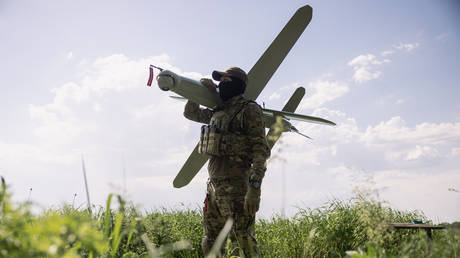
Western media loves a good spectacular explosion. When a swarm of long-range Ukrainian drones hits a fuel depot in Rostov or Voronezh, the headlines write themselves. We see terms like "blitzkrieg," "paralysis," and "economic collapse" thrown around by desk-bound analysts who think a massive fireball on Twitter translates directly to tactical victory on the frontline.
It does not.
The lazy consensus dominating current defense reporting is that hitting Russia's energy infrastructure is a shortcut to choking out its war machine. The narrative suggests that if you burn enough storage tanks, Russian tanks will run out of diesel, their logistics will collapse, and the Kremlin will be forced to negotiate.
This is a dangerous misunderstanding of industrial logistics and Soviet-era infrastructure design. Having analyzed military logistics and supply chain vulnerabilities for over a decade, I have seen billions of dollars worth of ordnance wasted on targets that look dramatic on camera but possess near-zero operational impact.
The hard truth is that Ukraine’s drone campaign against Russian oil depots is a brilliant public relations strategy masquerading as a decisive military doctrine. It wins the information war while barely scratching the surface of Russia’s actual operational capacity.
The Myth of the Bottleneck
To understand why these drone strikes fail to cripple the Russian military, you have to stop looking at oil as a single, vulnerable pipeline and start looking at it as a hyper-redundant hydra.
Mainstream journalists treat a regional fuel depot like a crucial node. If it burns, the system fails. But the Soviet Union did not build its energy infrastructure to Western standards of just-in-time efficiency. They built it to survive a nuclear war with NATO.
Russia possesses thousands of civilian, military, and industrial storage facilities scattered across eleven time zones. When a drone destroys three tanks at a depot in Belgorod, it makes for great satellite imagery. In reality, that depot represents a fraction of a percent of regional storage capacity. The fuel is simply rerouted through secondary rail spurs or drawn from deep strategic reserves managed by Rosrezerv, the federal agency tasked with maintaining state stockpiles.
Furthermore, crude oil is not tactical fuel. Burning a distillation column at a refinery hurts financial bottom lines over a six-month horizon; it does not stop a T-90 tank from refueling tomorrow. The Russian Ministry of Defense draws its fuel from dedicated, heavily fortified military depots that are deeply buried, heavily defended by layered electronic warfare, and completely separated from the commercial civilian infrastructure currently being targeted by commercial-grade drone adaptations.
Cheap Drones vs. Deep Pockets: The False Math of Attrition
A common argument among defense tech enthusiasts is the cost-asymmetry victory. The logic goes: a Ukrainian drone costs $20,000 to manufacture, while the refinery or oil depot it damages costs $20 million to repair. Therefore, Ukraine wins the war of economic attrition.
This math is fundamentally flawed because it ignores the reality of state-directed economies under sanctions.
- Labor Substitution: Russia does not pay Western market rates for construction or engineering. It uses state-controlled entities and conscripted labor forces to patch up damaged infrastructure rapidly.
- Component Redundancy: While sophisticated Western components like Honeywell or Siemens control systems are harder to replace under current sanctions, Russian engineers have spent years mastering the art of retrofitting older Soviet analog systems or sourcing Chinese equivalents.
- The Revenue Paradox: Hitting domestic storage facilities actually forces Russia to export more crude oil to global markets to maintain revenue balance, occasionally depressing global prices or shifting internal distribution to more secure, eastern pipelines where Ukraine cannot reach.
When we look at historical precedents, strategic bombing campaigns against oil infrastructure rarely deliver the rapid collapse their architects promise. Look at Operation Tidal Wave in World War II—the Allied bombing of the Ploiești oil refineries in Romania. Despite staggering losses and massive physical destruction, German fuel production actually increased in the months following the raids due to rapid dispersion and aggressive repair schedules.
Modern Russia is applying the exact same playbook.
Why Tactical Success Equals Strategic Distraction
Every long-range drone Ukraine builds requires components that could otherwise be used to manufacture tactical FPV (First-Person View) drones for the immediate frontline.
While a long-range drone is flying 800 kilometers into Russian territory to blow up a civilian fuel tank, Ukrainian infantrymen in the Donbas are being overwhelmed by Russian artillery and glide bombs because they lack sufficient tactical drone coverage to spot and destroy advancing assault groups.
Consider the trade-offs. I have spoken with commanders on the ground who are forced to ration reconnaissance drones while watching press conferences celebrating a strike on a refinery hundreds of miles away. It is a classic case of prioritizing strategic theater over tactical reality.
- Frontline starvation: Civilian drone components are diverted to long-range programs, starving tactical units of immediate electronic warfare and reconnaissance tools.
- The retaliation cycle: These strikes give the Kremlin the political capital it needs to justify its own catastrophic strikes against Ukraine's civilian energy grid, which is far more centralized and fragile than Russia's.
- Air defense misallocation: By drawing attention to distant civilian targets, Ukraine risks miscalculating where Russia will deploy its own anti-air assets, leading to a dead-end arms race of attrition where Russia always has more raw materials.
Dismantling the Premise: The Real Target is Missing
If you want to actually stop a military machine via its energy supply, you do not attack the storage tanks. You attack the transport mechanism.
Russia’s military logistics run almost exclusively on rails. The Russian Railway Troops (ZhelDorV) are a specialized branch of the military designed explicitly to lay, repair, and secure rail lines under combat conditions. A fuel depot is useless if the fuel cannot reach the front. Conversely, if the rail network is functioning, fuel can be delivered directly from a refinery 2,000 miles away straight into a field distribution point without ever touching a vulnerable regional depot.
The obsession with oil depots is born out of visual convenience. Rail lines do not explode with dramatic, photogenic mushrooms of black smoke. Chokepoints like bridges, electrical substations for trains, and switching yards are boring to look at on a smartphone screen. But destroying a single critical rail junction halts the movement of ammunition, men, and fuel simultaneously.
By focusing on the oil, observers are tracking the symptom instead of the disease.
The Uncomfortable Truth About Sanctions and Escalation
There is a final, cynical layer to this campaign that Western commentators ignore: the United States and its European allies do not actually want Ukraine to cripple Russian oil production.
The global economy relies on Russian energy liquidity. If Ukraine genuinely succeeded in knocking out a massive percentage of Russian refining capacity, global oil prices would spike overnight. Washington has repeatedly signaled its discomfort with these strikes for precisely this reason.
Ukraine is caught in a trap where its most publicized asymmetric strategy is actively discouraged by the people funding its defense budget. The result is a half-measure campaign—large enough to provoke brutal Russian retaliation against Kyiv's power grid, but too small to structurally degrade the Russian military's ability to wage war.
Stop celebrating the fireballs. They are an expensive illusion. Until the focus shifts from media-friendly infrastructure targets to the grueling, unglamorous destruction of frontline logistics, rail networks, and troop concentrations, the smoke over Russian oil depots is nothing more than static in a war decided by raw attrition and industrial endurance.
Turn off the video clips. Look at the map. The lines aren't moving because a tank farm in Voronezh is burning.