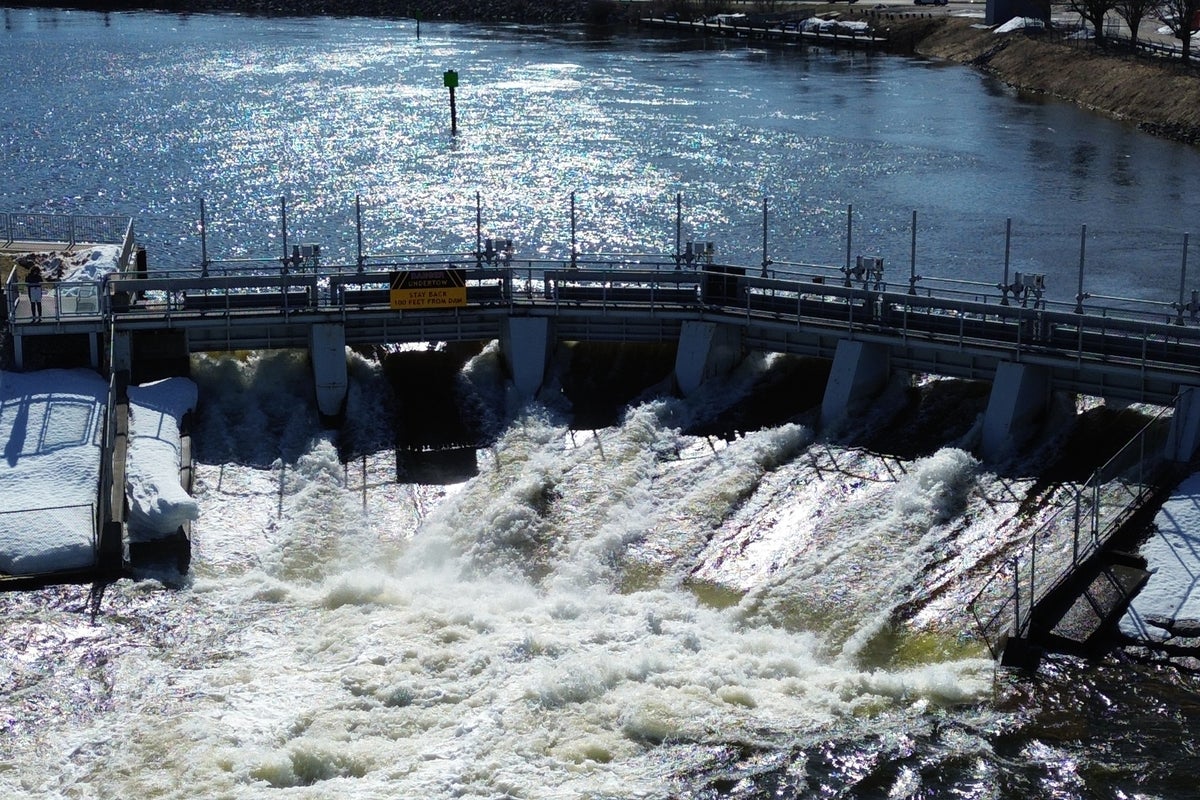
The failure of high-hazard infrastructure is rarely a localized event; it is the inevitable output of a multi-decade decay function where capital expenditure deferment intersects with shifting hydrological baselines. In the case of Michigan’s Cheboygan Dam, the 2024 near-breach was not a statistical anomaly but a predictable result of a "latent defect" lifecycle. When a water control structure enters the phase of terminal maintenance backlog, the margin of safety—traditionally calculated as the difference between the Probable Maximum Flood (PMF) and the structure's physical height—evaporates. The Cheboygan scenario serves as a diagnostic template for understanding how regulatory inertia and owner insolvency create systemic physical risk.
The Triple Constraint of Dam Failure Risk
Evaluating the risk profile of the Cheboygan Dam requires a departure from binary "safe" or "unsafe" labels. Instead, risk must be quantified through the interaction of three distinct variables: structural integrity, hydraulic capacity, and the financial solvency of the responsible entity.
- Hydraulic Overload Sensitivity: The ability of a dam to pass water through spillways is its primary defense against overtopping. In Cheboygan, the aging gates and mechanical systems lacked the redundancy required to handle rapid inflow spikes. When inflow exceeds the discharge rate, the reservoir level rises exponentially, increasing the hydrostatic pressure on the dam's upstream face.
- Structural Fatigue and Seepage: Gravity dams rely on their mass to resist the horizontal force of water. However, internal erosion—often called "piping"—occurs when water finds pathways through or under the dam structure. Over time, these pathways widen, carrying away fine sediment and creating voids. This reduces the effective mass of the dam and introduces uplift pressure, which can lead to a sudden sliding failure.
- The Insolvency Trap: Infrastructure ownership carries a "permanent liability" cost. When a private owner lacks the liquid capital to perform preventative maintenance, the structure enters a state of managed decline. In Cheboygan, the owner’s inability to fund basic repairs meant that the state was forced into an emergency intervention role, a reactive posture that is significantly more expensive and less effective than proactive engineering.
Quantifying the High-Hazard Designation
The "High-Hazard" classification assigned to the Cheboygan Dam by the Michigan Department of Environment, Great Lakes, and Energy (EGLE) does not describe the physical condition of the dam, but rather the potential for loss of life and catastrophic economic damage upon failure. This distinction is critical for resource allocation.
The inundation zone for the Cheboygan Dam includes residential neighborhoods and critical municipal infrastructure. A failure would initiate a wall of water moving at high velocity, leading to "downstream scouring," where the force of the water strips away topsoil, destroys foundations, and severs utility lines. This creates a secondary crisis: the loss of power and water services for the surviving population, complicating rescue and recovery operations.
The Mechanism of Regulatory Capture and Deferment
The legal framework governing dam safety in Michigan creates a bottleneck. While EGLE has the authority to inspect and issue violation notices, the enforcement mechanisms are often slow and lack the teeth to compel an insolvent owner to act. This leads to a cycle of "paper compliance" where inspections identify risks, but those risks remain unmitigated for years.
The Cheboygan Dam had been flagged for deficiencies as early as 2020. The gap between the identification of a structural flaw and the physical remediation is known as the "vulnerability window." During this period, the dam is a static risk exposed to dynamic weather events. The 2024 rains simply exploited a vulnerability window that had been left open by a lack of capital and a slow-moving legal process.
The Cost Function of Emergency Intervention
When a dam reaches the point of imminent failure, the cost-to-remediate shifts from a linear growth to an exponential one. Proactive maintenance—such as sealing leaks, greasing gate mechanisms, and clearing debris—costs thousands of dollars annually. Emergency intervention, which requires the mobilization of heavy equipment, temporary cofferdams, and 24-hour monitoring, costs millions.
The State of Michigan's eventual takeover of the Cheboygan Dam is a case study in "socializing the losses." The private owner benefited from the dam's utility while it was functional, but the taxpayers are now responsible for the multi-million dollar repair bill required to prevent a regional catastrophe. This economic model is unsustainable given that Michigan has over 2,500 dams, many of which are approaching the end of their design life.
Engineered Resilience vs. Natural Restoration
The long-term strategy for Cheboygan and similar structures involves a binary choice: total reconstruction or dam removal.
- Total Reconstruction: This involves replacing the current structure with a modern design that meets updated PMF standards. It preserves the reservoir for recreation and property values but requires an ongoing commitment to maintenance costs that likely exceed the dam's economic output.
- Dam Removal (Decommissioning): This is the process of controlled breaching and restoring the natural river flow. While it eliminates the risk of catastrophic failure and restores ecological connectivity, it fundamentally changes the local landscape and can lead to a drop in upstream property values.
The decision-making process must be driven by a Benefit-Cost Analysis (BCA) that accounts for the "Statistical Value of Life" (VSL) alongside the cost of reconstruction. If the cost of maintaining the dam over a 50-year horizon exceeds the economic benefit of the reservoir, removal is the logically superior strategy.
Strategic Recommendation for Regional Infrastructure Management
The Cheboygan near-miss should trigger an immediate shift in how regional infrastructure risk is audited. The current "inspect and report" model is insufficient for aging assets owned by insolvent entities.
A state-level "Infrastructure Receivership" framework must be established. This would allow the state to legally seize control of high-hazard assets the moment a critical deficiency is identified and the owner fails to provide a bonded repair plan within 90 days. Waiting for an emergency rain event to force action is a high-stakes gamble with human lives.
Furthermore, the state must implement a tiered "Risk Scoring" system that combines the structural integrity rating with real-time hydrological data. This would allow for a "Ready-State" mobilization of resources before the rain starts, rather than a frantic response once the spillway capacity has already been breached. The goal is to move from a culture of emergency management to one of predictive engineering.