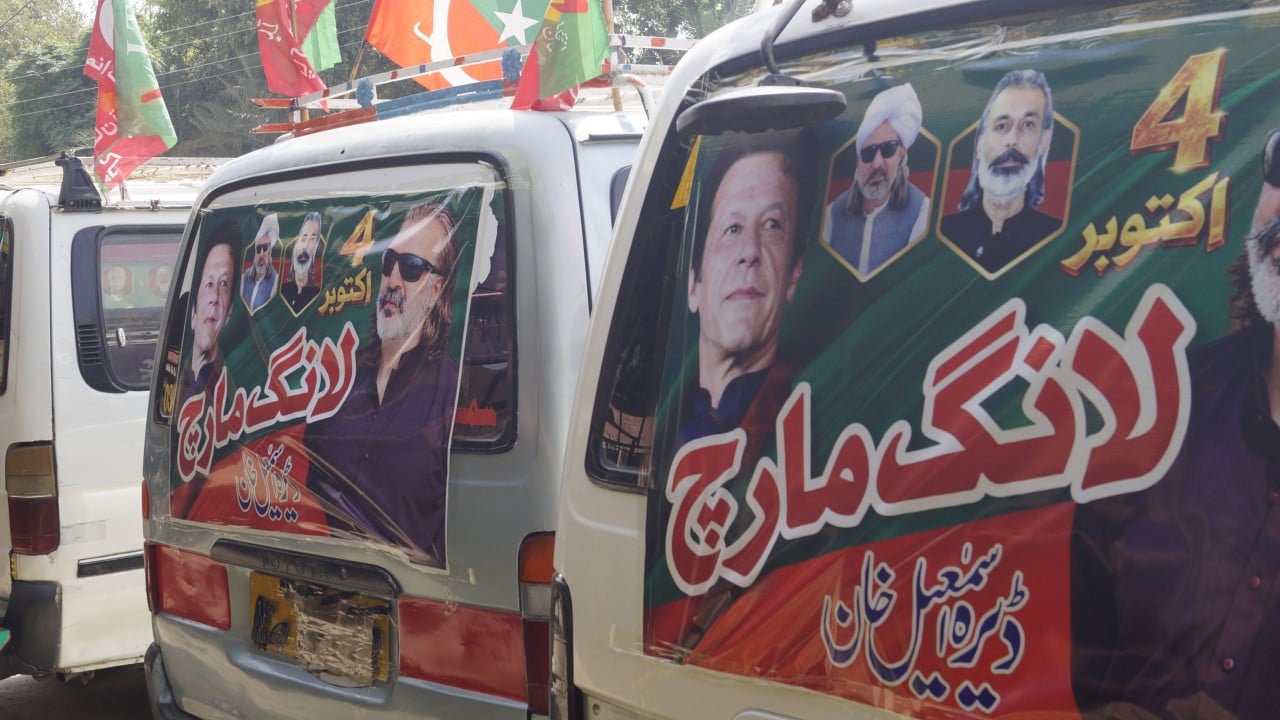
You don't understand Pakistani street politics if you think a long march is just a political rally with extra steps. When supporters of jailed former Prime Minister Imran Khan mobilize and push toward Islamabad, they are running a high-stakes stress test on the state's entire apparatus.
Let's look at what's actually happening on the ground. Since his dramatic ouster via a parliamentary no-confidence vote and subsequent legal fallout, Khan’s Pakistan Tehreek-e-Insaf (PTI) party has weaponized mass mobilization. When caravans pour out of strongholds like Khyber Pakhtunkhwa toward a heavily barricaded capital, it isn't spontaneous chaos. It's a calculated strategy to overwhelm security blockades, defy containment orders, and force a political reckoning. Meanwhile, you can find related developments here: Why Quebec Voters Are Driving the Separatist Parti Québécois Back to Power.
The Anatomy of a Capital Lockdown
When the state learns that a PTI convoy is rolling toward Islamabad, the playbook is almost always identical. Shipping containers block highways, razor wire chokes entry points, and police forces deploy tear gas. Authorities try to turn the twin cities into an impenetrable fortress long before protesters even cross provincial lines.
Why do they panic? Because past demonstrations proved that sheer volume can paralyze administrative functions. Governments live in fear of a permanent sit-in at D-Chowk or along major transit arteries like the Srinagar Highway. To see the bigger picture, check out the detailed analysis by USA Today.
Yet, treating these marches merely as a law-and-order nuisance misses the bigger picture. For millions of working-class and youth supporters, Khan represents an anti-establishment defiance that resonates deeply with public frustration over inflation, governance, and judicial independence. When leaders call for these marches from prison cells, they tap into a potent narrative of systemic victimization that no amount of roadblocks can easily filter out.
Why the Establishment Playbook Keeps Failing
Successive administrations often assume that mass arrests, internet restrictions, and heavy-handed crackdowns will bleed momentum from the movement. Honestly, it usually backfires.
- Radicalization of Base Support: Every blocked road or detained local organizer deepens the grievance. Supporters view state resistance as proof that the ruling coalition fears democratic pressure.
- Economic Friction: Lockdown strategies freeze commerce in major economic hubs. Paralyzing Islamabad with shipping containers hurts local businesses just as much as it disrupts political momentum.
- Information Warfare: In an era of hyper-connected social media, clamping down on mobile networks or media coverage only fuels viral counter-narratives.
The core grievance centers on democratic legitimacy and institutional overreach. Whether it's demanding snap elections or protesting the detention of party leadership, the underlying fuel is a profound lack of trust between the electorate and the political-military establishment.
Where This Standoff Leads
Resolving this cycle requires more than temporary container walls and overnight curfews. As long as millions remain convinced that their political mandate has been hijacked, street agitation will remain a primary tool of opposition expression.
You can lock down a city, but you can't barricade underlying public sentiment. Until political actors find a functional framework for dialogue, Islamabad will brace for the next inevitable collision on the highway.