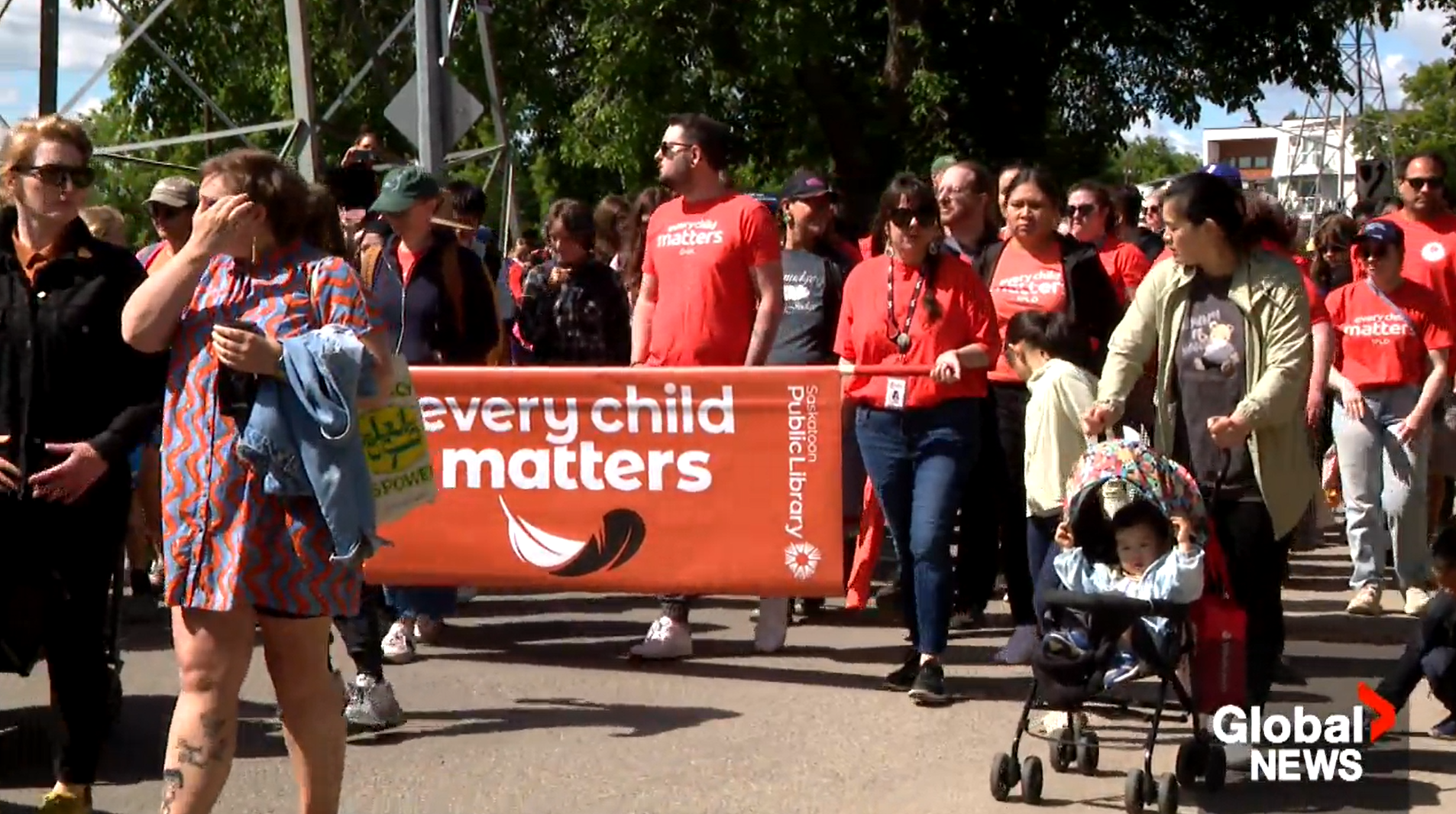
Saskatoon’s Rock Your Roots Walk for Reconciliation just celebrated its tenth anniversary by filling Victoria Park with an estimated 7,000 participants, including over 5,000 schoolchildren in orange shirts. On paper, the milestone is a triumph of public engagement and civic education. Nine-year-olds distributed birthday cards to residential school survivors, mayors gave optimistic speeches about getting to know each other at hockey rinks, and corporate banners fluttered along Spadina Crescent.
Yet beneath the carefully coordinated display of multi-faith, multicultural unity lies a starker reality that standard news coverage consistently ignores. While symbolic public events have grown exponentially over the past decade, the material conditions for Indigenous people in Saskatchewan remain stubbornly, tragically unchanged. The generation being shaped by these events is inheriting an educational framework that treats reconciliation as a completed historic milestone rather than an ongoing, deeply uncomfortable structural battle.
Moving thousands of children through a park for one morning does not automatically translate into systemic reform. It risks doing the exact opposite by offering a performative escape hatch that satisfies the conscience without demanding sacrifice.
The Danger of Commercialized Empathy
The mechanics of modern civic pageantry are highly effective at generating emotional resonance. During the anniversary walk, fourth-grade students reacted with genuine, heart-wrenching sadness upon learning that residential school survivors were systematically denied the simple dignity of celebrating their birthdays. To remedy this, organizers distributed cupcakes and facilitated card-making workshops.
This approach targets the heart, but it fundamentally oversimplifies a brutal state-sponsored apparatus designed for cultural erasure. Converting the legacy of the residential school system into an digestible lesson about missed birthdays reduces an institutional horror to a series of personal misfortunes.
When structural oppression is reframed as a historic tragedy that can be answered with a birthday card, the actual mechanisms of accountability are obscured. The children leaving the park learn that the past was sad, but they are rarely forced to confront how that past directly constructed the economic and social stratification of the city they live in today.
The Concrete Realities Behind the Pageantry
To understand the gap between symbolic reconciliation and systemic reality, one only needs to look at the provincial metrics that define daily life in Saskatchewan.
- Child Welfare: Indigenous children make up less than half of the youth population in the province, yet they consistently account for over 85% of all children in state care.
- Incarceration Rates: Provincial correctional facilities report that Indigenous adults represent upwards of 75% of the inmate population, a statistic that has not shifted meaningfully despite a decade of public awareness walks.
- Economic Stratification: The geographic divide between Saskatoon’s affluent east side and the underfunded core neighborhoods of the west side remains a visible testament to economic segregation.
A walk along the South Saskatchewan River does not reallocate municipal budgets, it does not reform discriminatory policing practices, and it does not return land. It creates a temporary, highly visible zone of racial harmony that disappears the moment the orange shirts are packed away into closets for the summer.
The Burden of the Survivor
Residential school survivors like Harry Lafond and Sid Fiddler have spent decades carrying the weight of their experiences into public view. During the anniversary gathering, Lafond noted that the event forces the broader community to acknowledge Indigenous existence in a positive way, stating that if people do not actively work at reconciliation, it simply will not happen.
However, the current framework places an unfair, ongoing burden on the survivors themselves to act as educators and agents of emotional healing for the settler population.
Survivors are asked to stand on stages, relive deeply traumatic memories for an audience of dignitaries and school groups, and validate the city’s progress. The exchange is deeply asymmetrical. The city receives institutional absolution and a photogenic display of diversity, while the survivors are left with the exhausting task of continuously proving their humanity to an audience that struggles to look at the current provincial justice or child welfare statistics.
The Limits of Friendship as Policy
Saskatoon Mayor Cynthia Block remarked at the event that reconciliation happens when people simply get to know each other at the soccer pitch or the hockey rink. While interpersonal goodwill is necessary, treating structural racism as a mere lack of neighborly acquaintance is a profound misdiagnosis of the problem.
Systemic discrimination is not a misunderstanding that can be resolved through casual conversation over a sports game. It is an intentional, legally codified distribution of power and resources. Framing the solution around personal friendships shifts the responsibility away from municipal, provincial, and federal governments and places it onto individual citizens. It suggests that if marginalized people simply make themselves more familiar and palatable to the dominant culture, equality will naturally follow. History demonstrates that power structures do not yield to proximity alone; they yield to policy, litigation, and economic pressure.
Moving Beyond the One-Day Metric
If the next generation is truly going to be shaped by initiatives like Rock Your Roots, the metric of success must move past attendance numbers and corporate sponsorship tallies. A successful public event should not leave its participants feeling comfortable or self-congratulatory. It should leave them deeply unsettled by the contrast between the harmony displayed in the park and the inequality waiting outside it.
True progress requires moving from symbolic walking to institutional altering. School curricula must transition from simplified lessons on historic sadness to rigorous analysis of treaty rights, resource wealth distribution, and the legal frameworks that maintain current disparities. Municipal leadership must match its presence at the front of the walk with a willingness to tackle systemic zoning issues, police spending allocations, and accessible housing shortages that disproportionately affect Indigenous residents.
The children who walked through Saskatoon wearing orange shirts demonstrated an immense capacity for empathy. The true test of the city's commitment to reconciliation is whether it will allow that empathy to mature into political action, or whether it will continue to use these annual gatherings as a visual shield against substantive structural change.