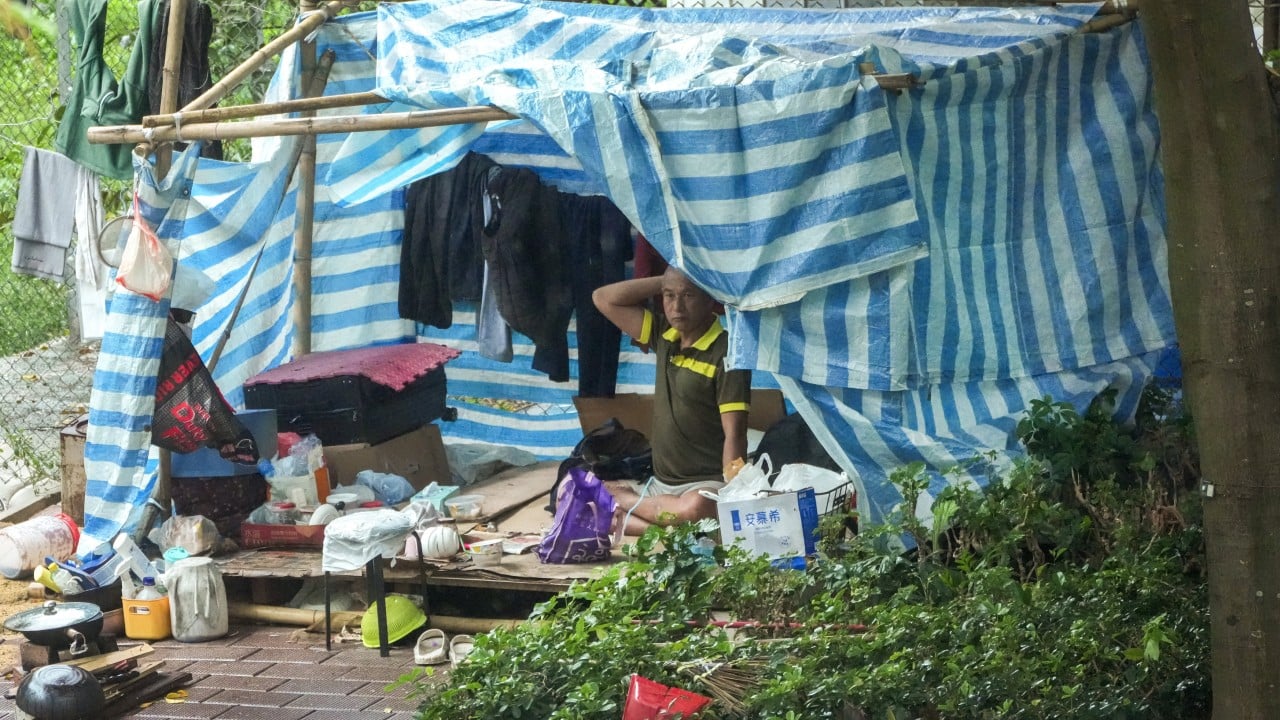
The rain in Sham Shui Po does not wash the heat away. It turns it into a thick, visible vapor that rises from the asphalt, carrying the smell of wet cardboard and old cooking oil.
I know this smell. I spent three years navigating these exact streets, visiting families squeezed into architectural afterthoughts. Tonight, the air feels heavier. The Hong Kong government has just announced a fundamental shift in how it measures human misery. We are officially abandoning the old poverty line—which was tied strictly to median household income—and replacing it with a multi-dimensional framework featuring twenty-one separate indicators.
On paper, it sounds sophisticated. It includes metrics for housing, health, asset ownership, and social connectivity. But as I stand beneath the rusting scaffolding of a Cheung Sha Wan tenement, watching an elderly woman struggle with a cart of flattened boxes, a unsettling truth becomes clear.
Changing the way we calculate the equation does not change the reality on the ground. You can rewrite the formula on a whiteboard in a climate-controlled government office in Admiralty. But the woman with the cardboard cart still has to walk the same steep incline.
Consider what happens when a city decides to hide its thermometer because it dislikes the reading of the fever.
For more than a decade, the income-based poverty line served as an uncomfortable, unyielding mirror. It told us, with brutal simplicity, that roughly one in five people in this glittering financial hub lived in poverty. It was an absolute mathematical reality: if your household earned less than half of the median income for your household size, you were poor.
The new framework replaces that single, stark line with a mosaic. Officials argue that a purely income-based line misses the bigger picture. They point to elderly residents who own their flat but have no liquid income, or families receiving heavy government subsidies for public housing. By tracking twenty-one different indicators, the administration claims it can target resources with surgical precision. They call it targeted poverty alleviation.
The logic is tempting. It sounds pragmatic. But it carries a profound risk: when poverty becomes a complex, multi-variable equation, it becomes remarkably easy to manipulate the variables until the problem appears smaller than it is.
Let us look at a hypothetical household that perfectly illustrates the blind spot of this new mathematical optimism. We will call her Ah-Mei.
Ah-Mei is forty-two. She lives with her seven-year-old son in an eighty-square-foot subdivided unit in Kwun Tong. The room is the size of a standard parking space. Her kitchen consists of a single electric hotplate resting on top of a miniature washing machine. Her bathroom is a wet room where the toilet sits directly beneath the showerhead.
Ah-Mei cannot work full-time because her son has mild developmental delays and requires specialized care after school. She gets by on part-time cleaning gigs and piecemeal government assistance. Under the old system, her household income put her squarely beneath the poverty line. She was a statistic that demanded a structural response.
Under the new multi-dimensional framework, however, Ah-Mei’s situation becomes delightfully ambiguous for a bureaucrat.
Recently, she started utilizing a government-subsidized Community Living Room—a communal space where her son can do his homework and she can use a proper kitchen. The government’s new framework tracks social connectivity and access to community services as positive indicators. Suddenly, because Ah-Mei has a place to sit that is not her bed, her multi-dimensional score improves.
The official metrics tick upward. The performance indicators are met.
But when the clock strikes 10:00 PM and the community center closes, Ah-Mei and her son must return to the eighty-square-foot room. The ceiling is still yellowing with mold. The rent still consumes forty-five percent of her meager monthly intake. The landlord is still threatening to raise the rent because the building is facing a mandatory government upgrade scheme by 2030.
Ah-Mei is not less poor. Her life has simply been accessorized with temporary relief.
By dissolving the absolute standard of income into twenty-one subjective buckets, the state can claim success by pointing to isolated improvements. They can celebrate a rise in social connectivity while ignoring the stagnant wages and astronomical housing costs that caused the isolation in the first place. It is a classic administrative pivot: when you cannot hit the target, you redefine what the target looks like.
The real problem lies elsewhere. Poverty in Hong Kong is not a crisis of definition. It is a crisis of structural architecture.
We live in a city where the land premium system dictates everything. The government relies heavily on land sales for revenue, which naturally incentivizes a high-property-value economy. This is the foundational DNA of the city. It has created a world-class skyline, but it has also created a housing market that functions as a giant siphon, draining the wealth from the working class and funneling it directly into the hands of real estate conglomerates and the state treasury.
When affordable living space is treated as a premium luxury commodity, the societal fabric fractures.
Landlords take a standard four-hundred-square-foot apartment, slice it into five separate cubicles with thin drywall, and rent them out individually to desperate people. These subdivided units generate a higher rental yield per square foot than a luxury penthouse in the Mid-Levels. It is a highly profitable monetization of human desperation.
The administration’s current response to this is a mix of enforcement and charity. They have introduced ordinances to mandate minimum sizes for these micro-apartments and have pledged to eliminate substandard units over the next few years.
But look at the immediate human consequence of these well-meaning regulations.
Walk through the wet markets of Sham Shui Po and talk to the tenants. They are terrified. They know that if their landlord is forced to renovate a unit to meet the new safety and hygiene standards, two things will happen: the unit will become more expensive, or it will disappear entirely.
Where do they go then? The wait time for a public rental housing flat still hovers at over five years for families, and vastly longer for single individuals. Temporary transition housing is a stopgap, a revolving door that eventually dumps people back into the private market.
Without a massive, aggressive expansion of permanent public housing that decouples a citizen's shelter from the speculative real estate market, banning substandard apartments simply shuffles the deck chairs on a sinking ship. It forces the poorest segment of the population to compete for an even smaller pool of legal, expensive housing.
This is where the new multi-dimensional analysis framework reveals its true utility to the status quo. It acts as an intellectual sedative.
If the government can show that a family’s well-being has increased because their child attended a government-sponsored after-school care scheme, it can offset the uncomfortable truth that the family’s real income has shrunk due to inflation and rising rent. It allows policy reports to sound triumphant. It lets officials stand at press conferences and declare that key performance indicators have been exceeded.
But a key performance indicator is a poor substitute for a living wage.
I remember talking to a retired construction worker named Wah Gor. He lived in a bunk bed inside a "coffin home"—a wire-mesh cage stacked three-high in a room shared with fifteen other men. He had a chronic lung condition from decades of breathing in concrete dust, but he didn't qualify for significant cash welfare because he possessed a tiny amount of savings he had painstakingly scraped together for his eventual funeral.
Under the old income-based line, Wah Gor was a glaring anomaly: a man who had built the very high-rises that defined Hong Kong’s wealth, left to rot in a cage.
Under the new system, his asset ownership—that tiny funeral fund—can be used to argue that his economic vulnerability is mitigated. His access to public healthcare can be factored in to balance out his lack of income. The system can look at Wah Gor and see a nuanced case file that is being managed through multiple channels.
Wah Gor did not want his case managed. He wanted to be able to breathe clean air without hearing the man in the bunk below him cough through the night.
To understand why this matters so deeply, we have to look past the immediate policy cycle. This is about the stories we choose to tell ourselves as a society.
If we define poverty solely by income, we admit that our economic system is fundamentally unequal. We acknowledge that the distribution of wealth in our city is broken, and that the tireless labor of our working class is not being rewarded with basic economic security. That admission is dangerous because it demands radical, systemic change. It demands minimum wage increases that actually match the cost of a bowl of noodle soup. It demands a restructuring of land policy. It demands wealth redistribution.
If, however, we define poverty as a multi-dimensional deficit of services, the solution changes completely.
Poverty is no longer an economic failure; it becomes an administrative logistics problem. The solution is no longer to pay workers more or to curb the power of landlords. The solution is to build more community living rooms, to launch more mentorship programs, to deploy more volunteer care teams to hand out gift bags of rice and cooking oil.
It transforms the poor from citizens who are being economically exploited into clients who need to be socially managed. It replaces justice with philanthropy.
The rain stops, but the air does not clear. The neon signs of the reflexology parlors and late-night noodle shops blink awake, casting a pink and green glare across the wet pavement.
Ah-Mei will soon be walking her son back from the community center. She will climb the four flights of dark, narrow stairs to her room. She will lock the door, turn on the small electric fan, and try to sleep in a space where her feet touch the opposite wall.
She does not know about the twenty-one indicators. She does not care about the multi-dimensional framework. She knows exactly how much money is left in her octopus card, and she knows the exact date the rent is due.
We can move the goalposts as much as we like. We can redraw the lines until the charts look orderly and the progress reports shine. But until we confront the reality that a city of immense, structural wealth is choosing to let its foundation rest on the backs of people living in cages, our new metrics are nothing more than a elegant vocabulary for abandonment.