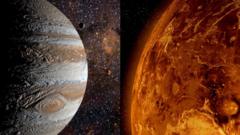
On the evening of June 9, 2026, millions of casual observers will look toward the western horizon and witness what popular media outlets are already breathlessly labeling a "cosmic kiss." Venus and Jupiter, the two brightest planets in our night sky, will appear to pass within a mere 1.6 degrees of one another—roughly the width of a pinkie finger held at arm's length. To the naked eye, they will seem to flirt with collision in the fading twilight of the Gemini constellation.
It is a beautiful lie.
The primary reality of a planetary conjunction is not intimacy, but immense, unfathomable separation. While the casual viewer sees two brilliant beacons sharing a single patch of evening sky, the physical reality is an exercise in extreme cosmic distance. On June 9, Venus will hang roughly 110 million miles from Earth. Jupiter, the gas giant, will sit brooding a staggering 560 million miles behind it. The apparent embrace is a temporary trick of line-of-sight geometry, an accidental alignment born from our position on a third rock looking outward through a flat orbital plane.
The Mechanics behind the Geometry
To understand why this optical illusion occurs, one must look at the structural layout of the solar system. All planets orbit the Sun along a relatively flat disk called the ecliptic. Think of it as a racetrack where every runner stays in their own lane, but the lanes are slightly tilted relative to one another.
Because Earth sits inside the orbit of Jupiter but outside the orbit of Venus, our vantage point constantly shifts. Venus, an inferior planet, zips around the Sun every 225 days. Jupiter takes nearly 12 years to complete a single journey. Roughly every 10 to 15 months, Venus laps Jupiter from our perspective, creating a conjunction—or more technically, an appulse, which is the point of minimum apparent separation between two bodies.
$$Separation \approx 1.6^\circ$$
The June 2026 event is uniquely favorable because of its elongation from the Sun. Many Venus-Jupiter conjunctions occur too close to the solar disk, meaning the planetary pair is swallowed by the blinding glare of daytime or the immediate, bright glow of sunset. On June 9, however, the pairing occurs a comfortable 36 degrees away from the Sun. This provides a generous window of dark twilight for observers, meaning the planets will remain visible for up to two and a half hours after the Sun dips below the horizon.
Deconstructing the Brightness Disparity
When you look west 45 minutes after sunset, Venus will easily dominate the view. It shines with a brilliant, unblinking white light at a magnitude of –4.0. Jupiter, despite being more than eleven times the physical diameter of Venus, will appear noticeably softer, shining at a magnitude of –1.8.
This disparity comes down to two factors: distance and atmospheric composition. Venus is our immediate neighbor, meaning the light reflecting off its surface travels a fraction of the distance that Jupiter’s reflected light must traverse. More importantly, Venus is wrapped in a thick shroud of highly reflective sulfuric acid clouds. This gives it an incredibly high albedo, meaning it reflects roughly 75% of the sunlight that hits it. Jupiter is a massive gas giant composed largely of hydrogen and helium; while large, its distance minimizes its apparent brightness, and its cloud decks reflect only about 52% of incoming light.
Planet      Visual Magnitude    Albedo (Reflectivity)
Venus       -4.0                75%
Jupiter     -1.8                52%
The June Planet Parade Escalates
The interaction between the two brightest planets is merely the opening act of a larger orbital ballet playing out across the month. For those tracking the horizon with precision, the structural dynamics of the inner solar system will become glaringly obvious as June progresses.
Starting around June 11, the swift planet Mercury will emerge from the solar glare, positioning itself lower on the western horizon to the lower right of the Venus-Jupiter pair. This creates a temporary three-planet alignment. By June 16 and 17, a thin, waxing crescent Moon will slide into the frame, cutting a path directly through the planetary grouping.
[Western Horizon - June 12, 2026]

      * Venus (Mag -4.0)
   * Jupiter (Mag -1.8)

 * Mercury (Mag -0.5)
--------------------------------- (Horizon)
After the peak of the conjunction on June 9, the paths of the two primary actors will diverge sharply. Jupiter is currently heading toward the end of its evening visibility cycle, sinking lower into the solar glare each night until it disappears from view later this summer. Venus, conversely, is climbing higher. Over the next several months, it will ascend further into the evening sky, establishing itself as a brilliant fixture of the autumn nights.
How to Witness the Alignment
Observing the conjunction requires no specialized scientific hardware. Because both objects are exceptionally bright, they can easily pierce through the light pollution of major metropolitan suburbs, provided the sky is free of cloud cover.
- Timing: Step outside between 30 and 45 minutes after local sunset on June 9.
- Orientation: Find an elevated vantage point or a location with a completely unobstructed view of the west-northwest horizon.
- Naked-Eye Viewing: Look for Venus first. It will pierce the twilight as a bright, steady beacon. Jupiter will appear just 1.6 degrees to the lower left of Venus.
- Optical Aid: While a telescope will reveal Venus as a partially illuminated disk and Jupiter with its equatorial bands, the two planets will be too far apart to fit in a standard telescope field of view. Instead, use a basic pair of binoculars. A standard 7x50 or 10x50 binocular set will easily capture both planets simultaneously, alongside Jupiter's four largest Galilean moons: Io, Europa, Ganymede, and Callisto.
The Long Separation
If you miss the event due to weather, you will have to wait a considerable amount of time for an equivalent view. While Venus and Jupiter cross paths roughly every year, the geometry of their upcoming meetings is highly unfavorable.
The next conjunction, occurring on August 25, 2027, will take place when the planets are positioned almost directly behind the Sun from Earth's perspective, rendering it entirely invisible to ground-based observers. The subsequent pairing in November 2028 will be visible, but it will require waking up before dawn to catch them low on the southeast horizon. June 9 offers the last premium, easily accessible evening view of this planetary duo for the remainder of the decade.
Step outside and look west. What you are seeing is not a romantic cosmic event, but the silent, rigid execution of Kepler's laws of planetary motion, playing out across hundreds of millions of miles of empty space.